Florida Home Repair Grants: 2026 Financial Assistance Guide
Do you own a home in Florida and face unique challenges from hurricane-force winds to blistering humidity that damages essential systems? The government is now offering specific home improvement grants in Florida to help homeowners secure affordable roof repairs for any type of damage, which is a blessing in 2026 due to rising maintenance costs. For ongoing updates and guides, visit Housing Grants Finder.
Florida offers dedicated programs, whether you are looking for government grants for roof replacement after a storm or home repair grants for seniors to ensure a safe living environment. This comprehensive guide details available financial relief, including the Weatherization Assistance Program 2026. Read till the end to ensure you have the correct information to protect your privacy and family safety.
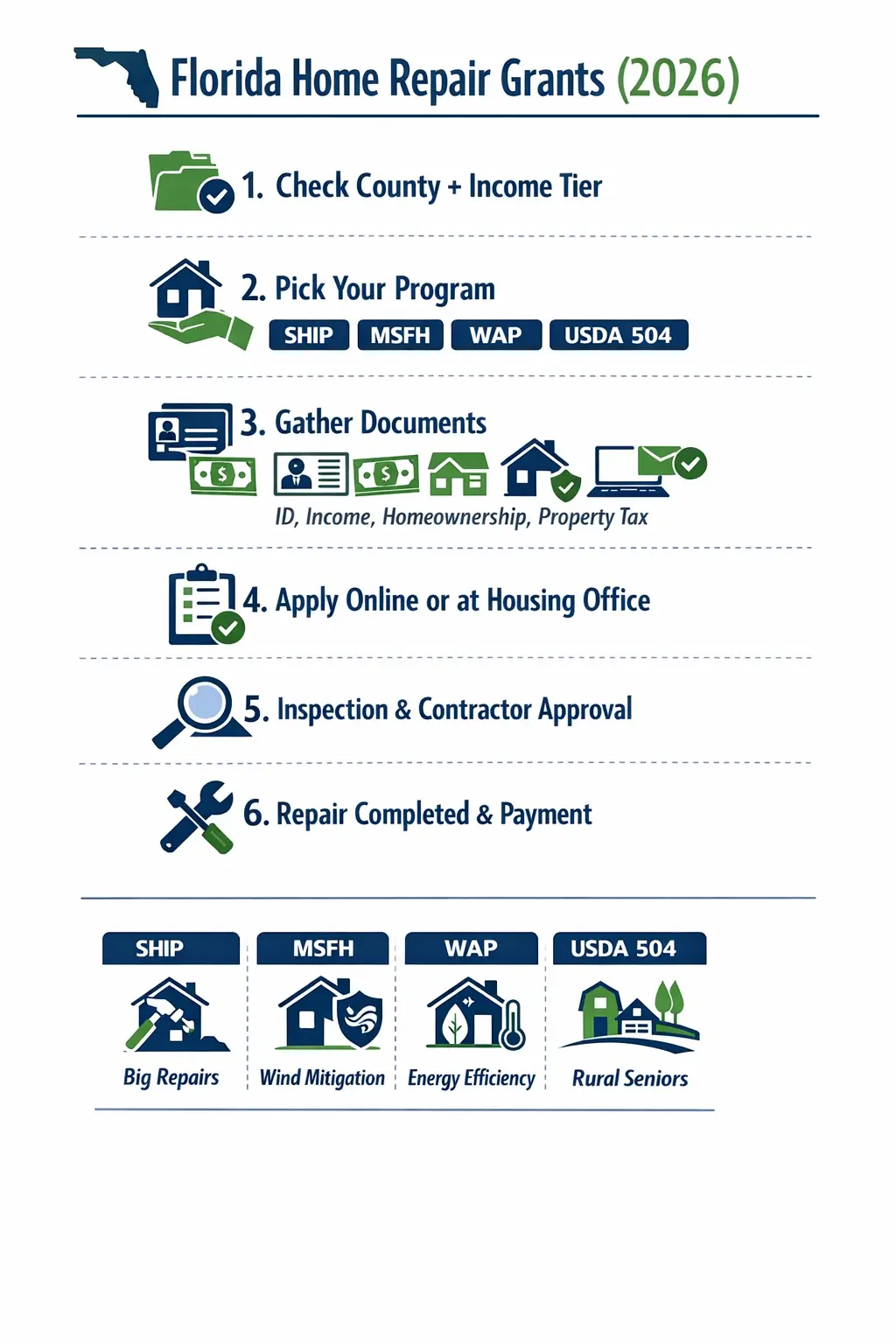
Before you start calling offices, Check your eligibility to narrow down the programs that match your county and income tier.

Quick Program Snapshot (Compare Your Options)
| Program | Best For | Typical Repairs Covered | Key Notes |
|---|---|---|---|
| SHIP (County-Level) | Emergency repairs and rehabilitation | Roofing, HVAC, plumbing, electrical hazards, structural issues | Often structured as a deferred payment, forgivable loan (0% interest, no monthly payments) if you meet the retention period |
| My Safe Florida Home (MSFH) | Wind mitigation and insurance savings | Roof improvements, impact windows and doors, garage door reinforcement | Uses prioritization windows, but awards still move quickly once your window opens |
| Weatherization Assistance Program (WAP) | Lower electric bills and energy efficiency | Energy audit, insulation, air sealing, HVAC support | Typically income-based, with priority for seniors (60+) and high energy burden households |
| USDA Section 504 | Very-low-income rural homeowners | Remove health and safety hazards, essential repairs | Seniors 62+ may qualify for grants; loans may be available for broader repairs |
| Local City Programs | City-specific help (code violations, urgent rehab) | Roofing, electrical work, essential rehab support | Funding and rules vary by city and backlog |
The SHIP Program: Florida’s Largest Repair Resource
The State Housing Initiatives Partnership (SHIP) is the pillar of Florida’s housing assistance. It distributes funds to all 67 counties to help residents with emergency repairs and rehabilitation.
The “Forgivable Loan” Structure: Unlike a traditional loan, SHIP assistance is often a Deferred Payment Loan. This is a second mortgage with 0% interest and no monthly payments. If you remain in your home for the retention period, typically 5 to 15 years, the debt is fully forgiven.
What it Covers: Major structural issues, specifically providing free roof replacement for low income households. (Note: To apply, counties often require you to submit free roof repair estimates from licensed contractors to prove cost eligibility). It also covers HVAC (AC/Heating) repair, plumbing, and electrical hazards.
Financial benefits: Depending on the county (e.g., Miami-Dade, Pinellas, Orange), you can receive between $20,000 and $90,000.
Eligibility criteria: Based on Area Median Income (AMI) and covering Very Low (50%), Low (80%), and sometimes Moderate (120%) income levels.
| SHIP Advantages | SHIP Watchouts |
|---|---|
|
|
| Program | Where Applications Happen | What You Usually Need Ready |
|---|---|---|
| SHIP |
County or city housing office Find your Local Office ➤ | Proof of income, ID, proof of ownership, insurance, property tax status |
| MSFH | Official portal: mysafeflhome.com | Homestead/ownership docs, ID, income proof, inspection scheduling |
| Weatherization | Local office: Florida WAP Providers | Utility bills, proof of income, household info, ID, proof of residence |
| USDA 504 | USDA Rural: Check Florida Map | Proof of income, ownership, rural eligibility, contractor estimates |
Note: Each county can have different SHIP intake periods, caps, and waitlists, so always confirm your local window.
My Safe Florida Home (MSFH)
The My Safe Florida Home (MSFH) program focuses on “Wind Mitigation” to make your home stronger and your insurance cheaper. For the 2025-2026 cycle, the program has been allocated $280 million.
2026 Prioritization and Award Basis: While the program utilizes 4 Prioritization Groups to determine eligibility windows, grants are still awarded on a first-come, first-served basis once a group’s window opens.
- Group 1: Low-income seniors (60+) – This priority group is the main recipient of free elderly home repair assistance in Florida.
- Group 2: Low-income homeowners (any age)
- Group 3: Moderate-income seniors (60+)
- Group 4: Moderate-income homeowners (any age)
The $10,000 Grant:
- Low-Income (Groups 1 and 2): Receive a No-Match Grant up to $10,000 (State covers 100% of the cost).
- Moderate-Income (Groups 3 and 4): Receive a 2-to-1 Match (State pays $2 for every $1 you spend).
Eligible Improvements:
Roof Improvements, Impact Windows and Doors, Garage Door Reinforcement, Secondary Water Barrier Installation
Weatherization Assistance Program
If your electricity bills are increasing due to an old AC unit, the Weatherization Assistance Program is your best option. It focuses on the home’s envelope to improve energy efficiency.
What They Offer: They perform a comprehensive Energy Audit, which may include repairing or replacing HVAC systems, adding attic or wall insulation, and sealing air leaks.
Income Limits: To qualify for this program, your household income must not exceed 200% of the Federal Poverty Level.
Priority: Preference is given to seniors (60+), families with children, and households with a high energy burden.
USDA Section 504: The Rural Grant
Specifically for very-low-income residents in rural designated areas of Florida:
Grants for Seniors (62+): Receive up to $10,000 as an absolute grant to remove safety hazards. It only needs to be repaid if the home is sold within 3 years.
Loans: Access up to $40,000 at a fixed 1% interest rate.
URGENT: Federal Energy Tax Credit Deadlines
Homeowners should confirm the current federal rules before counting on energy tax credits. Under current IRS guidance for Public Law 119-21 (commonly referred to as the One Big Beautiful Bill), some credits are treated as ended after December 31, 2025 based on the IRS termination dates for the relevant sections.
Official reference: IRS FAQs on modifications and termination dates
Section 25C (Energy Efficient Home Improvement Credit): This credit is not allowed for any property placed in service after December 31, 2025. Your HVAC, windows, or insulation must be fully installed and operational by this cutoff.
Section 25D (Residential Clean Energy Credit): This 30% credit is not allowed for any expenditures made after December 31, 2025. The IRS generally treats an expenditure made as occurring when the item’s original installation is completed.
Local “Gold Nugget” Programs (City-Specific)
| Location | Program | What It Helps With |
|---|---|---|
| Miami-Dade | Single Family Rehabilitation Program | Support tied to code violations and rehabilitation needs |
| City of Orlando | Grants up to $20,000 | Roofing and electrical work |
| Pinellas County | Up to $75,000 (often as a forgivable loan) | Essential rehabilitation and safety repairs |
FAQs
Can I apply for these grants if I still have a mortgage on my home?
Yes, having an existing mortgage does not disqualify you from most programs. However, you must be current on payments and property taxes.
Will I receive the grant money up front to pay my contractor?
Usually, No. For example, the MSFH is a reimbursement grant, while SHIP and USDA often pay contractors directly upon project completion.
Are mobile homes eligible for these grants?
Mobile homes are generally ineligible for MSFH, but you may qualify for USDA Section 504 or local SHIP emergency funds.
Can I combine multiple grant programs?
Yes, you can combine programs, e.g., MSFH for Windows and SHIP for plumbing, as long as you avoid duplication of benefits for the same repair.
How long does the process take?
Expect a timeline of 4 to 12 months, depending on the program’s backlog and your priority group window.
Conclusion
Securing a government home repair grant in Florida requires proper preparation. With the My Safe Florida Home portal operating on a prioritized first-come, first-served basis and federal tax credits expiring on December 31, 2025, the window for maximum savings is closing.
Whether you are applying for emergency home repair assistance via SHIP or hurricane-proofing your roof through MSFH, the first step is always the same: gather your documents and verify your income tier. By acting now, you can protect your home’s structural integrity and significantly lower your insurance premiums for years to come. For more guidance and updates, visit Housing Grants Finder.