Stacking Energy Rebates: Master Guide to HEAR & HOMES
Since the One Big Beautiful Bill (OBBB) passed, those old federal tax credits are officially gone. But here is the good news: that money didn’t just vanish! It actually turned into instant discounts you receive at checkout. At Housing Grants Finder, we track these shifts daily to keep you updated.
While Sections 25C and 25D were repealed for new projects starting January 1, 2026, the funding was moved directly into Point-of-Sale (POS) State Rebates. This guide is your roadmap for Stacking, the only proven way to combine federal grants such as USDA Section 504 with new state-run HEAR and HOMES rebates to achieve a $0 out-of-pocket cost. To make this work, you’ll need to meet specific income thresholds and use a contractor from the Qualified Contractor Network (QCN).
⚡ Check Your Rebate Eligibility
Don’t guess. See which HEAR & HOMES rebates match your income and zip code instantly.
Who Can Actually Get This Money?
In 2026, the help you get depends on how much you make compared to your neighbors. This is called your Area Median Income (AMI). You can check your local limits at the HUD AMI Income Map.
The Three Income Tiers
- Low-Income (Under 80% AMI): You’re in the “Golden Tier.” Programs can cover 100% of the cost (up to the individual item caps).
- Moderate-Income (80%- 150% AMI): You can have 50% of the cost covered by rebates.
- Standard Income (Over 150% AMI): You won’t qualify for the appliance rebates (HEAR), but you can still receive HOMES efficiency rebates if your upgrades save significant energy.
You can check your specific local limits at the Official HUD AMI Income Map.
Residency & Property Requirements
- Primary Residence Only: You must live there for at least 6 months each year to be eligible.
- Renters: You ARE eligible for the HEAR program. You can receive rebates for portable equipment (such as induction stoves) or permanent installations if you have written permission from your landlord.
- Property Type: This includes single-family homes, duplexes, mobile homes on permanent foundations, and condos.
The Big Discounts: What Can You Get?
HEAR (Home Electrification and Appliance Rebates)
This program focuses on high-efficiency electric equipment and offers instant discounts at the point of sale. The contractor deducts the fee from your bill before you pay.
High-efficiency heating and cooling. Must be Energy STAR certified.
Covers the heavy-duty breaker box required for new electric equipment.
For dedicated circuits. Must be installed by a certified (QCN) professional.
Specifically for high-efficiency heat pump tanks.
For air sealing and insulation that meets 2026 standards.
For induction ranges and heat pump clothes dryers.
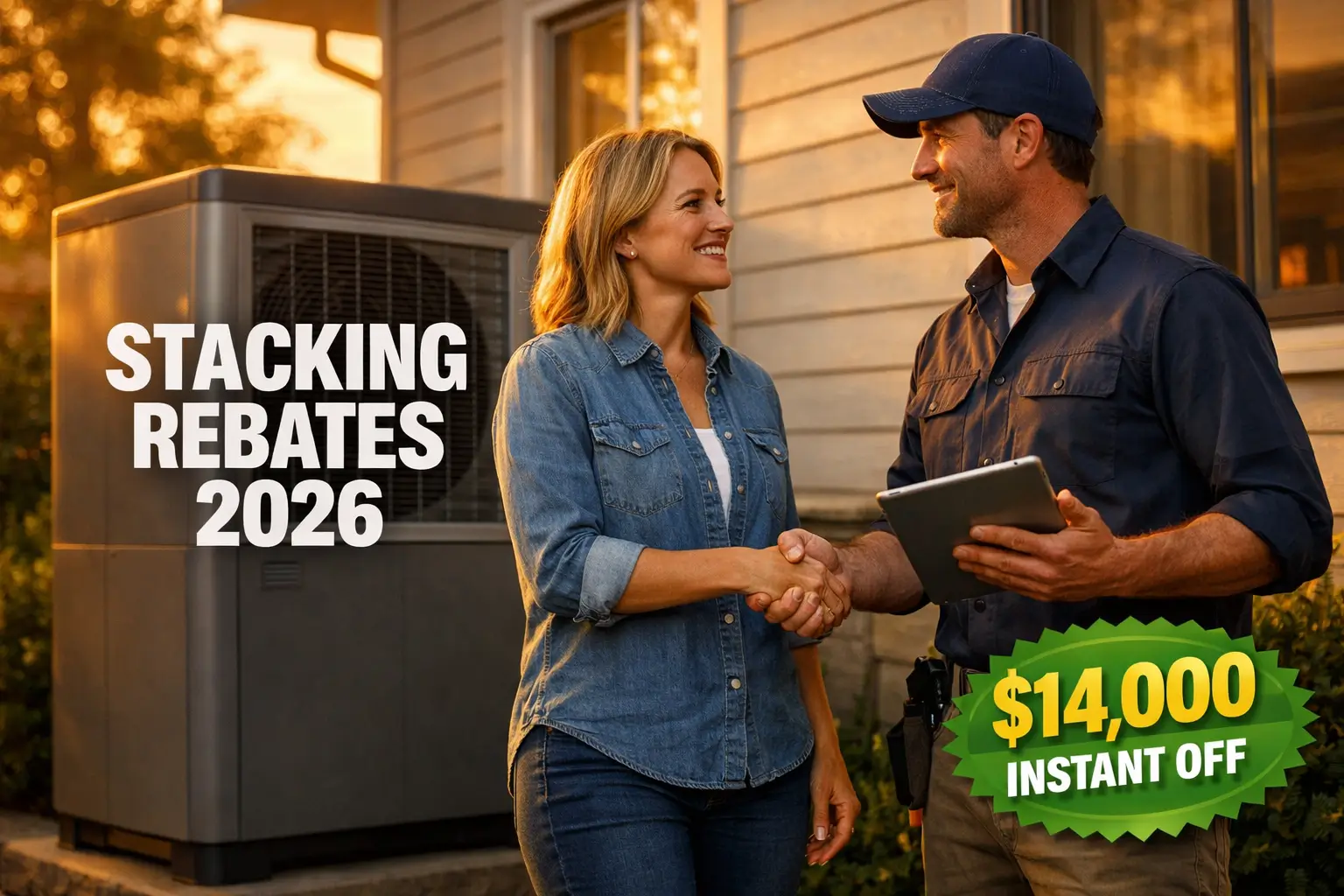
The Hard Cap: You can combine different upgrades, but the total household limit is $14,000.
HOMES (Home Efficiency Rebates)
This is like a performance bonus for making your house more energy-efficient. It’s open to everyone, regardless of income.
- The 20–34% Savings Tier: You get $4,000 ($2,000 for standard income).
- The 35%+ Savings Tier: You get the max $8,000 ($4,000 for standard income).
- Requirement: A pro must conduct an energy audit, a Blower Door Test before and after the work to demonstrate the savings.
4 Secrets: No One Tells You
- Don’t Buy It First: You can’t just buy a heater at Home Depot and ask for the rebate later. Your contractor must reserve your funds in the state portal before any purchases are made.
- The Categorical Eligibility: Don’t waste your time digging up three years of tax returns. If you have an approval letter for LIHEAP, SNAP (EBT), SSI, Medicaid, WIC, or Head Start, you’re automatically approved for 100% funding.
- The QCN Gatekeeper: You must use an approved pro. In California, look for “TECH-certified” badges; in New York, use the “NYSERDA-approved” list. They are the only ones with login credentials for the state systems.
- The 2026 Reservation Crisis: Funds are moving fast. Check the DOE National Rebate Tracker daily to see if your state still has active funding.
Rules for Stacking & Braiding
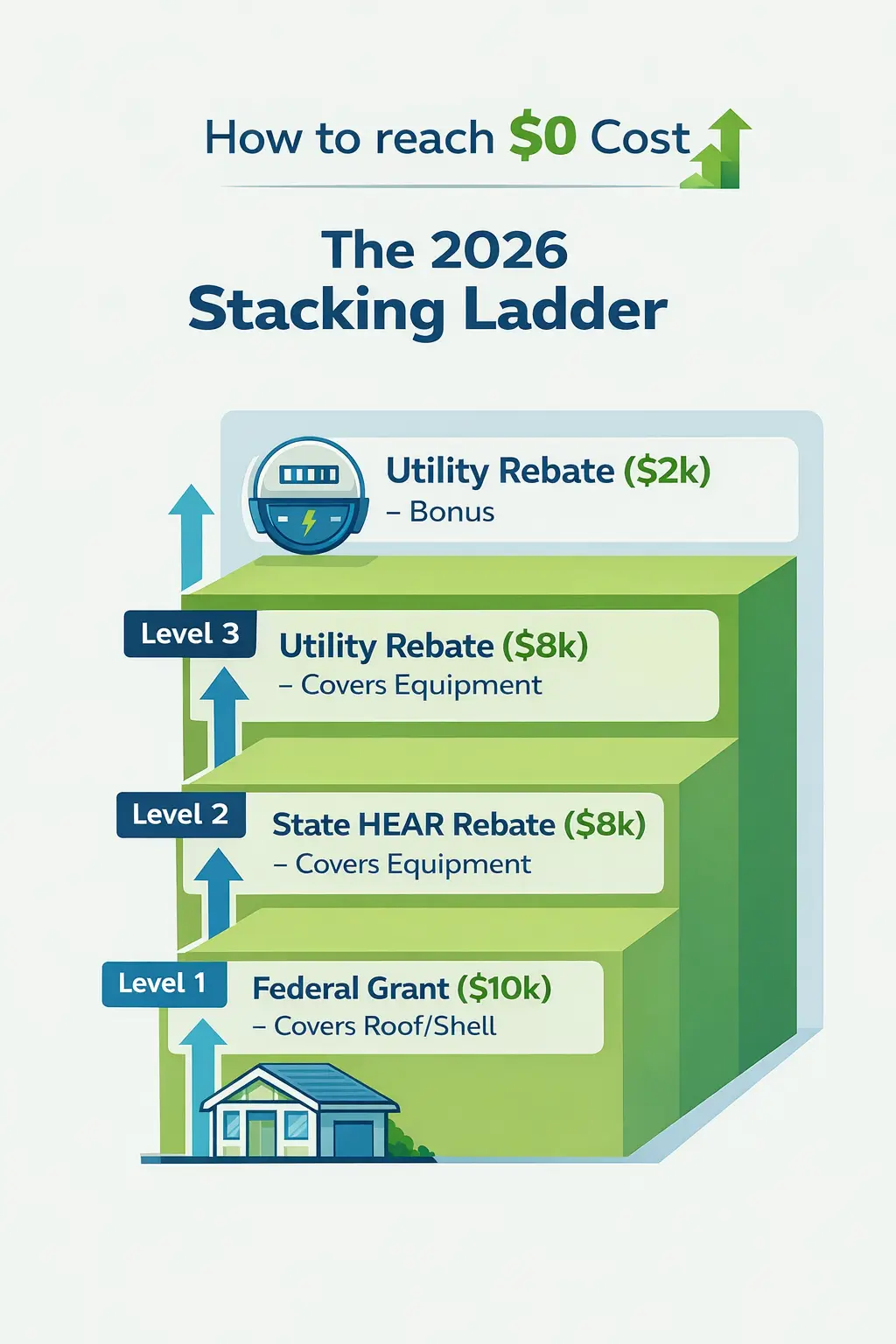
The government is very strict about not double-dipping on the same physical upgrade. You can’t use two federal programs for the same unit, but you can stack them if they cover different parts of the job.
- The Braiding Strategy (Federal + State): Use your $10,000 USDA 504 Grant (if you are 62+) for a structural improvement, such as a roof or foundation (see our guide on roof grants), and use your $8,000 State HEAR Rebate for an HVAC heat pump.
- The Gap-Filling Strategy (Loan + Rebate): If your new HVAC costs $12,000 and the state rebate only covers $8,000, you can use a 1% interest USDA 504 loan to cover the remaining $4,000.
Note: This converts a $4,000 debt into a small monthly payment of roughly $18.50. - The Incentive Layering (Utility + State): Most states encourage you to take money from your local utility, like Duke Energy or PG&E, and add it to your HEAR/HOMES rebate, as long as the total doesn’t go over 100% of the cost. (Residents in hurricane zones should also check our Florida Home Repair Guide for state-specific stacking rules).
How to Apply: The Stacking Process
- Verification: Visit your State Energy Office, such as NYSERDA in NY or The Switch Is On in CA, and confirm your income level.
- Audit: Schedule a Whole-Home Energy Assessment. This audit is the “key” that unlocks the HOMES money.
- Braid with USDA: Apply for the USDA Section 504 Grant for the structural stuff and the HEAR Rebate for the mechanical items at the same time. Consider bundling this with window replacement grants if your audit identifies drafts.
- Confirm the Reservation ID: Before any work begins, ask your contractor for your State Reservation ID Number. If they don’t have it, your funds aren’t secure.
FAQs
Can I stack a state rebate with the 1% USDA Loan?
Yes! Use the HEAR rebate to cover the first $8,000 of your heat pump cost, and use the 1% interest USDA loan to pay the remaining balance over 20 years.
Can I do a Self-Install?
Generally, no. For HEAR and HOMES, the government requires a registered contractor to make sure everything meets safety and efficiency standards.
What if I have a mobile home?
You qualify! The 2026 rules specifically include mobile and manufactured homes, provided they are your primary residence and on a permanent foundation.
Are these rebates available for newly built homes?
A: No. These are specifically for existing homes. For new builds, you’ll need to look into the Section 45L Builder Credit.
What if my furnace is broken right now?
Ask your contractor about Emergency Crisis Assistance. Programs like LIHEAP often allocate additional funds for life-threatening failures that require repair within 48 hours.
Can I use these rebates for a vacation home?
No. These programs are strictly for primary residences. You have to live there for more than six months of the year.
Conclusion
The door to these free home upgrades is wide open right now, but the funds are being claimed quickly. By stacking a state rebate with a USDA grant, you aren’t just saving a few bucks; you are basically getting a modern, energy-efficient home for potentially zero dollars out of pocket.
Your first step is actually straightforward: Check your local income limit (AMI) and find a certified contractor. They will handle all the annoying portal paperwork for you while you focus on getting a safer, cheaper-to-run home.
Head over to your State Energy Office portal today and reserve your spot before the 2026 Funding runs out!