Florida Home Repair Grants 2026: SHIP, MSFH & Roof Help
Florida homeowners may be able to get help with serious repair needs such as roof leaks, hurricane wind-mitigation upgrades, HVAC failure, plumbing or electrical hazards, window and door improvements, and energy-efficiency repairs. The right program depends on your county, income, ownership status, repair type, funding availability, and whether the work is approved before it starts.
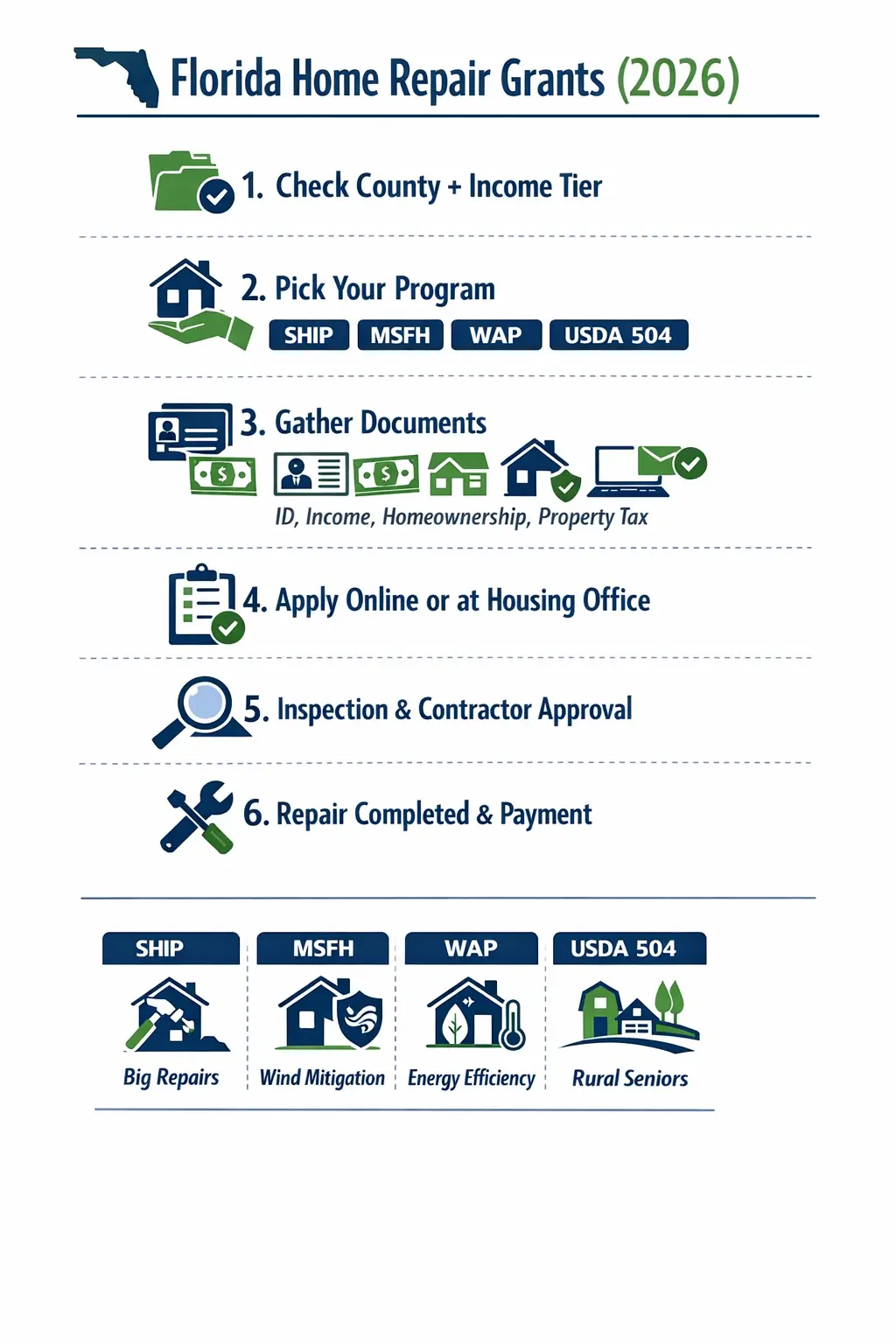
For 2026, the main Florida paths to check are SHIP through your county or city, My Safe Florida Home (MSFH) for approved wind-mitigation upgrades, the Weatherization Assistance Program for energy-related repairs, and USDA Section 504 for eligible rural homeowners. For storm damage tied to a declared disaster, compare these programs with our disaster recovery grant guide.
Who can get Florida home repair grants in 2026?
Florida homeowners may qualify for repair help through SHIP, My Safe Florida Home, WAP, USDA Section 504, or local city and county programs. There is not one single Florida-wide repair application. Eligibility depends on your county, income level, homestead or ownership status, repair urgency, inspection results, funding, and program rules.
- Roof, HVAC, plumbing, or electrical hazards: Start with your county or city SHIP office.
- Hurricane wind-mitigation upgrades or Florida window grant options: Check My Safe Florida Home for inspection and grant rules.
- Florida HVAC repair assistance, high electric bills, insulation, air leaks, or AC-related energy problems: Check Florida WAP through a local provider.
- Rural senior homeowners: Check USDA Section 504 if the home is in an eligible rural area.
- Declared storm damage: Review disaster recovery help instead of treating MSFH as a disaster repair grant.

Quick Program Snapshot (Compare Your Options)
| Program | Best For | Typical Repairs Covered | Key Notes |
|---|---|---|---|
| SHIP (County-Level) | Emergency repairs, rehabilitation, and Florida roof replacement grants research | Roofing, HVAC, plumbing, electrical hazards, structural issues, and grants for home repairs in Florida | Often structured as a deferred payment, forgivable loan (0% interest, no monthly payments) if you meet the retention period |
| My Safe Florida Home (MSFH) | Wind mitigation, Florida window grant searches, and insurance savings | Roof improvements, impact windows and doors, garage door reinforcement, and free roof replacement grants Florida research | Uses prioritization groups and application steps. Funding can run out, and grant approval usually comes after inspection and eligible recommendations. |
| Weatherization Assistance Program (WAP) | Lower electric bills and energy efficiency | Energy audit, insulation, air sealing, HVAC support | Typically income-based, with priority for seniors (60+) and high energy burden households |
| USDA Section 504 | Very-low-income rural homeowners | Remove health and safety hazards, essential repairs | Seniors 62+ may qualify for grants; loans may be available for broader repairs |
| Local City Programs | City-specific help, code violations, urgent rehab, and mobile home repair grants Florida checks where local rules allow | Roofing, electrical work, essential rehab support | Funding and rules vary by city and backlog |
The SHIP Program: Florida’s Largest Repair Resource
The State Housing Initiatives Partnership (SHIP) is Florida’s county and city housing assistance path. The Florida Housing Finance Corporation’s Florida Housing SHIP Program distributes SHIP funding to local governments, and each local office sets its own repair categories, income limits, caps, waitlists, and retention rules through its Local Housing Assistance Plan.
How assistance is structured: SHIP Florida home repair help is often structured as a deferred payment loan, forgivable loan, or low-interest loan instead of unrestricted cash. Some local programs may offer 0% interest and no monthly payments, but the balance, forgiveness rules, and retention period depend on the county or city program.
What it may cover: Eligible SHIP programs may help with major safety and habitability repairs such as roof repair or replacement, HVAC, plumbing, electrical hazards, accessibility work, and structural issues. Counties may ask for licensed contractor estimates, proof of ownership, income documents, insurance, and property-tax status before approval. Before signing repair paperwork, review our contractor fraud and home repair scam guide.
Funding limits: Do not treat one statewide dollar amount as guaranteed. Miami-Dade, Pinellas, Orange, Orlando, and other local governments can use different caps, intake windows, and repayment rules. Always verify the current local limit before listing a final grant or loan amount.
Eligibility criteria: Based on Area Median Income (AMI) and covering Very Low (50%), Low (80%), and sometimes Moderate (120%) income levels.
| SHIP Advantages | SHIP Watchouts |
|---|---|
|
|
| Program | Where Applications Happen | What You Usually Need Ready |
|---|---|---|
| SHIP |
County or city housing office Find your Local Office ➤ | Proof of income, ID, proof of ownership, insurance, property tax status |
| MSFH | Official portal: My Safe Florida Home | Homestead/ownership docs, ID, income proof, inspection scheduling |
| Weatherization | Local office: Florida Weatherization Assistance Program | Utility bills, proof of income, household info, ID, proof of residence |
| USDA 504 | USDA Rural Development Florida: USDA Section 504 Florida | Proof of income, ownership, rural eligibility, contractor estimates |
Note: Each county can have different SHIP intake periods, caps, and waitlists, so always confirm your local window.
How SHIP Really Works by County
SHIP is not one Florida-wide homeowner application. Florida distributes SHIP funds through local governments, and each county or city can set its own intake windows, repair caps, retention period, and priority rules through its Local Housing Assistance Plan.
That is why one county may focus on emergency roof repairs, another may prioritize accessibility work, and another may place more funding into rehabilitation for very-low-income owners. Before you collect contractor bids, confirm that your county or city is actively taking owner-occupied rehabilitation or emergency repair applications.
Because SHIP help is often structured as a deferred payment loan or forgivable loan, it also helps to understand when home repair grants have to be paid back.
My Safe Florida Home (MSFH)
The My Safe Florida Home (MSFH) program focuses on wind-mitigation improvements that may strengthen eligible homes against hurricane damage and may help with insurance-related mitigation recommendations. It is not a general repair grant for every roof problem or storm damage claim.
2026 application order: Homeowners generally create an account, complete the prioritization questionnaire, wait for inspection group placement, submit the inspection application, receive a wind-mitigation inspection, and then apply for a My Safe Florida Home grant only if the inspection report recommends eligible improvements.
- Group 1: Low-income homeowners age 60+ may receive the earliest priority window when the program is processing applications for that group.
- Group 2: Low-income homeowners (any age)
- Group 3: Moderate-income seniors (60+)
- Group 4: Moderate-income homeowners (any age)
The $10,000 Grant:
- Low-income grants: Eligible low-income homeowners may qualify for grant funds up to $10,000 without a homeowner match, subject to legislative appropriation and program approval.
- Matching grants: Eligible matching-grant homeowners may receive $2 in grant funds for every $1 contributed, up to a maximum state contribution of $10,000.
Eligible Improvements:
Roof Improvements, Impact Windows and Doors, Garage Door Reinforcement, Secondary Water Barrier Installation
If your inspection recommends windows or doors, also read our window and door replacement grants guide.
Weatherization Assistance Program
If high electric bills, poor insulation, air leaks, or an old AC system are the main problem, the Florida Weatherization Assistance Program may be a better fit than a roof grant search. WAP focuses on energy savings and home performance, not cosmetic remodeling.
What it may include: A local FloridaCommerce provider or Community Action Agency may perform an energy audit and recommend eligible measures such as air sealing, attic or wall insulation, duct improvements, minor energy-related repairs, and HVAC-related support when allowed by program rules and funding.
Income and priority: Florida WAP is income-based. Priority may be given to seniors age 60+, disabled residents, families with children, and households with repeated high utility bills or high energy burden.
For AC-specific help, compare this with our free AC and heating grants guide.
USDA Section 504: The Rural Grant
USDA Section 504 Florida may help very-low-income homeowners in eligible rural parts of Florida repair, improve, or modernize a home, or remove health and safety hazards.
- Grant path: Eligible homeowners age 62+ may qualify for grant help up to $10,000 to remove health and safety hazards. USDA grants generally must be repaid if the home is sold in less than 3 years.
- Loan path: Eligible homeowners may qualify for a loan up to $40,000 at 1% fixed interest over 20 years.
- Disaster-area note: In presidentially declared disaster areas, the grant cap may be higher under USDA rules.
- Check first: Use the USDA eligibility site and contact the Florida Rural Development office before spending time on paperwork.
My Safe Florida Home Application and Waitlist Rules
The My Safe Florida Home program does not work like a simple cash voucher. First, you create an account, complete the prioritization questionnaire, wait for your inspection group, submit the inspection application, receive a free wind-mitigation inspection, and only then apply for a grant if your inspection report recommends eligible improvements.
- Why this matters: Your prioritization group controls when you can move forward in the process.
- Funding risk: If program funding runs out before your group opens, you may not reach the inspection or grant stage in that round.
- Important limit: Only improvements recommended in the initial inspection report can be funded.
- Common eligible work: Opening protection, roof-to-wall attachment, roof deck attachment, and secondary water resistance.
If your home damage is tied to a declared storm event instead of routine hurricane mitigation grants or mitigation work, compare your options with our disaster recovery grant guide.
Local City and County Repair Programs
| Location | Program | What It Helps With |
|---|---|---|
| Miami-Dade | Housing Rehabilitation Program | May help eligible owner-occupied single-family homes with health and safety repairs, code violations, roof repairs, plumbing, electrical, exterior painting, and related rehabilitation work. Verify open intake and funding before applying. |
| City of Orlando | Housing Rehabilitation Program | May help qualified homeowners correct health and safety conditions. Orlando lists up to $20,000 as a grant tier, with higher assistance handled through longer lien or deferred-loan rules. |
| Pinellas County | Home Repair & Independent Living Programs | Pinellas lists up to $75,000 for major repairs such as roofs, windows, exterior doors, AC/heating, and code-related electrical work, but the program was closed to new applications as of May 4, 2026. Recheck status before sending users there. |
Best Florida Repair Options for Seniors
Older homeowners looking for Florida home repair grants for seniors or free elderly home repair assistance Florida usually have the strongest path when the issue affects safe occupancy, insurance costs, or essential home systems.
- MSFH: Low-income seniors age 60+ are in the first prioritization group and may qualify for no-match grant help for approved wind-mitigation upgrades.
- WAP: Florida weatherization gives priority to seniors age 60+ when high utility costs, poor insulation, or HVAC issues are affecting the home.
- USDA Section 504: Rural homeowners age 62+ may qualify for grant help to remove health and safety hazards. For the full Section 504 Home Repair rules, read our USDA Section 504 guide.
- SHIP: Many counties also prioritize fixed-income seniors when emergency roof, HVAC, plumbing, or electrical hazards threaten safe occupancy.
If your main goal is age-related repair help, also review our guide to home repair grants for seniors.
FAQs
Are there Florida home repair grants for roof replacement?
Possibly. Roof help may be available through SHIP, My Safe Florida Home, USDA Section 504, Miami-Dade, Orlando, Pinellas, or another local repair program. Approval depends on county rules, income, ownership, inspection results, repair urgency, funding, and whether the work is approved before it starts.
What is SHIP and how do I apply in Florida?
SHIP is Florida’s county and city housing assistance program. You usually apply through your local SHIP office, not one statewide repair form. Each local government sets its own intake window, repair cap, eligible work, documents, and repayment or forgiveness rules.
Is My Safe Florida Home a roof replacement grant?
My Safe Florida Home is mainly a wind-mitigation program. It may help with approved roof improvements, impact windows and doors, garage door reinforcement, or secondary water barrier work if recommended by the inspection report and approved by the program. It is not a general grant for every roof leak or storm damage claim.
Can seniors get home repair help in Florida?
Yes, seniors may qualify through SHIP, My Safe Florida Home priority groups, Weatherization, USDA Section 504 if rural and very-low-income, or local city and county programs. The strongest option depends on income, county, repair type, and current funding.
Can Weatherization help with AC or high electric bills?
Florida WAP may help eligible households with energy-related improvements such as audits, insulation, air sealing, and HVAC-related measures when allowed by the local provider. It is income-based and may prioritize seniors, disabled residents, families with children, and high energy-burden households.
Will I receive the grant money up front to pay my contractor?
Usually not. MSFH matching grants may work by reimbursement, low-income MSFH grants follow a separate disbursement process, and SHIP or USDA often use contractor-payment or program-controlled payment methods. Do not start work before approval unless the program specifically allows it.
Are mobile homes eligible for Florida repair grants?
It depends on the program. Mobile or manufactured homes may be excluded from My Safe Florida Home inspection eligibility, but some SHIP, USDA Section 504, or local programs may have separate rules. Verify title, ownership, land status, foundation, and local eligibility before applying.
Can I combine SHIP, MSFH, WAP, and USDA?
Sometimes. You may be able to use different programs for different approved repairs, but you must avoid duplication of benefits for the same work. Ask each program before combining funds.
Conclusion
Florida home repair grants in 2026, including grants for home repairs in Florida and home repair grants Florida searches, work best when you match the problem to the right program. SHIP is the broad county-run repair path, My Safe Florida Home is the strongest option for wind-mitigation upgrades, WAP fits high energy bills and HVAC-related efficiency work, and USDA Section 504 remains a key option for eligible rural homeowners.
The smartest next step is to confirm your county intake window, your income tier, and whether your repair is being treated as emergency rehabilitation, wind mitigation, weatherization, or rural health-and-safety work. Once that is clear, gather your ownership, income, insurance, and contractor documents before your local window fills up.