Home Repair Scams 2026: Avoid Contractor Fraud Red Flags
I know that feeling when something breaks at home. A small leak turns into a repair bill. A bad roof becomes a safety worry. Then the calls, ads, and door knocks start: “free roof grant,” “government-approved contractor,” “we just finished a job nearby.” That is exactly where many home repair scams begin.
Scammers target homeowners, seniors, disaster victims, and low-income families because repairs feel urgent. They use fake grant ads, rushed contracts, door-to-door pressure, inflated estimates, and contractor fraud to get money before you have time to verify anything.
This guide shows you how to spot home repair contractor scams, check whether a contractor is legitimate, avoid fake government grant offers, protect your money, and report fraud if someone has already taken advantage of you.
Red Flag Alert
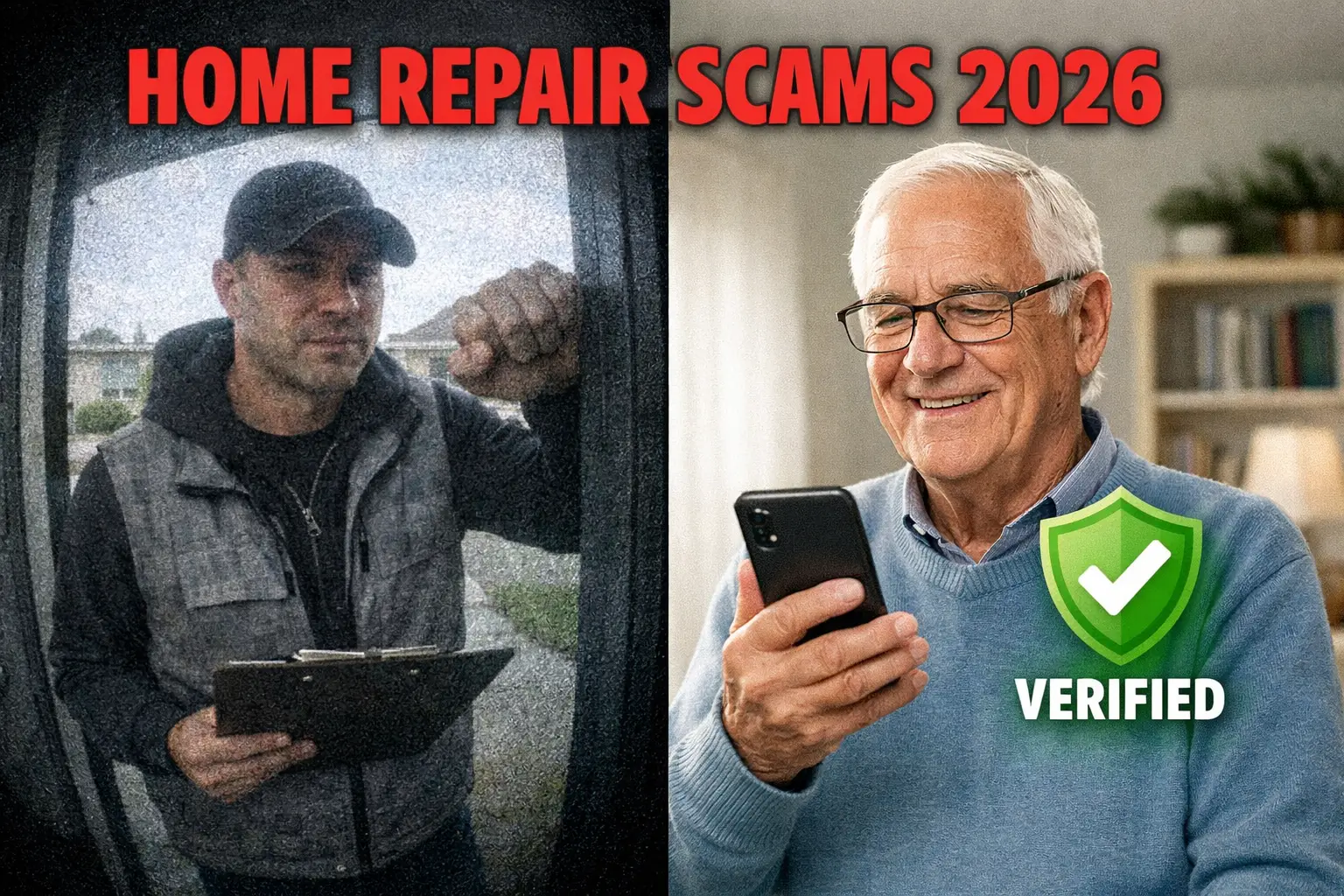
Real government inspectors never show up unannounced. If someone demands cash or an immediate signature, close the door.
Quick Scam Checklist Before You Sign Anything
Before you sign a repair contract, give money, or share personal details, run through this checklist. One red flag does not always prove fraud, but two or more should stop the deal immediately.
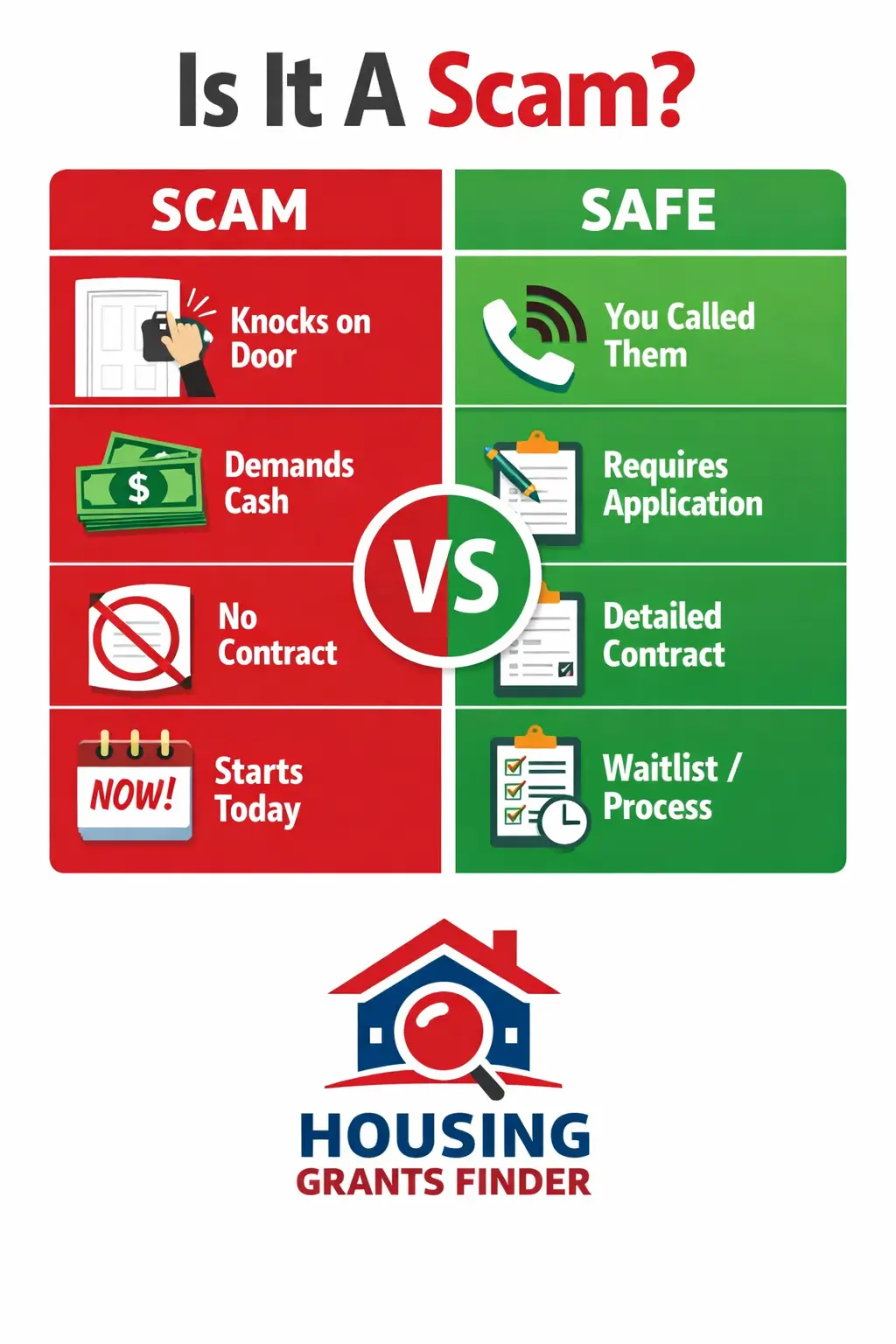
- They knock without an appointment: Be careful with anyone claiming to be a government inspector, roof specialist, or grant representative who shows up uninvited.
- They promise a free government repair: Real programs require applications, income checks, inspections, and agency approval. They do not hand out instant approvals at your door.
- They want cash today: Cash payments, wire transfers, gift cards, or payment apps are major warning signs.
- They avoid license details: A real contractor should give you a license number, business address, insurance proof, and written scope of work.
- They pressure you to sign now: A safe contractor gives you time to compare bids and read the contract.
Common Home Repair Scams in 2026
Scammers have updated their playbooks. Beyond the old leftover materials trick, watch out for these newer 2026 tactics:
The Official Fake Inspector
Someone is knocking, claiming to be a Federal Energy Auditor or City Building Inspector. They find a violation that only their recommended contractor can fix. Real inspectors do not show up unannounced to sell you repairs.
AI Voice Cloning
If a contractor or a family member calls from an unknown number requesting emergency funds for a repair, hang up. Scammers now use 3-second clips of a person’s voice to mimic them perfectly. Call your family member back on their known number to verify.
The Fake Free Roof Grant and Social Media Trap
Ads promising $0-down windows are usually lead-gen traps. They aren’t grants; they are high-pressure sales companies trying to sign you up for high-interest predatory loans. (Check verified window replacement grants here).
The Rule: Most official government resources end in .gov, but some local or non-profit partner portals may use .org or state-specific domains. If the site is a .com and asks for your Social Security number to verify grant eligibility, proceed with extreme caution.
How to Check If a Contractor Is Legit
Do not rely on a business card, a yard sign, or a nice-looking truck. Before you let anyone inspect your roof, start demolition, or collect a deposit, verify the contractor through official sources.
- Check the license: Search your state contractor licensing board or consumer protection website. Make sure the name, license number, and business address match the person in front of you.
- Ask for insurance: Request proof of general liability insurance and workers’ compensation coverage. Call the insurer if the document looks suspicious.
- Compare at least two bids: A scammer wants you isolated. A real contractor expects you to compare estimates.
- Search complaints: Look up the business name with words like “complaint,” “lawsuit,” “scam,” and your city or state.
- Verify grant claims: If they say a government grant will pay for the work, call the agency directly. The homeowner must apply through the real program, not through a salesperson.
The Paper Trail: What Your Contract MUST Have
A safe home improvement contract in 2026 should be detailed. If it’s missing any of these, don’t sign:
- Specific Materials: It shouldn’t just say roof shingles. It should list the brand, the weight, and the color. (Especially for roof replacement grants).
- A Solid Timeline: It must include a Start Date and a Completion Date.
- Permit Clarity: The contract should clearly state that the contractor is responsible for obtaining all necessary local permits. If a contractor asks you to pull the permits, it’s a massive red flag; it often means they aren’t licensed or are trying to avoid an inspection.
- The Cooling-Off Rule: Under the FTC’s Cooling-Off Rule, you generally have three business days to cancel certain sales made at your home or a temporary location for more than $25. Note: This rule doesn’t cover every transaction, like emergency repairs you requested, so always check the contract for a written Notice of Cancellation.
Financial Safety: Keep the Power in Your Wallet
The biggest mistake is paying too much too soon. Once the money is gone, you lose all your leverage.
Never pay more than 10% or $1,000 upfront, whichever is less. Tie the rest of the payments to milestones.
Never make the final payment until the job is 100% finished and you have physically inspected it.
Pay by check or credit card. Credit cards offer protection if the contractor disappears.
Verified Home Repair Assistance
Don’t call the numbers on the flyers. For verified help, dial 2-1-1 to reach the universal help line for local social services. They can connect you with these official 2026 programs:
- USDA Section 504 Home Repair: Grants of up to $10,000 for low-income seniors (62+) in rural areas to fix health and safety hazards. In Presidentially declared disaster areas, the grant cap can hit $15,000. (Full details in our USDA 504 Guide). USDA Official Page
- Weatherization Assistance (WAP): Administered by the Department of Energy, this covers whole-home energy efficiency, insulation, and furnace repairs for eligible households. (See our HVAC & WAP Guide). DOE Official Page
- VA Housing Grants: For Veterans with service-connected disabilities, the SAH Grant for FY 2026 is capped at $126,526, and the HISA Grant provides up to $6,800 for medically necessary modifications like walk-in tubs. VA Official Page
- Habitat for Humanity: Its Aging in Place program provides professional, honest repairs on a sliding-scale basis. Habitat Official Page
What If I Already Got Scammed?
If you realized too late that you were targeted, do not be ashamed. These people are professional manipulators. Take these steps immediately:
- Document Everything: Take photos of the work or lack thereof, keep all text messages, and save all receipts.
- Send a Certified Cancellation: If you are within the 3-day window, send a cancellation letter by certified mail with a return receipt requested. This is your legal proof.
- Report the Fraud: Contact the Federal Trade Commission at ReportFraud.ftc.gov and your State Attorney General’s consumer protection office.
- Local Help: Contact your local Area Agency on Aging or 2-1-1. They often have resources to help seniors who have been victims of financial exploitation.
FAQs
Do I have to repay this grant money?
Usually, no. For programs like the USDA 504, the funds are a gift if you follow the program rules and remain in the home for the required period. If you sell, move out, or violate the terms too early, you may have to repay the money. For a clearer breakdown, read our guide on when home repair grants must be paid back.
Can a contractor apply for a government grant on my behalf?
No. While a contractor can help you gather the quotes you need for an application, you must be the one to initiate the process with the agency. If a contractor claims they can handle the grant for you, it is a scam.
Why do I have to provide my income tax returns?
Legitimate government grants are reserved for those who need them most. Agencies use your tax returns to verify that you meet the very-low-income requirements for your county. If a grant doesn’t care about your income, it isn’t a government program.
How long does the real grant process take?
Real grants don’t happen tomorrow. Because they involve background checks, home inspections, and multiple bids, the process usually takes 3 to 6 months. If someone says they can get you instant grant money, they are likely selling a loan.
What if my income is too high for a grant?
Don’t lose hope. Many programs, like the USDA 504, also offer 1% interest loans. For a $10,000 repair. This is often safer and less expensive than using a high-interest credit card.
Are free roof grant ads on Facebook real?
Most are not direct government grants. Many are lead-generation ads that collect your information and sell it to contractors or finance companies. A real roof repair program will send you through an official agency, require income verification, inspect the home, and give you written approval before work starts.
Conclusion
Taking that first step to ask for help can feel a little intimidating, but remember, these programs were created because you earned them. You have spent decades contributing to your community and caring for your family. Now, it’s the community’s turn to help take care of you.
Don’t let the noise of the scammers make you feel like you’re alone in this. Pick up the phone, dial 2-1-1, and just ask, “Is there a local program that helps with senior home repair grants?” You’ll be surprised at how many people are waiting on the other end of the line just to help you stay right where you belong: in your own home, safe and sound.