Texas Home Repair Grants 2026: USDA, City & Senior Help
Texas homeowners may qualify for repair assistance through TDHCA accessibility and reconstruction programs, local city or county housing programs, Weatherization, USDA Section 504 and nonprofit repair providers. The right option depends on your location, income, ownership or rental status, repair type and current funding.
This guide covers the main Texas home repair grants, no-cost repair services and forgivable or deferred assistance for roofs, plumbing, electrical hazards, HVAC systems, accessibility modifications and serious health or safety problems.
Fast Eligibility Check
Most programs look for some mix of:
- Income: Many programs use household income limits such as 80% AMI or AMFI, but each program has its own standard.
- Ownership or rental status: Most rehabilitation programs target owner-occupants, but some accessibility programs, including Amy Young, can also serve qualifying renters.
- Location: State-funded programs may only operate where a participating local administrator has funding.
- Repair need: Health, safety, accessibility, code and habitability problems are stronger fits than cosmetic remodeling.
- Documents: Programs may review income, title or lease, taxes, mortgage, insurance, disability documentation and the repair condition.
Important: Eligibility does not guarantee funding. Local providers may be at capacity, use waiting lists or temporarily close intake.
Best Texas Home Repair Programs by Situation
If you are trying to find the right Texas home repair program fast, match your situation first instead of applying blindly.
- Disability or accessibility needs: Amy Young Barrier Removal is one important Texas accessibility option for ramps, safer bathrooms, wider access points, and hazard-removal work tied to daily use.
- Home is unlivable or beyond repair: Homeowner Reconstruction Assistance is the better fit when reconstruction, replacement housing, or site-based rebuilding may be required.
- City-specific repair help: Austin, Dallas, San Antonio, and Harris County each run separate repair tracks with their own intake rules, funding windows, and documentation standards.
- Rural homeowners: USDA Section 504 is one of the most practical options for very low-income owners in eligible rural areas who need essential repairs.
- High energy bills or inefficient HVAC: Check the Texas Weatherization Assistance Program. Local providers serve all 254 counties, and approved work may include insulation, duct repairs and repair or replacement of inefficient heating or cooling equipment.
- Senior households: Priority often improves when the homeowner is older, has a disability, or the repair affects basic health and safety. See our full guide to home repair grants for seniors.
Amy Young Barrier Removal (AYBR): Disabled Texans
The Amy Young Barrier Removal (AYBR) program is Texas’s standout accessibility grant. It is not a general remodeling. It is intended to make a home safe for daily living when someone in the household has a documented disability.
What AYBR covers
This is where searches for wheelchair ramp grants, walk-in showers, roll-in showers, grab bars, and widened doorways fit naturally. (See our full guide on bathroom safety grants).
- Entry and interior ramps
- Handrails and safer pathways
- Bathroom safety upgrades and accessibility layouts
- Accessibility-related fixes are tied to serious hazards when they affect the safe use of the home
What it Offers
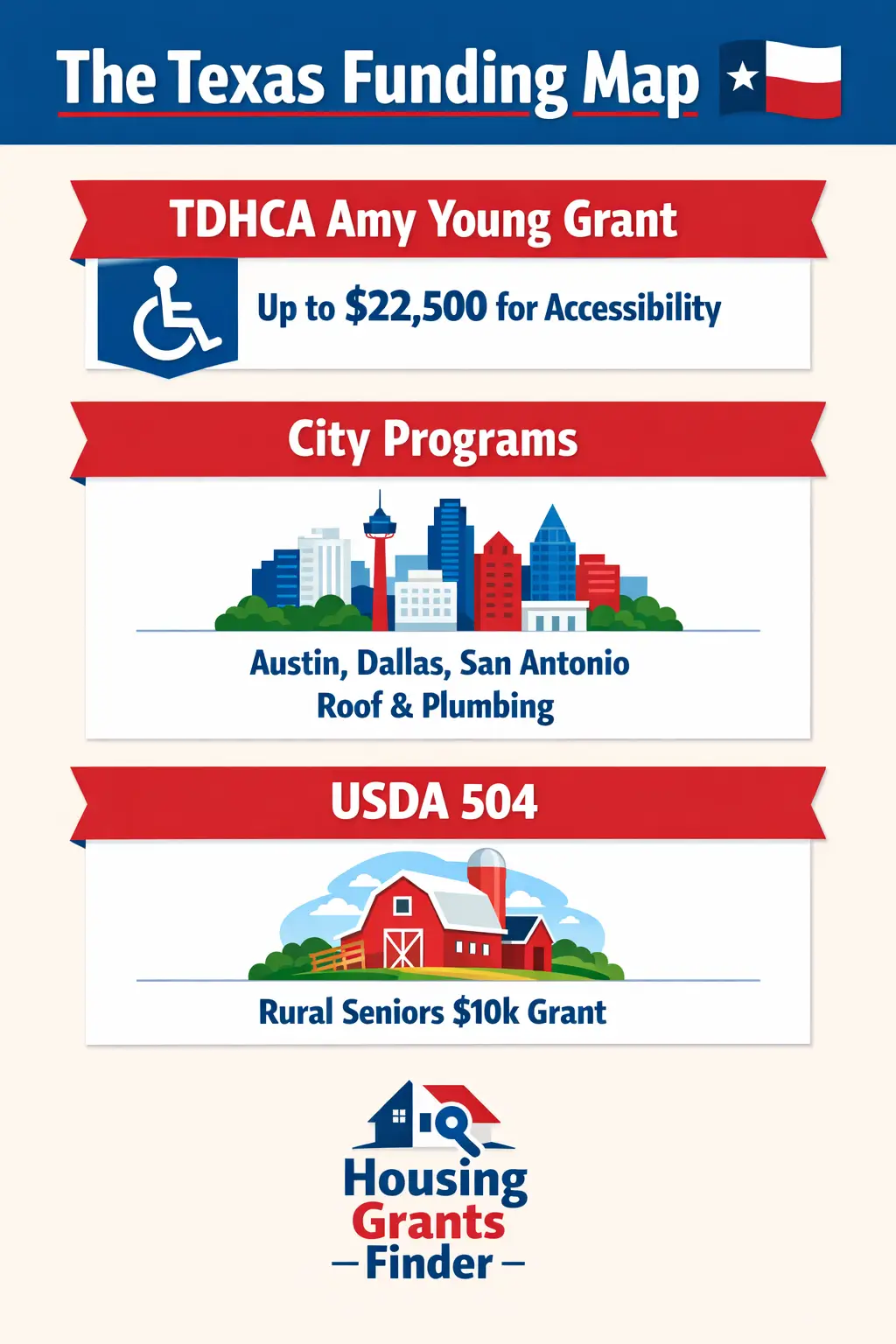
- Maximum grant: Up to $22,500 as a one-time grant.
- Income: Household income must not exceed 80% of Area Median Family Income (AMFI).
- Who can qualify: A qualifying household must include a person with a disability. Eligible beneficiaries may be homeowners or renters.
- 75/25 rule: At least 75% of the grant is generally used for barrier removal. Up to 25% may address qualifying health or safety hazards unless TDHCA approves otherwise.
- Availability: AYBR is not available in every Texas area. Households apply through a participating local provider rather than directly to TDHCA.
How Funding Actually Works
AYBR uses a reservation system through local administrators. Reservations are time-stamped and reviewed in order, but funding is not guaranteed just because a name is on a list. Availability depends on the local provider’s funding cycle and remaining capacity.
Official Resource: TDHCA Amy Young Program Details
Texas Homeowner Reconstruction Assistance (HRA)
Texas Homeowner Reconstruction Assistance (HRA) uses HOME funding through participating local governments, housing authorities and nonprofit administrators. It is not available in every part of Texas.
- Income: Household income generally must not exceed 80% AMFI.
- Same-site reconstruction: HRA may reconstruct an eligible owner-occupied home on the same site.
- Manufactured housing: HRA may replace an existing owner-occupied manufactured home with new manufactured or site-built housing in qualifying situations.
- Floodplain relocation: Qualifying housing in a floodplain may be replaced or relocated to an alternative site.
- Disaster or condemnation: New construction or replacement may be considered when a home becomes uninhabitable because of a qualifying disaster or local condemnation.
- Service area: Most TDHCA HOME funds are reserved for non-participating jurisdictions, which are typically rural communities. Use TDHCA’s provider finder to confirm local HRA availability.
- Financial terms: Do not assume one statewide grant, loan or forgiveness structure. Confirm the local administrator’s written assistance and occupancy terms.
Best Texas Programs for Seniors
Older homeowners are one of the strongest priority groups for Texas repair help, especially when the issue affects safe occupancy, mobility, sanitation, or a major home system.
- USDA Section 504: Eligible very-low-income rural homeowners age 62+ who cannot repay a repair loan may qualify for the grant portion.
- Austin Architectural Barrier Removal: Qualifying Austin homeowners and renters age 62+ or with a verified severe disability may receive accessibility modifications up to $20,000.
- Harris County: The county’s Home Repair Program targets eligible homeowners age 62+ or disabled homeowners, but current intake should be confirmed directly because the county webpage shows conflicting status messages.
- Meals on Wheels Central Texas: Its home repair program currently uses a waiting list and focuses on safety, accessibility and aging-in-place needs.
Texas does not use one single senior repair portal, so the best next step is usually to identify the local administrator first and then confirm whether your issue is treated as emergency repair, accessibility work, or major systems rehabilitation.
2026 Program Directory: City and County Hubs
If you are looking for an emergency home repair grant, a roof replacement grant, a sewer line repair grant, a 0% home rehabilitation loan, lead hazard help, code violation repairs, or health and safety home repairs, this section will be helpful.
City of Austin: Home Repair Programs
Austin currently offers several separate repair pathways. The correct program depends on the repair and household situation.
- Safety Repairs and Modifications: Up to $20,000 in grant assistance for eligible households at or below 80% MFI.
- Minor Home Repair: Up to $7,500 for immediate life-threatening health and safety repairs.
- Architectural Barrier Removal: Up to $20,000 in no-cost accessibility work for qualifying seniors or persons with severe disabilities.
- Plumbing: Up to $15,000 for qualifying plumbing repairs; income limit may reach 100% MFI.
- Private Lateral: Free qualifying sewer lateral repair or replacement for eligible Austin Water customers.
- Home Rehabilitation Loan: Up to $75,000 for repairs or up to $350,000 for qualifying demolition/reconstruction. Loans are 0% interest and may be forgiven over the applicable occupancy period.
Contact: (512) 974-3100 | Email: hpdcs@austintexas.gov | Official Site
City of Dallas: HIPP and the Strict Emergency Rule
Dallas assistance can open and close based on funding and city intake periods, so applications are accepted only when the city opens the program.
- Emergency Home Rehabilitation: Program rules provide grants up to $10,000 when funding is available. The qualifying emergency generally must have occurred within four days before the application and pose an immediate life, health or safety concern.
- Major-Systems Repair: Program structure allows an interest-free, forgivable, self-amortizing loan up to $24,000.
- Dallas Tomorrow Fund: Up to $20,000 for eligible exterior code violations after referral from Dallas Code Compliance.
Contact: (214) 670-3644 | Email: HIPP@dallascityhall.com | Official Site
City of San Antonio: Under 1 Roof and Healthy Homes
San Antonio programs are strong, but eligibility rules are strict, especially around title, insurance, and property documentation.
Under 1 Roof / Cool Roofs
- Maximum: One-time grant up to $19,000.
- Roof system: Projects use white asphalt shingles and reflective radiant-barrier underlayment.
- Not emergency assistance: Processing may take up to three months depending on demand.
- Structural limitation: Roofs needing significant structural repairs are not eligible for this program.
- Occupancy: Approved homeowners enter a five-year restrictive covenant requiring ownership and occupancy.
Program contact: (210) 207-6459 | Official Site
Green & Healthy Homes: San Antonio currently describes this program as addressing lead-based paint concerns while supporting safer, more energy-efficient housing. Verify the current repair scope during intake.
Program phone: (210) 207-4444 | General city contact: 3-1-1
Harris County Home Repair
Harris County Housing & Community Development operates a Home Repair Program for eligible very-low- to low-income homeowners with health and safety repair needs.
- Priority household: The current program page requires the homeowner to be age 62 or older or a disabled homeowner.
- Current intake: Harris County’s webpage currently shows conflicting status language—one section says applications are not being accepted, while another states that Health & Safety applications are being accepted only for septic and well projects.
- Best action: Call 832-927-4955 before completing an application to confirm which intake track is currently active.
- Do not use old caps: Remove the $20,000 minor and $60,000 moderate limits unless the county republishes them in current guidelines.
Contact: (832) 927-4955 | Official Harris County Site
Texas Weatherization Assistance Program (WAP)
Texas Weatherization is a statewide energy-efficiency pathway administered through local TDHCA subrecipients serving all 254 counties.
- Energy audit: The provider evaluates the home to identify cost-effective eligible improvements.
- Possible work: Caulking, weather stripping, ceiling, wall and floor insulation, building-envelope repairs and duct work.
- Heating and cooling: Tune-up, repair or replacement of inefficient heating and cooling equipment may be approved when it meets program rules and energy-savings requirements.
- No guaranteed free HVAC: The audit and program rules determine the measures installed.
- How to apply: Use TDHCA Help for Texans and select Weatherization for your city or county.
Federal Funding: USDA Section 504
If you live in an eligible rural area, USDA Section 504 Home Repair is one of the most reliable sources of repair assistance for seniors and very low-income homeowners.
The numbers
- Loan: Up to $40,000 at a fixed 1% interest rate for up to 20 years.
- Standard grant: Up to $10,000 for qualifying very-low-income homeowners age 62+ who cannot repay a repair loan.
- Presidential-disaster grant: Up to $15,000 for an eligible home damaged in a qualifying presidentially declared disaster area.
- Combined help: Up to $50,000 under normal rules or $55,000 in a qualifying presidentially declared disaster area.
- Grant purpose: Grant funds must address health and safety hazards.
- Repayment: A grant must generally be repaid if the home is sold within three years.
- Status: Texas Section 504 is currently open and applications are accepted through local Rural Development offices on an ongoing basis.
Texas USDA Housing Staff: (254) 742-9770
Nonprofit Repair Programs Texans Actually Use
Meals on Wheels Central Texas
This program is widely searched for aging-in-place support and major home safety repairs.
- General Home Repair: New inquiries can currently join the program’s waiting list.
- Travis CDBG repairs: May include roof, electrical, plumbing, septic and accessibility needs for qualifying households.
- Mobile homes: The current Travis CDBG grant requires the homeowner to also own the land for a manufactured home.
Waiting list phone: (737) 218-4262
Habitat for Humanity: Montgomery County
Habitat for Humanity of Montgomery County serves Montgomery County homeowners through a structured Home Repair intake. Qualified households and projects may receive repairs at no cost, but assistance is not guaranteed.
- Step 1: Online Home Repair pre-qualification.
- Step 2: Habitat says a team member generally contacts the homeowner within 5–7 business days for a pre-application interview.
- Step 3: Eligibility and repair scope are reviewed before assistance is approved.
Contact: (936) 441-4663 | Email: familyservices@habitatmctx.org
Find the Hidden Local Money for Your County
Texas repair funding often flows through local providers rather than directly to individuals.
Use TDHCA’s provider directory
Search for Home Repair or Home Repair and Accessibility, and enter your city or county. The local administrator is often:
- A Community Action Agency
- A Council of Government (COG)
- A nonprofit listed as the local program operator
Start with TDHCA Help for Texans
TDHCA does not accept individual applications for these local repair programs. Use Help for Texans, select Home Repair / Accessibility Modifications, and enter your city or county to identify participating local providers.
Use 2-1-1 as a Backup Referral
If no TDHCA-listed provider currently has capacity, 2-1-1 Texas may help identify additional local nonprofit, emergency or county resources. Always verify the actual administrator before sharing sensitive documents.
What Counts as an Emergency Repair in Texas?
Most Texas programs use emergency repair language for problems that create an immediate threat to health or safety, not for cosmetic damage or routine wear.
- Electrical hazards, exposed wiring, or systems that make the home unsafe
- Major plumbing failures, sewer backups, or gas-line issues
- Roof failures or structural problems that leave the home exposed to active water intrusion
- Unsafe heating or cooling conditions when they create a serious habitability problem
If the issue is tied to loss of heating or cooling, you may also want to review our guide to LIHEAP emergency furnace repair help because some energy-related emergencies move through a different funding path.
How to Apply for Texas Home Repair Help
- Match the problem to the right program: accessibility, emergency repair, major systems repair, reconstruction, or rural repair help.
- Find the real local administrator: in Texas, the operator may be a city housing office, county program, Community Action Agency, Council of Government, or nonprofit partner.
- Gather documents early: proof of ownership, ID, income records, insurance information if applicable, property-tax status, and photos of the damage.
- Do not start work before approval: many repair programs will not reimburse work that begins too early.
- Ask how the money is structured: some programs are true grants, while others use deferred or forgivable assistance. Read more in our guide on whether home repair grants have to be paid back.
- Stay careful with contractors: if a program is open, use approved intake channels and avoid anyone asking for large upfront payments or fake grant-processing fees. See our guide on how to avoid home repair scams.
FAQs
How much can the Amy Young Barrier Removal Program provide?
Eligible households may receive a one-time grant of up to $22,500. The household must include a person with a disability and generally must be at or below 80% AMFI. Eligible beneficiaries may be renters or homeowners.
Can I apply directly to TDHCA for a Texas home repair grant?
Usually no. TDHCA funds local governments and nonprofit providers that handle household intake. Use TDHCA Help for Texans to find a home repair or accessibility provider serving your city or county.
Is Dallas HIPP accepting applications now?
The City of Dallas currently states that HIPP applications are not being accepted. Monitor the City and its program administrator for the next application period. Emergency program rules and funding availability may differ.
Is San Antonio Under 1 Roof open?
San Antonio’s current repair page says NHSD is accepting Cool Roof appointments from homeowners living in Urban Heat Island neighborhoods. Confirm your address and current intake before applying.
Can Texas Weatherization replace an air conditioner or furnace?
Possibly. Texas Weatherization may repair or replace inefficient heating or cooling equipment when the energy audit and program rules support the measure. A free HVAC replacement is not guaranteed.
How much does USDA Section 504 provide in Texas?
Eligible rural homeowners may qualify for loans up to $40,000. Eligible homeowners age 62 or older who cannot repay a loan may qualify for grants up to $10,000, or up to $15,000 for qualifying presidential-disaster repairs.
Can manufactured homes qualify for Texas repair assistance?
Sometimes. Eligibility depends on the specific program, ownership or rental arrangement, land ownership, location and the condition of the manufactured home. Do not assume one statewide manufactured-home rule applies to every program.
Do Texas home repair programs have to be paid back?
It depends on the program. Amy Young is a one-time grant, USDA grants have a three-year sale repayment rule, and some city rehabilitation programs use liens, deferred loans or multi-year forgiveness requirements.
Conclusion
Texas home repair assistance is divided among TDHCA programs, city and county repair programs, Weatherization, USDA Rural Development and nonprofit providers. There is no single statewide homeowner application that covers every repair.
Start by matching the repair to the correct program and confirming current intake with the local administrator. Do not begin contractor work before required approval, and review whether assistance is a grant, deferred loan, forgivable loan, lien or other financing structure before accepting it.