Arkansas Home Repair Grants 2026: USDA, WAP & City Help
Arkansas homeowners may be able to get help through a mix of state, federal, and city-run home repair programs. The best options usually depend on the type of repair you need, where you live, your income, and whether the home is your primary residence.
This guide focuses on the most relevant Arkansas home repair grants and repair assistance programs for roofs, safety hazards, energy upgrades, senior repairs, and local rehabilitation help. If you are trying to find grants for home repairs in Arkansas, start by matching your situation to the program rules below before applying.
Quick Answer: Who can get Arkansas home repair help?
Arkansas homeowners may qualify for repair assistance through USDA Section 504, Weatherization, LIHEAP, city CDBG rehabilitation programs, lead-hazard programs, tribal housing providers, or local nonprofits. There is not one statewide grant that automatically pays for every repair.
- Rural senior or very-low-income repairs: Check USDA Section 504.
- Insulation, air leaks, HVAC efficiency or high energy bills: Check Arkansas Weatherization.
- Heating or cooling bill crisis: Check LIHEAP through the local Community Action Agency.
- Jonesboro, Little Rock or Fayetteville repairs: Verify current city intake, funding and eligible repair rules.
- Roof hardening: Monitor the Arkansas Insurance Department for official Strengthen Arkansas Homes application rules before paying a contractor or evaluator.
State & Federal Grant Programs
Strengthen Arkansas Homes Program Status
Arkansas homeowners are searching for the Strengthen Arkansas Homes program and possible FORTIFIED roof assistance. However, homeowners should not assume that a statewide $15,000 application is currently open.
Before hiring an evaluator or contractor, verify that the Arkansas Insurance Department has published an official application portal, current funding notice, eligible-home rules, award limit, approved evaluator process and contractor requirements.
- Roof work: Do not start construction before written program approval.
- Contractor: Verify whether the program requires an approved FORTIFIED evaluator, roofing contractor or designation professional.
- Related guide: Review our government roof replacement grants guide.
- Contractor safety: home repair scams and contractor fraud
- Official status: Arkansas Insurance Department
USDA Section 504
For rural Arkansas homeowners, USDA Section 504 is one of the most important repair programs for older adults. It can help eligible homeowners age 62 or older remove health and safety hazards, and it may also offer low-interest loan support for other qualified repairs.
This program is usually most relevant if you own and live in the home, meet USDA income rules, and are located in an eligible rural area. It is a strong fit for people looking for home repair for senior citizens free in Arkansas, especially when the repair involves roofing, electrical hazards, accessibility, plumbing, or other essential fixes. You can also review our home repair grants for seniors guide.
- Grant: Eligible very-low-income homeowners age 62 or older may qualify for up to $10,000 to remove health and safety hazards.
- Loan: Eligible rural homeowners may qualify for up to $40,000 at a fixed 1% interest rate for up to 20 years.
- Disaster-area rule: The grant maximum may increase to $15,000 only when repairing a home damaged in a qualifying presidentially declared disaster area.
- Repayment: USDA grants generally must be repaid if the property is sold in less than 3 years.
- Apply: Applications are accepted year-round, subject to local funding and USDA review.
- Official Link: USDA Section 504 Home Repair Program
Arkansas Weatherization Assistance Program
Arkansas Weatherization may help eligible households reduce heating and cooling costs through energy and health-and-safety improvements selected after a professional home energy audit. It is not a general remodeling grant.
- Possible work: Air sealing, insulation, weather-stripping, HVAC repair or replacement, ventilation, safety detectors and minor repairs connected to weatherization.
- Cost: Approved work is normally completed at no cost to the eligible occupant. The exact investment and measures depend on the home audit and program rules.
- Income: Households at or below 200% of the Federal Poverty Guidelines may qualify. LIHEAP or SSI participation can also provide categorical eligibility in some cases.
- Timing: The program operates year-round, but local wait times vary. Remove the universal 12-to-14-month claim.
- Apply locally: Contact the Community Action Agency or nonprofit serving your county.
- Related links: LIHEAP emergency furnace repair | Arkansas LIHEAP
- Official Link: Arkansas Weatherization Assistance Program
Window Replacement Help in Arkansas
There is no single statewide program that guarantees free window replacement for every homeowner in Arkansas, but window work may still be covered when it is tied to a larger health, safety, lead-hazard, or energy-efficiency repair. In practice, homeowners usually find help through Weatherization, lead hazard programs, or local rehabilitation programs rather than through a standalone window grant.
If you are searching for a free window replacement program in Arkansas, first check whether your home qualifies for Weatherization, lead-safe repair funding, or city rehab assistance. You can also review broader eligibility options on our window and door replacement grants guide.
For the best chance of approval, be ready to show that the window problem affects energy loss, child safety, structural condition, or code compliance. That is often the difference between a routine upgrade and an eligible repair item.
Lead, Tribal, and Solar Money
Lead Hazard Reduction
If your home was built before 1978, you are likely sitting on a health liability. Arkansas is currently distributing HUD Lead Hazard Reduction funds to de-lead homes where children under six reside. This can cover the full cost of window and siding replacements. If you test positive for lead, the state requires a Certified Abatement Contractor. Never try to scrape this yourself; you will be barred from the program for creating a hazard.
Native American Housing Assistance (NAHASDA)
If you have tribal affiliation, you may be eligible for the Indian Housing Block Grant (IHBG). These funds bypass the standard state waitlists. Help with rehabilitation, handicap mods, and even storm shelters. You must provide a CDIB card (degree of Indian blood).
- Action: Contact your Tribal Designated Housing Entity (TDHE), such as the Cherokee Nation Housing Authority.
Energy Rebates, Utility Programs and Property Tax Help
Do not rely on the former federal 30% residential solar or heat-pump tax credits for equipment placed in service during 2026. IRS guidance says the major residential clean-energy and energy-efficient home improvement credits ended for property placed in service after December 31, 2025.
Arkansas homeowners should instead check current Weatherization assistance, LIHEAP, utility rebates, Arkansas Home Energy Rebates availability, and local financing options. Verify any tax claim with the IRS or a qualified tax professional before purchasing equipment.
The Arkansas homestead property-tax credit is separate from a home repair grant. Because the amount has changed through recent legislation, confirm the current credit with your county assessor rather than publishing an outdated fixed amount.
Arkansas City and County Home Repair Programs
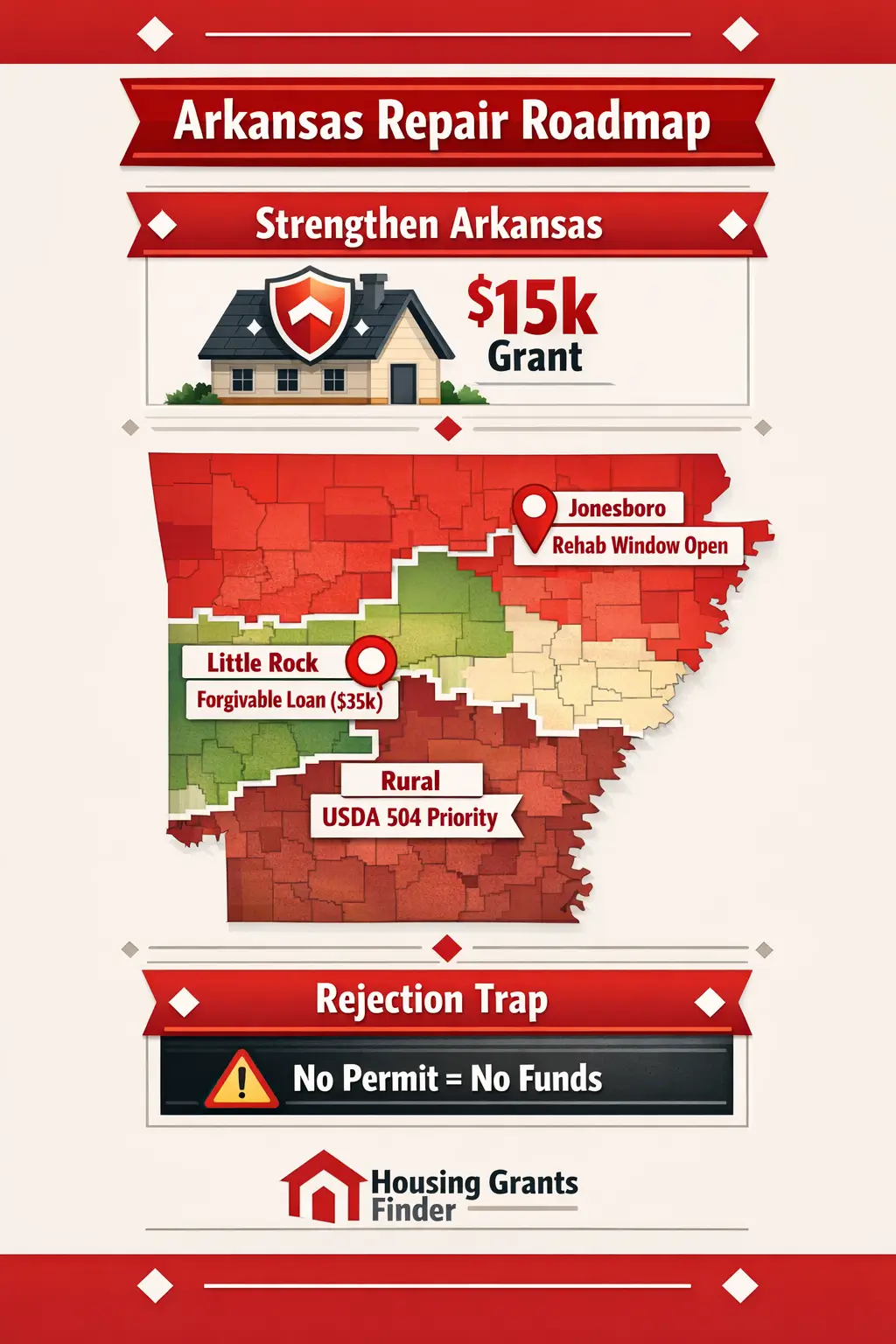
City and county repair programs may help with health, safety, code, accessibility, sewer, roofing or major-system repairs. Intake dates, funding limits and assistance types can change, so verify current status directly with the local housing or community development office.
Jonesboro Homeowner Rehabilitation Assistance
Jonesboro’s CDBG program lists Homeowner Rehabilitation Assistance for qualifying owner-occupied properties. Funds may support repair, rehabilitation or reconstruction and may be structured as grants, loans, loan guarantees, interest subsidies or another approved form of assistance.
- Current status: Contact the Grants and Community Development Department to confirm whether homeowner intake is currently open.
- Do not publish: Remove the February 12, 2026 meeting alert and the fixed $35,000 cap unless a current application packet confirms them.
- Official Link: Jonesboro CDBG Program
Arkansas Home Repair Application Checklist
The Permit Trap
This is a common reason for rejection in Pulaski and Benton counties.
- If you started a repair without a city permit and then applied for a grant to finish it, the agency will likely deny you.
The Rule: Most grant programs require an Environmental Review before any work begins. If you jump the gun, you forfeit the funds.
Ownership and Heir-Property Issues
A deed that remains in a deceased relative’s name may delay or prevent approval when the program requires clear ownership. Requirements vary, and some agencies may accept additional legal documentation.
- Next step: Check the recorded deed with the county Circuit Clerk or recorder.
- Legal help: Ask Arkansas legal-aid or an heir-property attorney what documents are needed to establish ownership.
- Do not assume automatic rejection: Ask the repair program which ownership documents it accepts.
Who Qualifies for Arkansas Home Repair Grants?
Eligibility depends on the program, but most Arkansas repair programs look at the same core factors before approving an application.
- You own and live in the home as your primary residence.
- Your household income falls within the program’s limits.
- The repair is tied to health, safety, weather damage, accessibility, or code issues.
- You can provide documents such as photo ID, proof of ownership, income records, insurance information, and repair estimates.
- No work has started before the program completes any required review, inspection, or approval.
How to Apply for Arkansas Home Repair Assistance
Start by identifying whether your repair is best matched to a roof program, senior repair grant, weatherization program, or city rehabilitation program. Then gather ownership records, income documents, contractor estimates, and photos of the damage before contacting the agency listed for that program.
If you are applying for more than one option, begin with the program that best matches the repair type. For example, roof damage should usually start with Strengthen Arkansas Homes, while senior rural homeowners should usually check USDA Section 504 first.
FAQs
Is Strengthen Arkansas Homes accepting applications?
Do not assume the program is open. Check the Arkansas Insurance Department for a dedicated application portal, current funding notice and published homeowner rules before paying an evaluator or contractor.
Can Arkansas seniors get home repair grants?
Possibly. Very-low-income rural homeowners age 62 or older may qualify for USDA Section 504 grant assistance to remove health and safety hazards. Local city programs and Weatherization may also help depending on location and repair type.
Can Weatherization replace an HVAC system?
Possibly. Arkansas Weatherization may include approved heating or cooling repair or replacement after an energy audit. A new system is not guaranteed solely because the existing unit is old.
Can I get free window replacement in Arkansas?
Sometimes. Window work may be approved through Weatherization, lead-hazard control or a local rehabilitation program when it is tied to energy loss, health, safety or code compliance.
Do Arkansas home repair grants have to be repaid?
It depends. Some assistance is a grant, while other programs use loans, deferred loans, liens or forgivable assistance. USDA grants must generally be repaid if the property is sold within three years.
Can a mobile home qualify for repair help?
It depends on the program. Weatherization may serve eligible manufactured housing, while USDA and city programs have separate ownership, land, foundation and property-eligibility rules.
Conclusion
Finding a home repair grant in Arkansas during 2026 is a race against narrow application windows. Because funding is spread across local city halls rather than one central state office, your success depends on being the squeaky wheel at your local office. Focus on safety issues such as failing roofs or hazardous electrical panels first. Keep your 2026 Social Security Award letters and a clean tax record ready to beat the inevitable rush.