Oregon Home Repair Grants 2026: County, Senior, USDA Help
Oregon homeowners may qualify for repair assistance through local nonprofits, county rehabilitation programs, Oregon Healthy Homes, Weatherization, USDA Section 504 and specialized city or veteran programs. The right option depends on your location, income, ownership status, repair type and current funding.
This guide covers the main Oregon home repair grants, no-cost services and repair loans for roofs, heating systems, accessibility improvements, electrical hazards, failing septic systems, lead, radon, indoor-air problems and other health or safety needs.
Quick Answer: Which Oregon Home Repair Program Should You Try?
- Low-income health or safety hazards: Check the Healthy Homes grantee serving your area.
- Rural homeowner: Check USDA Section 504.
- Insulation, air leaks or unsafe heating equipment: Contact your local Oregon Weatherization provider.
- Portland Interstate Corridor: Check Portland Housing Bureau’s Home Repair Loan.
- Portland elderly or disabled homeowner: Check REACH Community Builders.
- North Clackamas accessibility or manufactured-home safety repair: Check the applicable NCRA grant.
- Small-city or unincorporated Lane County: Check St. Vincent de Paul’s Regional Housing Rehabilitation Loan Program.
- Central Oregon veteran: Check NeighborImpact Veteran Restore.
Important: Assistance is not guaranteed. Intake, repair scope, income rules and funding vary by administrator.
Oregon Statewide Home Repair Programs
Oregon Healthy Homes Grant Program (HHGP)
The Oregon Health Authority Healthy Homes Grant Program funds qualified organizations that provide home repair and health-related housing improvements to eligible Oregon households. Individuals do not apply directly to OHA for a repair grant.
- Round 2 household focus: Older adults age 55+ and people with disabilities in households at or below 80% AMI.
- Possible work: Radon, lead, mold, indoor-air improvements, accessibility modifications, fire and seismic safety, cool-roof or heat-reduction work and qualifying electrical upgrades.
- Who delivers help: Nonprofits, Community Action Agencies, local governments, housing authorities, utilities, Coordinated Care Organizations and other eligible grantees.
- Homeowner action: Find the grantee serving your area and ask what repair categories and intake rules it currently offers.
Oregon Weatherization Assistance Program
Oregon Housing and Community Services funds local agencies to provide no-cost, audit-based weatherization services to qualifying households.
- Possible services: Insulation, air sealing, energy-related minor repairs, heating-system repair or replacement and heating-duct improvements.
- Income: Household income generally must be at or below 200% of the Federal Poverty Level.
- Priority: Seniors, people with disabilities, households with children, high energy users and households with high energy burden may receive priority.
- How to apply: Contact the Community Action Agency or weatherization provider serving your county.
- No guarantee: The home energy audit determines which measures are approved.
USDA Section 504
Oregon participates in a USDA Section 504 pilot that simplifies several program requirements, including title-clearance, site-size, insurance, escrow and appraisal rules. The pilot is not a new 2026 program.
- Loan: Up to $40,000 at 1% fixed interest for up to 20 years.
- Standard senior grant: Up to $10,000 for qualifying homeowners age 62+ who cannot repay a loan.
- Presidential-disaster grant: Up to $15,000 for qualifying disaster-damaged homes.
- Combined help: Up to $50,000 normally or $55,000 in a qualifying presidentially declared disaster area.
- Title rule: Oregon’s pilot simplifies title clearance, but full title service is required when total outstanding Section 504 loan debt exceeds $25,000.
- Repayment: Grants generally must be repaid if the property is sold within three years.
- Status: Oregon applications are accepted year-round through USDA Rural Development, subject to funding.
Who Actually Qualifies First in Oregon?
Eligibility differs sharply by program. Income is important, but location, ownership, disability or age, repair severity, property type and available funding can matter just as much.
- Low-income owner-occupants: Many county and nonprofit programs use income caps, often around 50% to 80% of AMI.
- Seniors and people with disabilities: Some programs specifically prioritize or target these households, including Weatherization and the current Healthy Homes Round 2.
- Homes with documented hazards: Lead paint, radon, indoor air quality issues, dangerous wiring, failing septic, and roof leaks are stronger than cosmetic repair requests.
- Rural households: USDA Section 504 is often the best fallback when county programs are limited or booked out.
- Owners with paperwork ready: Expect to show proof of ownership, income documents, and current property tax status before funding is approved.
County-Specific Programs for 2026
Multnomah County & Portland
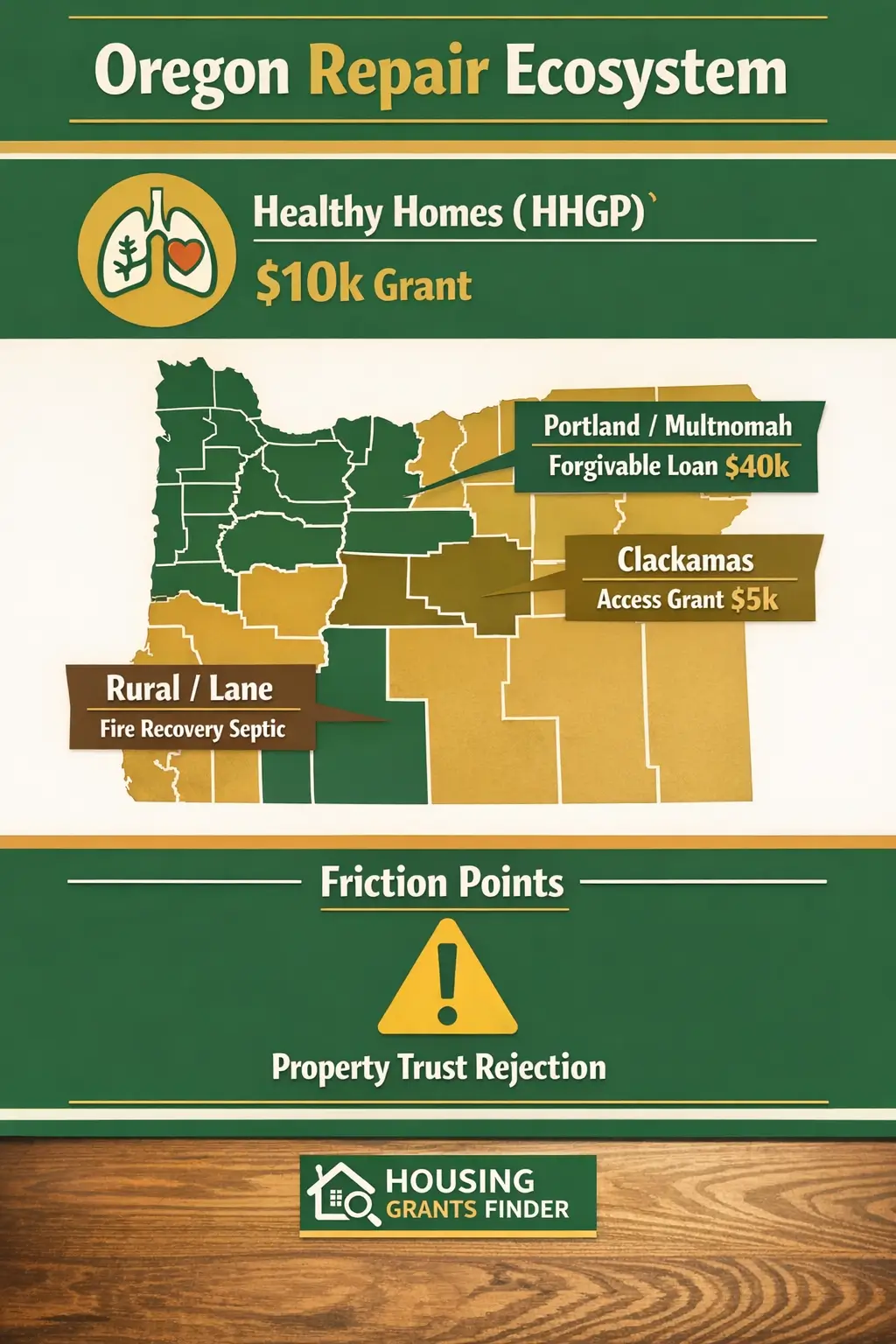
The Portland Housing Bureau Home Repair Loan currently has funding for eligible owner-occupants in the Interstate Corridor TIF District.
- Maximum: Up to $40,000.
- Interest: 0% with no monthly payments.
- Forgiveness: The loan is forgiven after 15 years when program occupancy requirements are satisfied.
- Income: Up to 120% of Portland AMI, adjusted for household size.
- Other screening: Existing mortgage must be current and the property must have sufficient equity.
REACH Community Builders: REACH currently provides free repairs to low-income elderly and disabled homeowners in the City of Portland. Its current cooling initiative also provides qualifying Portland households at or below 50% AMI with portable heat-pump/cooling units.
Clackamas County Access & Critical Repair
Clackamas County has several different repair pathways. Do not treat the $5,000 grants as countywide programs with identical rules.
- NCRA Home Access Grant: Up to $5,000 for qualifying accessibility and safety modifications for a person with a documented physical disability. Owners and renters may qualify within the North Clackamas Revitalization Area.
- NCRA Critical Repair Grant: Up to $5,000 for qualifying owner-occupied manufactured or mobile homes in the NCRA when the resident does not own the underlying land. Possible work includes leaking roofs, dangerous wiring and accessibility problems.
- Regular Home Repair Loans: Clackamas County also offers separate owner-occupied rehabilitation loans for qualifying repairs; loan limits and underwriting differ from the $5,000 grant programs.
- Check location first: Verify whether the property is inside the NCRA before describing these grants as available.
Lane County Regional Housing Rehabilitation
St. Vincent de Paul administers the Regional Housing Rehabilitation Loan Program for qualifying homeowners in participating small cities and unincorporated areas of Lane County.
- Assistance: Home-repair financing for health, safety, structural and accessibility needs.
- Basic eligibility: Own and occupy the home and land, live in a currently funded target area and meet the applicable income rules.
- Repair examples: Roofing, foundations, plumbing, electrical, heating systems, septic/drain fields, accessibility work and other health or safety repairs may be considered.
- Current availability: Contact St. Vincent de Paul to confirm which target areas currently have funding.
Central Oregon: NeighborImpact Veteran Restore
The Veteran Restore Health and Safety Program helps qualified Oregon veterans with essential health and safety home improvements.
- Typical grant size: Average grants currently range from approximately $15,000 to $30,000.
- Possible repairs: Accessibility, roofing, HVAC, electrical, plumbing, sewer or well work, code issues and hazard remediation.
- Inspection: The actual approved scope depends on the initial home inspection.
- Do not state: Remove the unsupported “check your email every Monday” application advice.
Best Oregon Home Repair Grants for Seniors
If you are age 62 or older, start with the programs that either reserve funding for seniors or place senior households higher in the queue.
- USDA Section 504: Usually the best first option for rural seniors who need hazard removal and may qualify for the grant portion.
- County accessibility grants: Best for ramps, grab bars, widened doorways, and other aging-in-place repairs.
- Oregon Healthy Homes: Round 2 specifically focuses on older adults age 55+ and people with disabilities in eligible low-income households, but homeowners must access assistance through a funded organization rather than applying directly to OHA.
- Local nonprofit repair partners: Groups like Reach CDC may be a better first call than the state if you need practical screening and application help.
For a broader breakdown of age-based options, see home repair grants for seniors.
Specialized Tribal & Veteran Assistance
Tribal Housing Assistance
Oregon provides dedicated housing funding to the Nine Federally Recognized Tribes, but it should not be described as one $3 million direct-to-member home repair grant.
- Current state funding: The 2025 Oregon Legislature allocated $10 million to the OHCS Tribal Housing Grant Fund for broader Tribal housing and homeownership needs.
- Healthy Homes: OHA also uses a separate Tribal engagement process for Healthy Homes set-aside funding.
- Where to start: Enrolled members should contact their Tribal Housing Department to ask which repair or rehabilitation assistance is currently available.
VA HISA & SAH Assistance
- SAH: Eligible veterans and service members with qualifying service-connected disabilities may receive up to $126,526 in FY2026 for an approved adapted-housing project.
- HISA: Provides medically necessary home modifications. Current lifetime limits are generally $6,800 for qualifying higher-priority cases and $2,000 for other qualifying disabilities.
- HISA limitation: Routine home maintenance such as normal roof, furnace or air-conditioner replacement is not covered simply because the home needs repair.
- Different programs: Do not combine SAH and HISA limits or requirements into one grant.
If You Need Emergency Repair Help Fast
When the repair cannot wait, start with the program that matches the actual hazard instead of sending weak applications everywhere.
- Cooling or heat-related health risk: Contact your local Community Action Agency and check the program that matches the need. Oregon Weatherization may address heating-system problems, while eligible Oregon Health Plan members may qualify for separate Home Changes for Health devices such as air conditioners, heaters or air filters.
- Rural roof, water, or septic hazard: USDA Section 504 is usually the better first call.
- Fire-recovery damage: Use the local recovery pathway first, then compare broader disaster recovery grant options.
- Accessibility or fall-risk issue: County access grants and senior-focused repair partners are usually faster than full rehabilitation programs.
How to Apply: The Navigator’s Checklist
- Match the repair first: Healthy Homes for qualifying health-related hazards, Weatherization for energy needs, USDA for eligible rural repairs and local city/county programs for location-specific rehabilitation.
- Confirm service area: Many Oregon programs serve only selected districts, counties, target areas or funded ZIP codes.
- Check the correct income rule: Do not assume every program stops at 80% AMI. Current limits range from program-specific AMI rules to Weatherization’s 200% FPL threshold.
- Gather requested documents: Prepare income, ownership, occupancy, mortgage, tax or disability documents only as required by that administrator.
- Wait for authorization: Do not start contractor work before required inspection and written approval.
- Read repayment terms: Assistance may be a grant, deferred loan, forgivable loan or no-cost service.
FAQs
Can homeowners apply directly to Oregon Healthy Homes?
No. Oregon Health Authority funds qualified organizations that deliver home repair assistance. Homeowners should identify the grantee or organization serving their area and ask about current intake.
What is Oregon Healthy Homes Round 2?
Round 2 opened June 29, 2026 and closes September 29, 2026 for eligible organizations. It focuses on households at or below 80% AMI that include older adults age 55+ or people with disabilities.
Does Oregon Weatherization repair heating systems?
Possibly. Oregon Weatherization may include heating-system repair or replacement, insulation, air sealing and other approved measures after a home energy audit.
How much does USDA Section 504 provide in Oregon?
Eligible rural homeowners may qualify for loans up to $40,000. Eligible homeowners age 62+ who cannot repay a loan may qualify for grants up to $10,000, or up to $15,000 for qualifying presidential-disaster repairs.
Can a property held in a trust qualify?
It depends on the program. For example, Clackamas County’s current Home Repair Loan inquiry says properties held in a trust are not eligible, but other Oregon programs use different ownership rules.
Is there still state septic repair grant money available?
Oregon DEQ says the original Onsite Septic Financial Aid Program awards have already been issued and no additional state grant funds are currently available. Homeowners should check current local, Tribal, county and financing resources.
Can veterans receive Oregon home repair help?
Possibly. NeighborImpact’s Veteran Restore program provides health and safety repairs for qualified veterans, while federal VA HISA and SAH programs may help with qualifying disability-related modifications.
Can I combine more than one repair program?
Sometimes. Different funding sources may be used for separate eligible needs, but the same repair cost generally cannot be paid twice. Ask each administrator about duplication-of-benefits and stacking rules before accepting assistance.
Conclusion
Oregon home repair assistance is highly local. Healthy Homes funds qualified organizations, Weatherization operates through local agencies, USDA Section 504 serves eligible rural homeowners, and Portland, Clackamas, Lane County and Central Oregon each use different repair programs and financing structures.
Start by confirming which administrator serves your address, whether intake is currently open and what repair types are eligible. Do not begin contractor work before required inspection or approval, and review any loan, lien or repayment terms before accepting assistance.