Washington Home Repair Grants 2026: HRGP & Roof Help
Washington homeowners may be able to get help with serious repair problems such as roof leaks, failed heating systems, moisture damage, mold-related health risks, septic issues, accessibility needs, and major safety hazards. The right program depends on your location, income, repair type, funding availability, and whether the home meets local program rules. For roof-specific help, also compare these options with our government roof replacement grants guide.
For 2026, the main Washington repair paths to check are the Home Rehabilitation Grant Program (HRGP) for eligible rural homeowners, Weatherization Plus Health for energy and health-related repairs, county housing repair programs, USDA Section 504 for eligible rural households, and special VA or tribal housing programs where applicable.
Quick Answer: Who can get Washington home repair help?
Washington homeowners may qualify for home repair assistance through HRGP, Weatherization Plus Health, county repair programs, USDA Section 504, VA disability housing grants, or tribal housing help. There is not one single statewide application for every repair. Eligibility depends on income, rural status, county, repair urgency, home ownership, funding, and program rules.
- Rural health and safety repairs: Start with HRGP and USDA Section 504.
- Mold, moisture, asthma, COPD, insulation, or indoor air issues: Check Weatherization Plus Health through your local agency.
- King, Pierce, Snohomish, Clark, or Vancouver repairs: Check the county or city repair program first.
- Roof, septic, heating, plumbing, or electrical hazards: Ask if emergency or life-safety intake is open.
- Seniors, disabled homeowners, veterans, and tribal members: Review the special programs below before applying.
State-Level & Special Programs
Home Rehabilitation Grant Program (HRGP)
Managed by the Washington State Department of Commerce, HRGP may help low-income homeowners in eligible rural areas pay for home repairs that address health, safety, and durability issues. This is not a general remodeling grant, and the home must meet program location and eligibility rules.
- Best fit: Major health, safety, habitability, and durability repairs in eligible rural owner-occupied homes.
- Possible work: Roofing, plumbing, electrical, heating, septic, sewer, water, foundation, structural, and accessibility-related repairs may be considered depending on agency rules and inspection results.
- Income rule: HRGP uses low-income eligibility standards tied to federal poverty level, area median income, or state median income. Verify the current limit with the agency serving your address before applying.
- Priority groups: Seniors, people with disabilities, veterans, and families with young children may receive priority when funding is limited.
- How to apply: Apply through the Commerce-approved rehabilitation agency for your area. Commerce does not approve every homeowner directly from one statewide intake form.
Official link: Washington Commerce HRGP
Weatherization Plus Health (W+H)
Washington’s Weatherization Plus Health combines energy-saving weatherization with repairs that may reduce health risks inside the home. It can be especially relevant when moisture, poor ventilation, asthma, COPD, or indoor air quality problems are connected to the repair need.
- Use it for: Weatherization, insulation, air sealing, ventilation, moisture reduction, indoor air quality improvements, and some health-related home repairs depending on the local agency’s audit.
- Cost: Assistance may be low-cost or no-cost for eligible households, but the exact work depends on income, funding, home assessment, and local agency rules.
- Priority: Households with seniors, people with disabilities, children under six, asthma, COPD, or other respiratory conditions may receive priority when the program is available.
- Apply locally: Washington Commerce Weatherization Portal
Official link: Weatherization Plus Health
If the repair involves old windows, doors, insulation, or air leaks, also read our window and door replacement grants guide.
For furnace, heat pump, or cooling repairs, compare this with our LIHEAP emergency furnace repair guide.
If you are stacking weatherization with rebates, read our HEAR/HOMES rebate stacking guide.
Mold and Moisture Help in Washington
If your home has visible mold, chronic condensation, poor ventilation, indoor air issues, or moisture problems that worsen asthma or COPD, Weatherization Plus Health may be a better starting point than a generic repair search. The local agency will decide what work is eligible after reviewing income, home conditions, health risk, and available funding.
- Typical measures: Mold and moisture reduction, carpet removal, flooring replacement, HEPA tools, ventilation, and other healthy-home improvements.
- Who gets priority: Households with respiratory conditions, disabilities, older adults, and children under six.
- Related help: If the moisture problem is also driving heating or cooling failures, review our guide to HVAC and heating grants.
County-Specific Programs for 2026
King County Housing Repair Program
This program serves most parts of King County outside certain city-run repair systems and offers a mix of loans and grants depending on the repair type.
- Deferred Loan Program: Up to $34,000 may be available for eligible repairs, with no interest and no monthly payments until the home is sold or no longer your primary residence.
- Matching Funds Loan Program: Up to $34,000 may be available when the homeowner can provide matching funds. This may be combined with other King County repair loan help depending on program rules.
- Manufactured Home Grants: Up to $11,000 may be available for eligible manufactured-home repairs such as roof, plumbing, electrical, or hot water issues.
- Emergency repairs: If the issue is urgent or life-safety related, contact King County Housing Repair directly and verify current emergency repair options before relying on a dollar cap.
- Income rules: Grant and loan limits vary by program. Manufactured home grant eligibility is generally tied to lower-income households, while loan programs may use separate income limits.
Official link: King County Housing Repair Program
Pierce County Human Services Repair
Pierce County’s home repair help may assist eligible owner-occupied households with health, safety, and habitability repairs. As of the current official Pierce County notice, the Minor Home Repair Program is closed to new applications and is expected to reopen on July 1, 2026, so homeowners should verify intake status before preparing a full application.
- Best fit: Health, safety, accessibility, roofing, heating, plumbing, and other critical repairs when intake is open.
- Eligibility: Income must generally be under 80% AMI. Pierce County also lists owner-occupancy, home ownership period, location, and assessed-value rules, including a $527,250 assessed value limit unless a qualifying property tax exemption applies.
- Apply carefully: Check whether you live outside excluded city-run service areas and confirm the current intake window before submitting documents.
- Link: Pierce County Home Repairs
Snohomish County Savvy Septic & Minor Repair
If your septic system is failing, start with Snohomish County’s Savvy Septic resources. The county lists loans, rebates, grants for low-income homeowners, workshops, and other financial incentives for septic maintenance, repair, or replacement. Verify the current grant or loan cap before listing a fixed dollar amount.
- Note: Septic grants are popular, and the inspection process is slow. Apply before your system entirely fails to avoid an emergency pump-out cost.
- Link: Snohomish County Savvy Septic Financial Incentives
Clark County & City of Vancouver Rehab
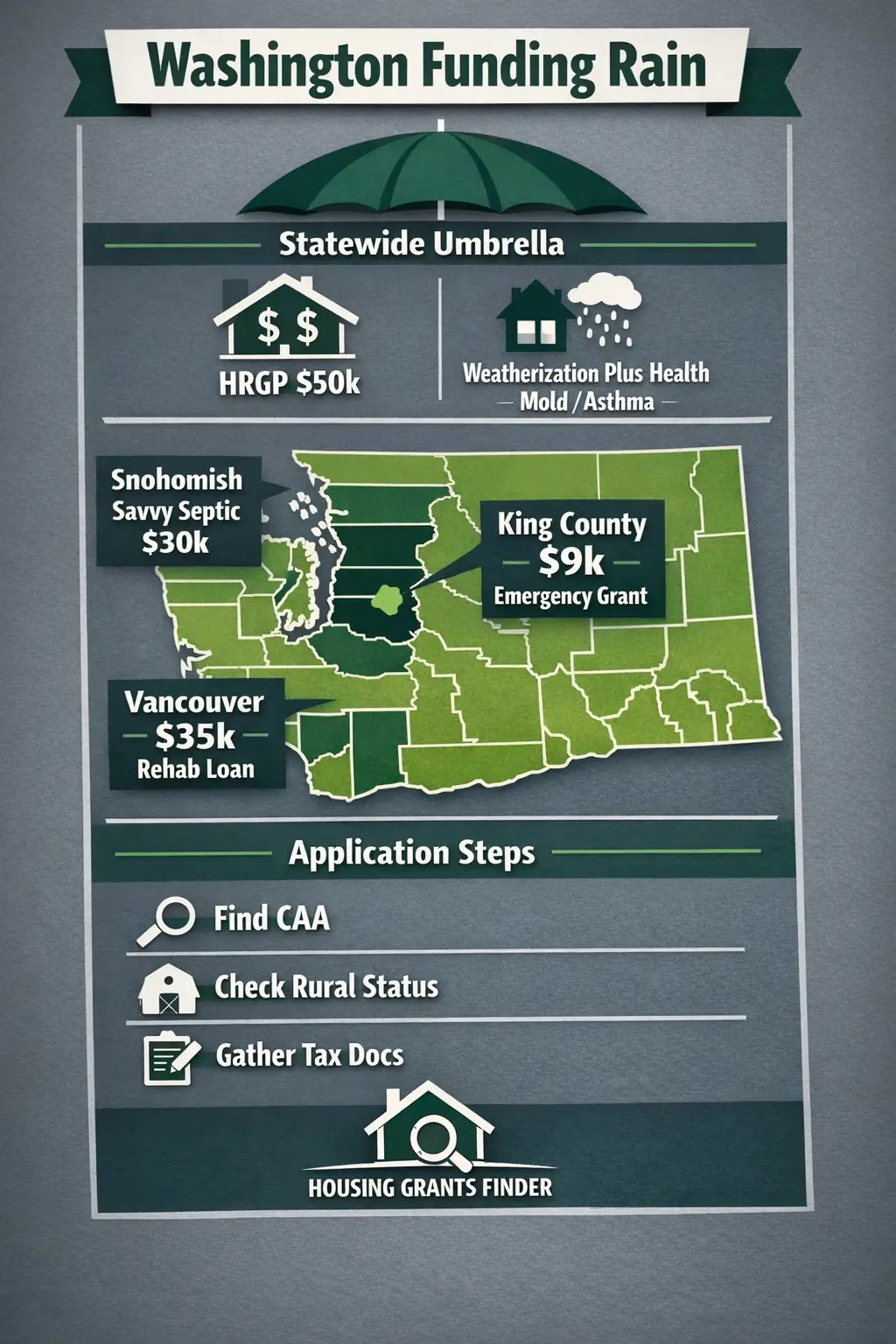
For homeowners inside the City of Vancouver, the Housing Rehabilitation Program offers 2% simple interest loans up to $35,000 for eligible basic home repairs. Payments are generally deferred until the home is sold, and households must be at or below 80% of Vancouver’s Area Median Income. Clark County homeowners outside Vancouver should verify whether a separate county or nonprofit program serves their address.
- The Catch: You don’t make monthly payments, but you must pay it back when you sell the house.
- Link: Vancouver Housing Rehabilitation Program
Best Washington Repair Options for Seniors
Older homeowners often have the strongest case for Washington repair assistance, especially when the issue affects safe occupancy, mobility, or indoor air quality.
- HRGP: Strong fit for seniors in eligible rural areas needing major health and safety repairs.
- Weatherization Plus Health: Helpful when mold, moisture, poor ventilation, or respiratory triggers are making the home unhealthy.
- USDA Section 504: Best known rural federal option for older homeowners age 62 and up who may qualify for grant help. See our full USDA Section 504 guide.
Federal, Veteran, & Tribal Assistance
USDA Section 504 Rural Repair
USDA Section 504 may help very-low-income rural homeowners repair, improve, or modernize a home, or remove health and safety hazards. Eligible homeowners age 62+ may qualify for grant help up to $10,000, while eligible homeowners may also qualify for a $40,000 loan at 1% fixed interest over 20 years. Disaster-area rules may allow a higher grant cap in limited cases.
- Warning: The rural boundary is strict. Check the map before you spend hours on the paperwork. (See our USDA 504 guide).
- Link: USDA Washington Section 504
Veterans Specially Adapted Housing (SAH)
For FY 2026, eligible veterans may qualify for a Specially Adapted Housing (SAH) grant of up to $126,526 for qualifying disability-related housing modifications. You must meet VA ownership and service-connected disability rules, and processing can take time, so start early if accessibility work is needed.
Tribal Housing Improvement Program (HIP)
Eligible members of federally recognized Tribes may be able to check the BIA Housing Improvement Program or their tribal housing office for repair, renovation, or replacement help. HIP is needs-based and is generally for households with no immediate resource for standard housing. If repair costs exceed program limits, the housing office may recommend replacement or another housing source instead of approving a repair grant.
How to Apply: 3 Essential Steps
- Find your local agency: Washington Commerce does not weatherize homes directly or approve every repair from one statewide intake form. Start with the local Weatherization or rehabilitation agency that serves your address. Find your Commerce Weatherization agency.
- Verify rural eligibility: Use the USDA eligibility map before applying for USDA Section 504 or rural-focused help. If your address is not rural, check county, city, weatherization, and nonprofit repair options first.
- Gather documents early: Most programs may ask for proof of ownership, photo ID, income records, benefit letters, tax returns, insurance if required, utility bills, repair photos, contractor notes, or inspection details. Before signing repair paperwork, review our contractor fraud guide.
FAQs
Are there Washington home repair grants for roof replacement?
Possibly. Roof help may be available through HRGP, county repair programs, King County Housing Repair, USDA Section 504, or local nonprofit programs. Approval depends on income, location, ownership, repair urgency, inspection results, and current funding.
Can I get help with mold or moisture problems in Washington?
Weatherization Plus Health may help when moisture, mold, ventilation, asthma, COPD, or indoor air quality issues are connected to the home. A local agency usually reviews income, health risk, and home conditions before deciding what work is eligible.
Can I get help with a failing septic system?
Snohomish County’s Savvy Septic program lists loans, rebates, grants for low-income homeowners, workshops, and other incentives. Other counties may have different septic or environmental health programs, so verify with your county before assuming a grant is available.
Why do Washington repair applications get rejected?
Common problems include missing income documents, ownership or title issues, living outside the service area, applying when intake is closed, repair work that does not meet program rules, or funding running out before approval.
Do I have to repay Washington home repair assistance?
It depends on the program. Some help may be a grant, some may be a deferred loan, and some may have repayment rules if the home is sold. USDA Section 504 grants generally must be repaid if the property is sold in less than 3 years.
Are there Washington home repair grants for seniors?
Seniors may qualify through HRGP, Weatherization Plus Health, county repair programs, USDA Section 504 if rural and very-low-income, VA grants if eligible, or local nonprofit repair programs. Priority depends on the program and funding.
Conclusion
Washington home repair help in 2026 works best when you match the repair problem to the right program. HRGP is strongest for eligible rural homeowners, Weatherization Plus Health is the best fit for mold, moisture, and health-related issues, and county programs may be the better option if you live outside the rural HRGP service area.
Start by identifying whether your address is rural, then contact the local agency or county program that actually serves your area. Have your tax return, benefit letters, proof of ownership, and repair details ready before intake opens.