Michigan Home Repair Grants 2026: SER, Revive & USDA
Michigan homeowners may be able to get help with serious repair needs such as furnace failure, unsafe septic systems, water heaters, roof damage, insulation problems, windows, lead hazards, accessibility needs, and rural health or safety repairs. The right program depends on your city or county, income, ownership status, repair type, funding availability, and whether the work is approved before it starts.
For 2026, the main Michigan repair paths to check are MDHHS State Emergency Relief for urgent health and safety repairs, Weatherization for energy-related work, Revive Home Repair Grant through participating FHLBank Indianapolis member institutions, USDA Section 504 for eligible rural homeowners, Detroit local repair programs, Habitat repair partners, and Michigan Saves financing when grants are not available.
Quick Answer: Who can get Michigan home repair help?
Michigan homeowners may qualify for repair help through State Emergency Relief, Weatherization, Revive, USDA Section 504, Detroit repair programs, Habitat, veteran programs, or Michigan Saves financing. There is not one single statewide grant that pays for every repair.
- Furnace, water heater, septic, or immediate safety issue: Start with MDHHS State Emergency Relief through MI Bridges.
- High heating bills, poor insulation, or furnace efficiency: Check Weatherization through your local Community Action Agency.
- Roofs, windows, siding, accessibility, or deferred maintenance: Ask a participating FHLBank Indianapolis member institution about Revive.
- Rural senior or very-low-income repair: Check USDA Section 504 Michigan.
- Detroit major repairs: Compare Detroit 0% loans and lead-safe housing programs.
- When grants are full: Michigan Saves may be a financing option, not a grant.
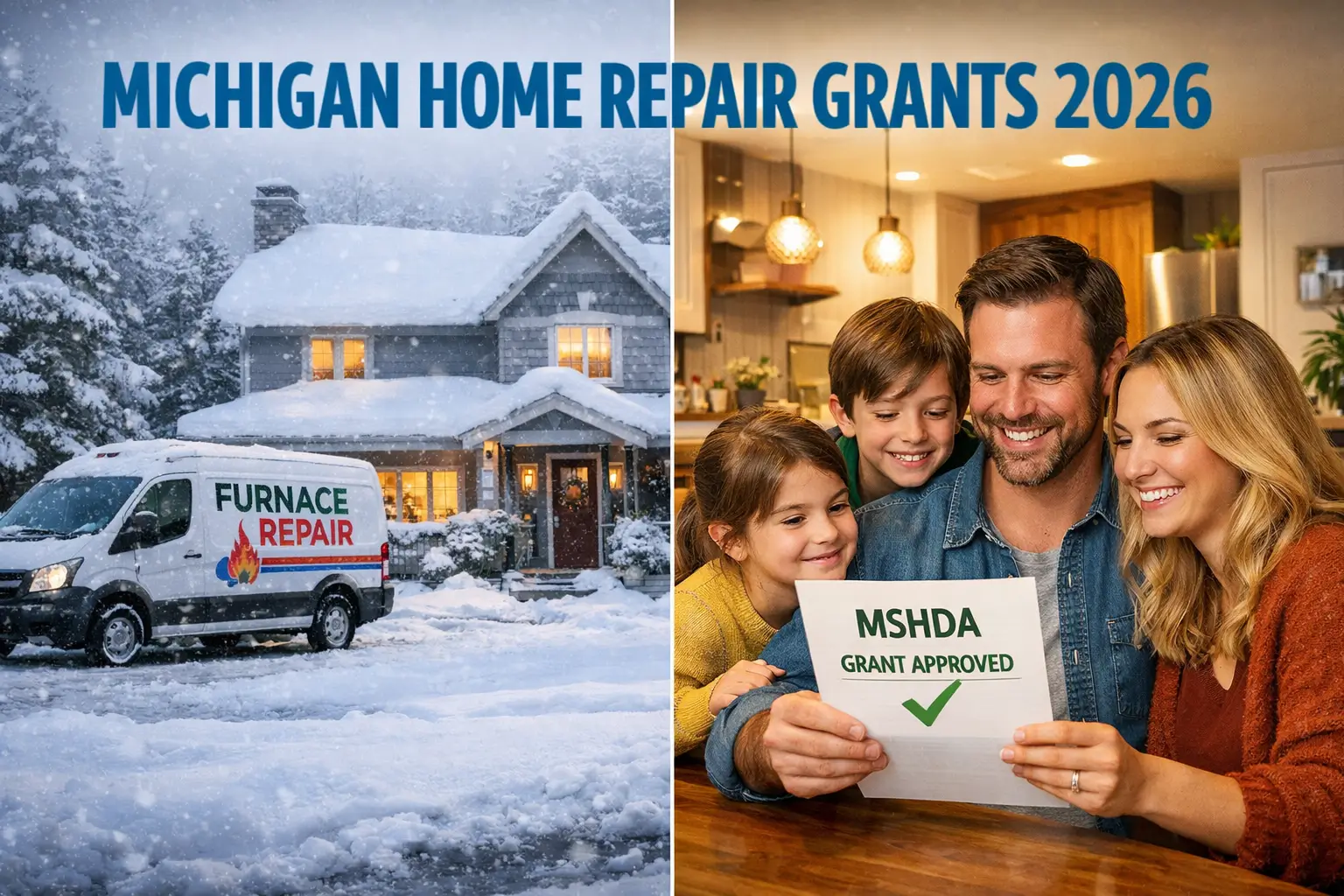
MSHDA MI-HOPE Status: Closed to New Public Applications
The MI-HOPE program should now be treated as a closed or existing-applicant status section, not a fresh application path. MSHDA says the online applicant portal is closed to the general public and program funds were expected to be expended before April 30, 2026.
⚠️ Status Update:
- The MSHDA MI-HOPE online applicant portal is currently closed to the general public. All funds will be expended before April 30, 2026.
- Existing Applications: If you have an active application, you must work directly with your local community agency subrecipient to ensure all construction and billing are finalized before the April deadline.
Scope: This funding is strictly for energy-related exterior repairs (roofs, furnaces, heat pumps, and windows) intended to lower utility costs. (See energy grant options).
Official Link: MSHDA MI-HOPE Program Status
Revive Home Repair Grant Through Member Banks
Unlike a state-run homeowner portal, Revive – Home Repair Grant is an annual program accessed through participating member financial institutions connected to the Federal Home Loan Bank of Indianapolis.
- 2026 round: opens on May 28.
- Income rule: total household income must be at or below 80% of Area Median Income (AMI).
- Ownership rule: you must own and occupy your primary residence.
- Payment rule: you must be paid as agreed on your mortgage and property tax obligations.
- How to access it: homeowners do not go directly to FHLBank Indianapolis. You must work through a participating member institution.
Official Link: Revive – Home Repair Grant
Michigan Saves: When Grants Are Full
When grant money is gone or the repair is too large for SER, Michigan Saves may be a backup financing option. It is not a grant and should not be described as free repair money. Terms, loan amount, eligible work, contractor rules, and approval depend on the lender and program track.
- Common eligible work: roofing tied to energy improvements, remediation, HVAC, insulation, water heaters, and other qualifying home energy upgrades.
- How to start: first find a Michigan Saves authorized contractor, then apply for financing with that contractor’s ID number.
- Important rule: owner-occupied homes qualify, but land-contract occupants are not eligible for Michigan Saves financing.
- Good companion read: if you want to understand the difference between grants, deferred help, and repayable programs, see when home repair grants have to be paid back.
Before accepting a loan, deferred repair award, or forgivable assistance, read our guide on when home repair grants have to be paid back.
The Emergency Lifeline: MDHHS State Emergency Relief (SER)
For Michigan homeowners facing immediate health or safety problems, MDHHS State Emergency Relief (SER) may help with essential repairs that restore the home to a safe, livable condition. It does not pay for upgrades, cosmetic work, or nonessential repairs.
Lifetime Maximums:
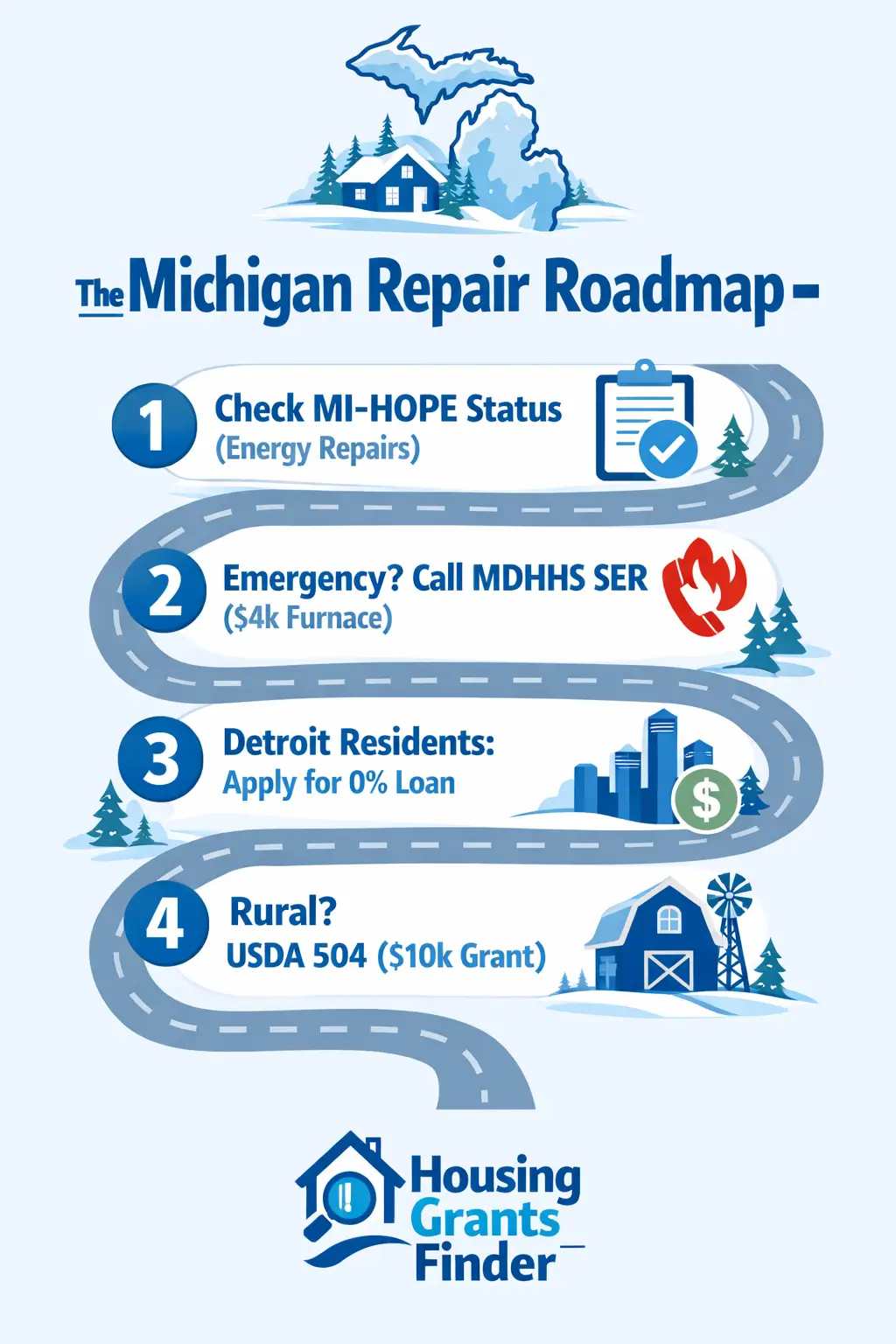
- Furnace Repairs/Replacement: $4,000 lifetime limit (energy-related). (Read about emergency furnace repair).
- Non-Energy Repairs: $1,500 lifetime limit (water heaters, septic systems, or plumbing).
For step-by-step emergency heating help, also read our LIHEAP emergency furnace repair guide.
Eligibility Tip: SER is income-based and asset-based. You must provide proof that your household income meets the low-income criteria and that your repair is necessary to remove an immediate hazard.
Official Link: MDHHS SER Home Repair Guide
Michigan Weatherization Assistance Program
If your home is losing heat fast, your furnace is inefficient, or your utility bills are crushing your budget, Michigan’s Weatherization Assistance Program is one of the most practical statewide options. It is not a general remodeling program. It is a no-cost energy and health-and-safety service delivered through local Community Action Agencies.
- What it can include: insulation, air sealing, furnace evaluation, ventilation-related improvements, and other whole-home energy upgrades based on an energy audit.
- How it works: no single service is guaranteed. The agency decides what makes the home more energy efficient after the inspection.
- Best fit: low-income homeowners dealing with high utility bills, weak heating performance, poor insulation, or related health and safety problems.
- Related help: if the immediate issue is a heating emergency, also review our emergency furnace repair guide.
If your repair involves old windows, doors, air leaks, or insulation, compare this with our window and door replacement grants guide.
Detroit & Wayne County: Specialized City Funds
Detroit residents have access to localized funding models that often run alongside state programs.
Detroit 0% Interest Loan
This is a 10-year, zero-interest loan ranging from $5,000 to $25,000. Because it is a loan rather than a grant, the “bucket” of money is often more stable and available than purely grant-based programs.
Detroit LeadSafe Housing
Provides lead hazard removal. Requires a pregnant woman or a child under 6 living in the home. Includes lead inspections and remediation, such as window and door replacement.
Rural Help: USDA Section 504
For eligible rural residents, the USDA offers the Single Family Housing Repair program.
- The Grant: Up to $10,000 (lifetime maximum) for homeowners age 62+ to remove health and safety hazards. (Check senior eligibility).
- The Loan: Up to $40,000 at a fixed 1% interest rate for up to 20 years. (See USDA guide).
- Geography: Eligibility is determined by the property’s “rural area” status, which can include communities with up to 35,000 residents.
Older rural homeowners should also review our home repair grants for seniors guide.
Official Link: USDA Section 504 Home Repair Program
Habitat for Humanity: The Sweat Equity Option
Habitat for Humanity Michigan is active in almost every county, providing critical home repairs and preservation services.
How it works: They often use a sliding scale for repayment. If you are very low-income, they might only ask you to pay for the materials at cost. You may also be asked to help with the work. This is called sweat equity.
Official Link: Habitat for Humanity Michigan Repair Portal
Veteran Specific Resources
If you are a veteran, you have a separate pot of money available that most civilian programs won’t mention.
- HISA Grant: The Home Improvements and Structural Alterations grant from the VA provides funding for veterans to make medically necessary home modifications.
- Michigan Veterans Trust Fund: This provides emergency financial assistance for critical home repairs during a temporary crisis.
- Adapted Housing Grants: Specifically for disabled veterans who need to modify their homes for accessibility. (Learn about bathroom grants).
6 Quick Tips for 2026 Approval
- Check Your PIN: Have your property tax ID (PIN) ready so agencies can pull your records instantly.
- Record the Contract: If you are buying on a land contract, ensure it is recorded with the Register of Deeds.
- Scan Your Utility Bill: Agencies need to see that your utility bill (DTE or Consumers) is in your name to prove residency.
- Audit Your Deed: Ensure the deed is in your name, not a deceased relative’s, to avoid the Heir Property trap.
- Pay Your Property Taxes: Even a small unpaid balance can stall your grant. Make sure your taxes are marked Paid before you hit submit.
- Stack Your Funds: Tell your agency worker that you are also applying for Weatherization because they often work together to cover the total cost.
How to Apply for Michigan Home Repair Help
- Start with the right program type: SER for immediate health and safety threats, Weatherization for whole-home energy efficiency, Detroit city programs for local major repairs, USDA Section 504 for rural owners, and Michigan Saves when you need financing instead of a grant.
- Use local operators first: in Michigan, the real intake point is often a city office, Community Action Agency, MDHHS path, or participating bank rather than a single statewide grant portal.
- Get your documents ready: deed, tax ID, utility bill, proof of income, and ownership records are the basics most programs want before they move forward.
- Fix ownership issues early: if you are on a land contract or the deed is still in a deceased relative’s name, resolve that first because many applications stall there.
- Keep contractor risk low: if anyone asks for large upfront money or claims they can “unlock” a grant for a fee, review our home repair scam guide before signing anything.
FAQs
Is MI-HOPE still open for Michigan homeowners?
No. MSHDA says the MI-HOPE online applicant portal is closed to the general public. Keep MI-HOPE in this guide for status and existing-applicant context, but send new applicants to SER, Weatherization, Revive, USDA, Detroit programs, Habitat, or Michigan Saves instead.
Can Michigan SER help with furnace repair?
Yes, State Emergency Relief may help with essential furnace repair or replacement when it removes a direct health or safety threat. MDHHS lists a lifetime maximum of $4,000 for energy-related furnace repairs.
Does Michigan give grants for septic systems or water heaters?
Possibly, but limits are tight. MDHHS lists a lifetime maximum of $1,500 for non-energy home repairs such as water heaters and septic systems. Larger rural repair needs may fit USDA Section 504 better.
Can homeowners apply directly for the Revive Home Repair Grant?
No. FHLBank Indianapolis does not work directly with households. Homeowners must work through a participating member financial institution, and eligibility depends on income, owner-occupancy, mortgage status, property tax status, and the participating institution’s process.
Can I use MI-HOPE to fix my kitchen?
No. MI-HOPE was focused on energy-related repairs and housing stability, not cosmetic kitchen remodeling. Since the portal is closed to the general public, new applicants should look at other programs.
I’m buying on a land contract; can I get repair help?
It depends on the program. Some programs may accept a recorded land contract or purchaser-of-record proof, while others require deed ownership. Michigan Saves says land-contract occupants are not eligible for its financing, so verify ownership rules before applying.
What if the repair costs more than the SER limit?
If a repair costs more than the SER limit, the agency may review how the remaining balance will be paid. You may need another program, a local nonprofit, USDA Section 504, Revive, Habitat, Michigan Saves financing, or documented gap funding.
Conclusion
Michigan home repair help in 2026 is strongest when you match the problem to the correct intake path. SER is for immediate threats, Weatherization helps with whole-home energy and health-safety issues, Detroit’s 0% loan covers major city repairs, USDA Section 504 remains a strong rural option, and Michigan Saves is the fallback when grant funds are gone.
The smartest move is to start locally, gather your ownership and income documents now, and choose the program that matches your real repair problem instead of waiting on a statewide portal that may never reopen.