North Carolina Home Repair Grants 2026: URP, USDA, ReNew
North Carolina homeowners may be able to get help through URP, ESFRLP, ReNew NC, Weatherization, USDA Section 504, and local Council of Government repair programs. The best option usually depends on whether the problem is urgent, storm-related, energy-related, rural, or tied to a major health and safety repair.
This guide covers the main North Carolina home repair grants and repair assistance options for low-income homeowners, seniors, disabled residents, rural households, and families recovering from storm damage. If you are comparing repair help in NC, start by matching your situation to the right program below.
Start Here: URP, ESFRLP, ReNew NC, Weatherization, or USDA?
Most homeowners lose time by applying to the wrong program first. In North Carolina, the right starting point depends on the repair problem.
- Immediate safety issue: Start with URP if the home has one or two urgent hazards, such as a failing ramp, unsafe wiring, a roof leak, or a septic issue that threatens health.
- Major system failure: Start with ESFRLP if the house needs larger rehabilitation, such as roof, HVAC, electrical, plumbing, or structural work.
- Helene-related damage: Start with ReNew NC if the home was your primary residence when Hurricane Helene hit and your county or ZIP code qualifies.
- High bills or energy loss: Start with Weatherization, but remember that unsafe systems may need repair before weatherization can begin.
- Rural health and safety repair: Start with USDA Section 504 if you are in an eligible rural area and the repair affects safety or habitability.
Who Qualifies for North Carolina Home Repair Grants?
Most North Carolina repair programs use the same core filters before approving an application.
- Owner-occupancy: You usually need to own and live in the home as your primary residence.
- Income limits: URP is usually stricter, while ESFRLP allows higher income limits in many cases.
- Repair type: The strongest applications involve health, safety, accessibility, storm damage, septic failure, roof leaks, heating or cooling problems, or structural hazards.
- Clear ownership: Heir property, unclear deeds, liens, or title issues can stop the file before inspection.
- Local partner capacity: Your county or Council of Government may have different funding, waitlists, and priority rules than a nearby county.
Reasons Why Applications Get Rejected Immediately
Before you spend a single minute on a portal, check these three facts. These are the stop signs that local NCHFA partners use to filter out files.
1. The Owner-Occupied Wall
You must own the home and use it as your primary residence. ReNew NC ties eligibility to the house being your primary residence at the exact time Hurricane Helene hit on September 27, 2024.
- Note: If you bought a storm-damaged home after the storm as an investment, you are 100% ineligible for disaster grants.
2. Income Rules are Not Flexible
North Carolina programs use Area Median Income (AMI).
- URP: Households cannot exceed 50% of AMI. In high-demand counties, they often prioritize people at 30% AMI first.
- ESFRLP: Allows up to 80% AMI.
- Pro Tip: Don’t guess your AMI. Check the 2026 NCHFA Income Chart for your specific county.
3. The Heir Property Stop Sign
A lack of proof of ownership is the reason files are closed. If the deed is still in a late parent’s name, you are in an Heir Property trap. You must clear the title before the 2026 funding windows close. Local agencies won’t touch a house unless they’re 100% sure who legally owns it.
Urgent Repair Program (URP)
URP is for homes that are dangerous but still salvageable, the kind of problems that push a family toward displacement. It moves faster than big rehab programs because it isn’t trying to rebuild the whole house. URP27 is the specific 2026–2027 funding cycle run by the North Carolina Housing Finance Agency (NCHFA).
What URP Actually Fixes
The goal is to remove threats to life or safety.
- Life-Safety Hazards: Electrical hazards that could start a fire, failing ramps for seniors, or roof failures letting water into the living room. (See senior repair options).
- Accessibility: Modifications to bathrooms (grab bars, walk-in tubs) to keep seniors in their homes. (Read about bathroom grants here).
- The Limit: It’s about one or two critical repairs, not a total makeover.
The Money and the Catch
URP provides deferred, forgiven loans up to $15,000. Many homeowners hear about grants, but URP is often an interest-free loan that is forgiven over time, typically $5,000 per year.
- Note: If you sell the home before the 3-year term is up, you will likely have to pay a proportion of that money back to the state from your home’s equity.
- Official website: NCHFA Urgent Repair Program
Essential Single-Family Rehabilitation Loan Pool: ESFRLP
The Essential Single-Family Rehabilitation Loan Pool is for homes where a quick fix isn’t enough. We are talking complete wiring, plumbing, foundation lifts, and significant structural rehabilitation.
The Forgivable Loan Structure
This is a 0% interest deferred loan secured on the property. No monthly payment means no paperwork.
How Big Can the Help Be?
County programs vary, but some local partners in 2026 are providing deferred or forgiven loans up to $70,000, depending on specific county caps and the severity of the home’s condition.
Target Requirements:
To qualify, your household must be at or below 80% AMI and have at least one member who is:
- Elderly (62+), Disabled, or a Veteran.
- A child under 6 who is at risk of lead poisoning.
- Official Website: NCHFA Single-Family Rehab Pool
The URGENT Deadline: ReNew NC (Hurricane Helene)
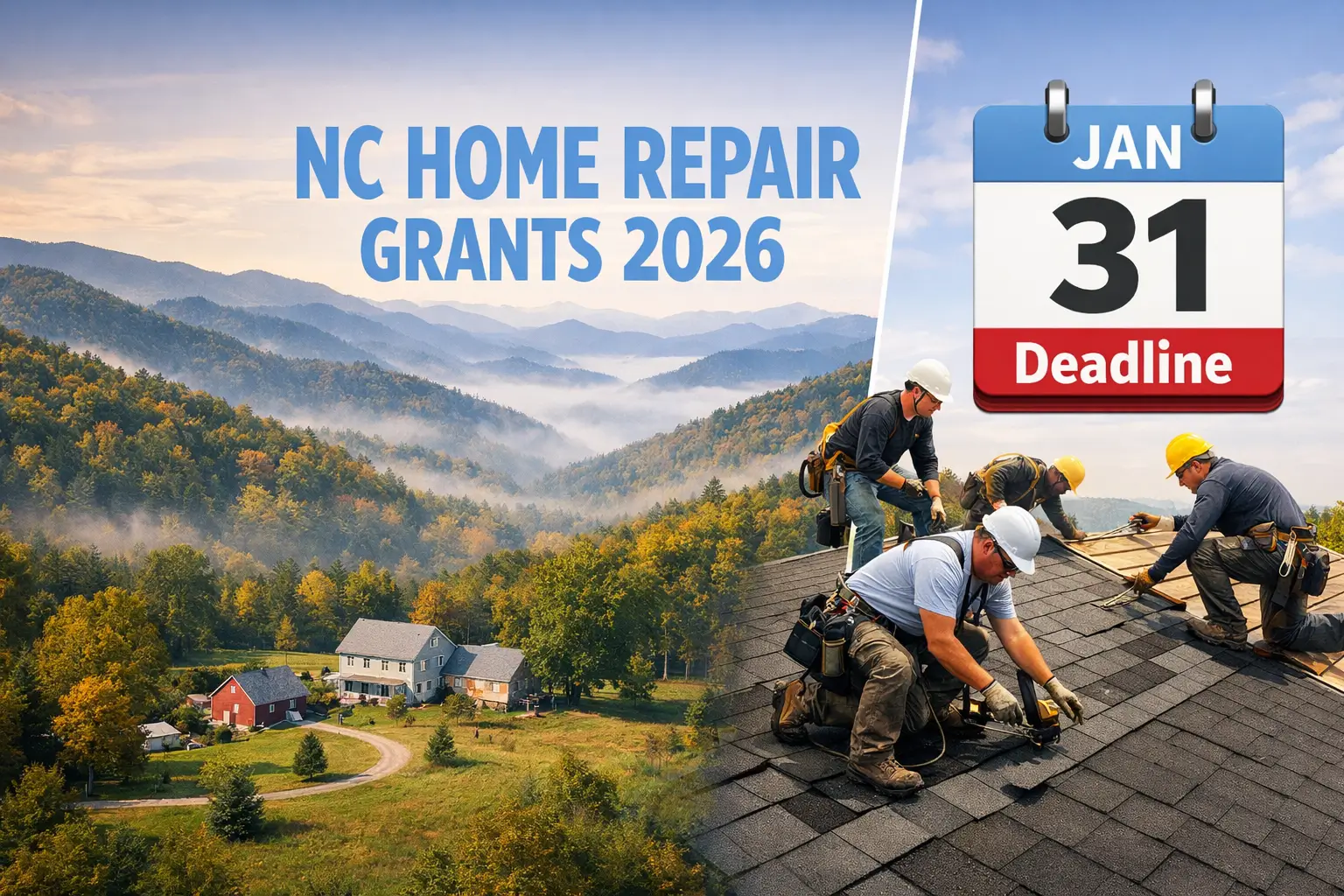
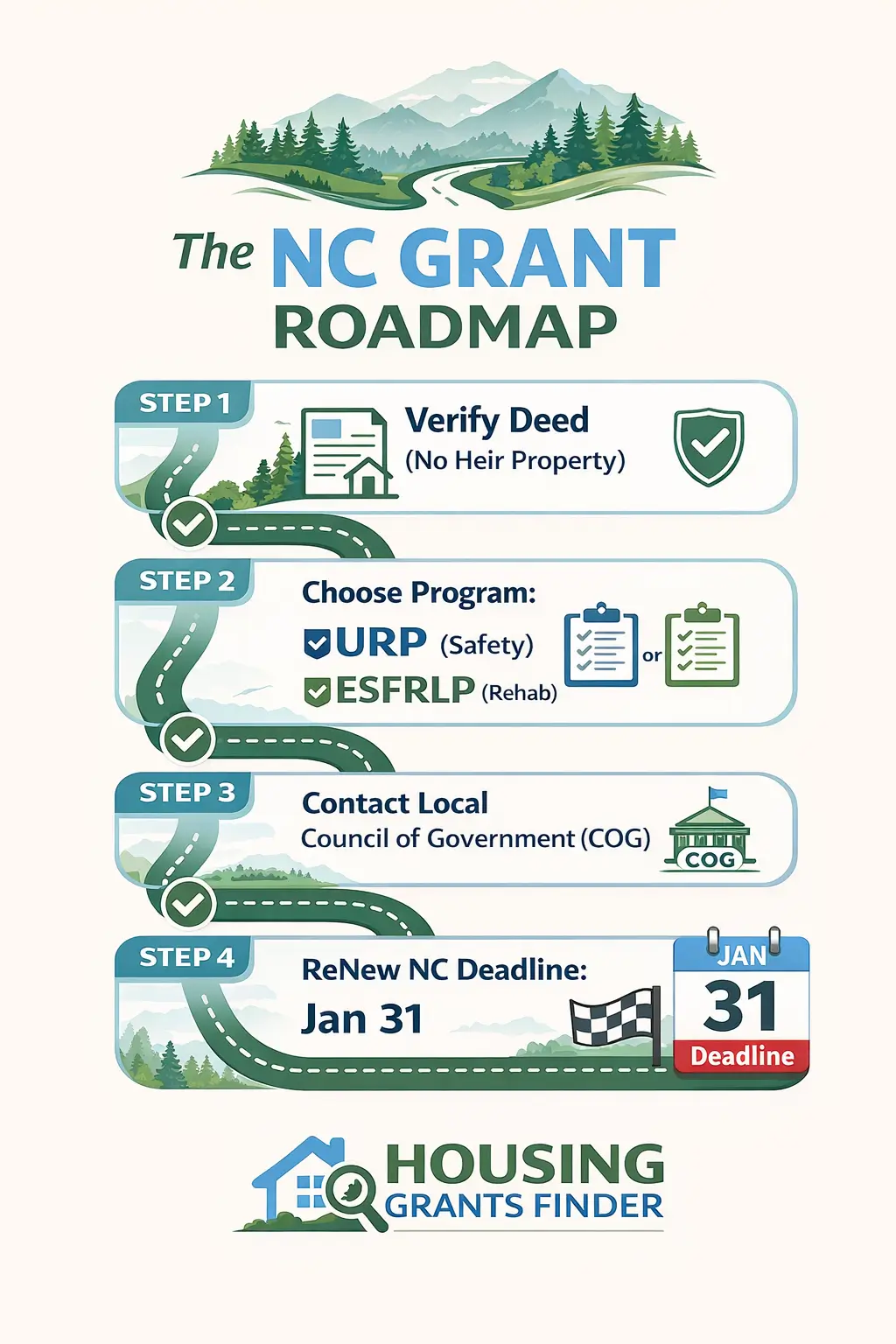
ReNew NC is the state’s massive recovery effort for 29 counties plus Mecklenburg ZIP 28214. The deadline to apply is January 31, 2026. Do not assume it will be extended. (For federal options, see our disaster recovery guide).
Who Qualifies, in Plain Terms?
You must have owned the home on September 27, 2024, when Helene hit.
- The Primary Test: Vacation homes, second homes, and rentals are a No.
- Assistance Limits: Up to $50,000 for home rehabilitation and up to $450,000 for total reconstruction.
The Paperwork that Trips People
- Primary Residence Proof: They want a FEMA IA award letter, utility bills, or insurance docs.
- The ROE: They require a Right of Entry (ROE) permit to walk on your property to inspect the damage legally. If you don’t sign this, your file won’t go anywhere.
Things to Keep in Mind
- Contractor Shock: Homeowners do not select their contractors. The program manages the construction on your behalf. This is a shock to people who wanted to use a specific local builder.
- The Repayment Note: ReNew NC uses a 3-year unsecured, forgivable promissory note. If you sell the home before the 3-year mark, you may have to pay it back.
- Official Portal: Apply.RenewNC.org
Help for Seniors, Disability Access, and Bathroom Safety
North Carolina repair programs often move faster when the work is tied to aging in place, fall prevention, disability access, or life-safety risks.
- Seniors: URP, ESFRLP, and USDA Section 504 are all stronger fits when the homeowner is older and the repair affects safety.
- Disability access: Ramps, safer bathrooms, grab bars, and widened access should be framed as accessibility needs, not cosmetic upgrades.
- Bathroom safety: If the real issue is a safer shower, fall risk, or mobility support, compare related options here: grants for walk-in tubs and bathroom safety.
- Senior repair options: You can also compare broader age-based help here: home repair grants for seniors.
If Your Problem is High Bills: Weatherization (WAP)
Weatherization helps with efficiency, but it has rules that can block you. In the 2026 plan, if your heating system is unsafe or nonfunctional, it must be repaired first; otherwise, the home will be deferred.
- The Trap: Deferred means you get zero help until you fix the bigger safety issues. If you don’t have the cash for a new furnace, you are stuck in a loop. You need a URP grant to fix the safety issue so the Weatherization grant can start.
- Income Limit: Usually 200% of the Federal Poverty Level.
- Official Link: NC DEQ Weatherization Agency Map
Rural North Carolina: USDA Section 504
If you are in a rural area like Wilkes, Sampson, or Robeson counties, this is one of the safest paths.
- The Terms: Loans up to $40,000 at 1% fixed interest for 20 years.
- The Grant (Age 62+): Lifetime limit of $10,000.
- Disaster Provision: If your county is a declared disaster area, the grant limits can sometimes be higher, and requirements may be streamlined.
- Apply Now: USDA Rural Repair NC
Fast Track Your Approval: 6 Quick Tips for 2026
Success in the North Carolina grant system isn’t about luck; it’s about preparation. Use this checklist to move your file to the top of the pile.
- Check Your Deed Today: If the home isn’t legally in your name (Heir Property), the state won’t touch it. Fix the paperwork before the funding window opens.
- The Receipts Rule: If FEMA or insurance gave you money for Helene, you must show exactly where that cash went. If you don’t have receipts, your grant will be cut by that amount.
- Scan Everything Now: Have your 2024 tax returns, ID, and utility bills scanned as PDFs on your phone. Uploading them instantly beats waiting for the mail.
- Call the COG: Don’t just apply online. Call your local Council of Government (COG) and ask for the Housing Manager. A 5-minute polite conversation can save you 5 months of waiting.
- Highlight Life-Safety: If your roof leaks, say it’s causing mold. If your floor is soft, say it’s a fall hazard. Use safety words to get priority.
- Apply on Tuesday: Most people flood the system on Monday mornings. Apply on Tuesday or Wednesday afternoon to avoid website crashes and lag.
Know What You’re Signing: Grants vs Forgivable Loans in NC
Many North Carolina repair programs are described as grants, but the paperwork may be a deferred, forgiven, or forgivable loan. That does not mean it is bad, but you need to know the rules before signing.
- URP: Often works like a deferred loan that is forgiven over time if you stay in the home.
- ESFRLP: Usually uses a recorded Deed of Trust and no monthly payment, but the lien structure matters if you sell or transfer the home.
- ReNew NC: May use a forgivable note tied to continued ownership and occupancy.
- USDA Section 504: The grant side is for eligible seniors, while the loan side must still be repaid.
For a broader repayment breakdown, see pay back home repair grants.
FAQs
Is the ReNew NC deadline really January 31, 2026?
Yes. State officials have stated that they need to close the intake to begin the massive construction phase. While some disaster deadlines are extended, you should treat this date as final. Apply online by midnight on the 31st to be safe.
Can I use a grant to fix my septic tank in North Carolina?
Yes, but you have to pick the right program. Weatherization will NOT fix a septic tank. You need ESFRLP or URP. If the septic failure poses an immediate health hazard, lead with that in your URP application to request Life-Safety priority.
Why did my neighbor get a grant for a new roof, but I was told I’m on a 2-year waitlist?
North Carolina funding is managed by local Councils of Government (COGs). One COG may have more capacity or funding remaining than another. Also, if your neighbor is a Veteran or 80+ years old, they may have a higher priority score than you under state rules. (Learn more about roof grants).
What is the VOARD grant I keep seeing in the news?
The VOARD Grant ($16M fund) is for volunteer groups. If you are working with a group like Baptists on Mission or Habitat, they might be using VOARD money to fix your home for free. You don’t apply to VOARD; you apply to the nonprofit. (Be ware of scams).
My AC is out, and I live in Eastern NC. Is this an emergency?
Under the 2026 Weatherization plan, a non-functioning primary cooling system is a “Health and Safety” issue. However, you will often need a doctor’s note stating that the lack of AC is life-threatening due to a medical condition to get priority. (See AC grant guide).
Can I get a grant if I still owe money on my mortgage?
Yes. Having a mortgage doesn’t stop you from getting a grant. However, you cannot have any liens or judgments that would prevent the state from recording its Deed of Trust.
Conclusion
North Carolina home repair help works best when you choose the right program first. Use URP for urgent life-safety repairs, ESFRLP for larger rehabilitation, ReNew NC for eligible Helene damage, Weatherization for energy-related work, and USDA Section 504 for rural health and safety repairs.
Before applying, check your deed, confirm your AMI, gather photos and receipts, and call your local Council of Government or program partner instead of relying only on online forms. For broader options, visit housinggrantsfinder.com.