Vermont Home Repair Grants and Loans: 2026 Guide
Mud season in the Green Mountains doesn’t just test your tires; it tests your foundation. Whether you are dealing with the structural aftermath of recent flood cycles in Washington County or trying to keep a 19th-century farmhouse from leaking heat in the Northeast Kingdom, maintaining a home here takes serious grit.
In 2026, the funding landscape has shifted. Some one-time federal funding is winding down, while Vermont continues to use disaster-recovery housing funds and current weatherization incentives. At the same time, some repair programs have limited or closed application windows, so homeowners need to check current intake before committing to a project.
This guide identifies the major verified doors you can knock on to help fund your roof, kitchen, furnace, accessibility, septic, mobile home, or flood repairs this year.
Quick Answer: Vermont homeowners may find repair assistance through regional home-repair organizations, USDA Section 504, Weatherization, Efficiency Vermont, Community Action Agencies, Healthy & Lead-Safe Homes, VCIL accessibility assistance, and disaster programs. Help may be a grant, low-cost loan, forgivable loan, rebate, or direct service.
Current 2026 note: MHIR is currently closed to new applications, while USDA’s separate Single Family Housing Disaster Assistance Fund is accepting qualifying applications for processing through September 30, 2026. Funding and eligibility still depend on the responsible agency.
The Flood Recovery Lane: CDBG-DR Round 3
If your home was caught in the catastrophic flooding of the last few years, the Community Development Block Grant – Disaster Recovery (CDBG-DR) program is an important part of Vermont’s recovery system in 2026.
One important distinction: CDBG-DR Round 3 should not be treated as a direct cash-grant application for an individual homeowner. The state awards CDBG-DR money to eligible housing, infrastructure, planning, and community recovery projects. Homeowners may benefit through projects or programs created with those funds, while direct household repair help may come through other programs.
- The Help: CDBG-DR projects may support housing rehabilitation, flood resilience, infrastructure, reconstruction, and other approved recovery work.
- 2026 Update: Vermont continues to make CDBG-DR awards and operate additional funding rounds. Check the ACCD portal for the current project-level application status.
- Priority Areas: Washington and Lamoille counties are federally identified Most Impacted and Distressed areas, with additional Vermont-identified disaster areas included in the broader recovery plan.
- Homeowner Action: Ask your town, regional housing organization, or recovery administrator whether a CDBG-DR-funded program currently serves individual properties in your community.
Official Portal: Vermont Agency of Commerce and Community Development Disaster Recovery
For FEMA, HUD, insurance, and other post-disaster options, read our FEMA and HUD disaster recovery assistance guide.
A Direct 2026 Disaster Option: USDA Disaster Assistance Fund
For qualifying homeowners, the USDA Single Family Housing Disaster Assistance Fund is a more direct repair path than CDBG-DR. USDA currently lists the application window as open for processing through September 30, 2026.
- Maximum grant: Up to $32,420.
- Who it serves: Qualifying very-low- and low-income homeowners whose homes were damaged by an eligible declared disaster.
- Location: The property generally must be in an eligible rural area.
- Covered costs: Approved disaster-related home repair expenses, site preparation, and certain manufactured-home moving expenses.
This assistance cannot duplicate insurance or another benefit paying for the same repair. Check the current eligible-disaster list before relying on this program.
Official Link: USDA Single Family Housing Disaster Assistance Fund
The Whole-House Fix: Regional Home Repair Organizations
Vermont doesn’t have a single statewide repair office. Instead, your location helps determine which regional housing organization may offer or refer you to financing for a new roof, failed heating system, structural problem, accessibility modification, or other essential repair.
- The Benefit: Terms vary. Depending on the organization and funding source, help may include low-cost loans, low-interest rehabilitation loans, grants, or a combination of assistance. Do not assume every regional program is a 0% deferred loan.
- Regional Contacts:
- Champlain Housing Trust: Chittenden, Franklin, and Grand Isle areas. Current funding restrictions can vary by location.
- NeighborWorks of Western Vermont: Contact the organization for current western Vermont home-repair coverage.
- Windham & Windsor Housing Trust: Windham and Windsor counties.
- Downstreet: Washington, Orange, and Lamoille counties through Green Mountain Home Repair.
- RuralEdge: Caledonia, Essex, and Orleans counties in the Northeast Kingdom.
These programs commonly focus on health, safety, structural, electrical, heating, plumbing, roof, septic, accessibility, and energy-efficiency repairs rather than cosmetic remodeling.
If your main problem is an unsafe breaker panel, outdated circuits, or another electrical hazard, see our electrical rewiring grants and repair help guide.
Before accepting financing secured by your property, understand when home repair assistance may need to be paid back.
The Mobile Home Lifeline: MHIR Program
The Manufactured Home Improvement and Repair Program (MHIR) remains an important Vermont resource for residents of registered manufactured-home parks, but its current application status matters.
- Foundation Help: Eligible foundation awards can provide up to $15,000 for a new permanent foundation or HUD-approved slab and related eligible costs on a vacant lot.
- Home Repair Awards: Tier 1 awards can provide up to $5,000. Awards above $5,000 are limited and require additional review under current program rules.
- Repairs Covered: Eligible uses may include roofs, heating systems, walls, ceilings, siding, skirting, plumbing, accessibility work, electrical safety corrections, and preparation for Weatherization.
- Important: MHIR does not pay retroactively. Projects must be approved before work begins.
Official Portal: VSHA Manufactured Home Improvement and Repair Program
Multi-Unit and ADU Support: VHIP 2.0
If you own a duplex, rental unit, or want to create an accessory dwelling unit on your property, the Vermont Housing Improvement Program (VHIP 2.0) is a resource many property owners overlook.
VHIP 2.0 should not be confused with a normal owner-occupied home repair grant. It is designed to rehabilitate or create rental housing, including ADUs.
- The Help: Funding can reach up to $50,000 for certain eligible units, new units, ADUs, or structural work affecting multiple units. Smaller rehabilitation projects may have lower caps.
- Match: Participants generally must provide at least a 20% match of the award.
- Affordability: Current administrators use five- or ten-year forgivable financing structures with rental affordability requirements.
- Current Intake: Application availability can differ by regional administrator, so check with the Homeownership Center serving the property’s county.
Program Information: Vermont VHIP 2.0 Property Owner Resource Guide
The Energy and Heating Lifeline: Efficiency Vermont and Weatherization
If your heating bill is higher than your property taxes, you may need to stack energy assistance, weatherization, and heating-system programs.
- 2026 Weatherization Incentives: Efficiency Vermont says enhanced weatherization support remains available through the end of 2026 or while funding lasts. Income-qualified households may qualify for a high percentage of eligible project costs, while current incentive caps depend on the program. The current Home Performance with ENERGY STAR offer lists up to $7,000 off project costs.
- Emergency Furnace Help: If your boiler or furnace stops working during heating season, contact your local Community Action Agency. Crisis Fuel programs may help eligible households with furnace repair or replacement.
- Crisis Season: Local winter crisis programs generally operate during a defined heating-season window and depend on funding. Do not assume a repair completed before approval will be reimbursed.
Official Links: Efficiency Vermont Home Performance and your local Community Action Agency.
For more on heating-system emergencies, read our LIHEAP emergency furnace repair guide.
Healthy Homes: Lead, Wastewater and Accessibility
A failed septic system, unsafe lead paint, or an inaccessible bathroom can turn into a major housing problem. Vermont has separate programs for each of these needs.
- On-Site Loan Program: Provides low-cost financing to eligible Vermont residents for the repair or replacement of failed on-site wastewater systems and drinking-water supplies.
- Healthy & Lead-Safe Homes: VHCB’s homeowner program serves qualifying low-income households with a child under age six. Current homeowner assistance may total up to $25,000, structured as 40% grant and 60% deferred 0% loan that may be forgiven over ten years if program conditions are met.
- VCIL Home Access Program: Provides home-entry and bathroom accessibility modifications for qualifying low-income Vermonters with physical disabilities.
For the On-Site Loan Program, the failed system must be documented under program requirements. Before paying for design work, excavation, or replacement, contact the program administrator and ask what inspection, failure documentation, design, and pre-approval steps are required.
The Rural Safety Net: USDA Section 504
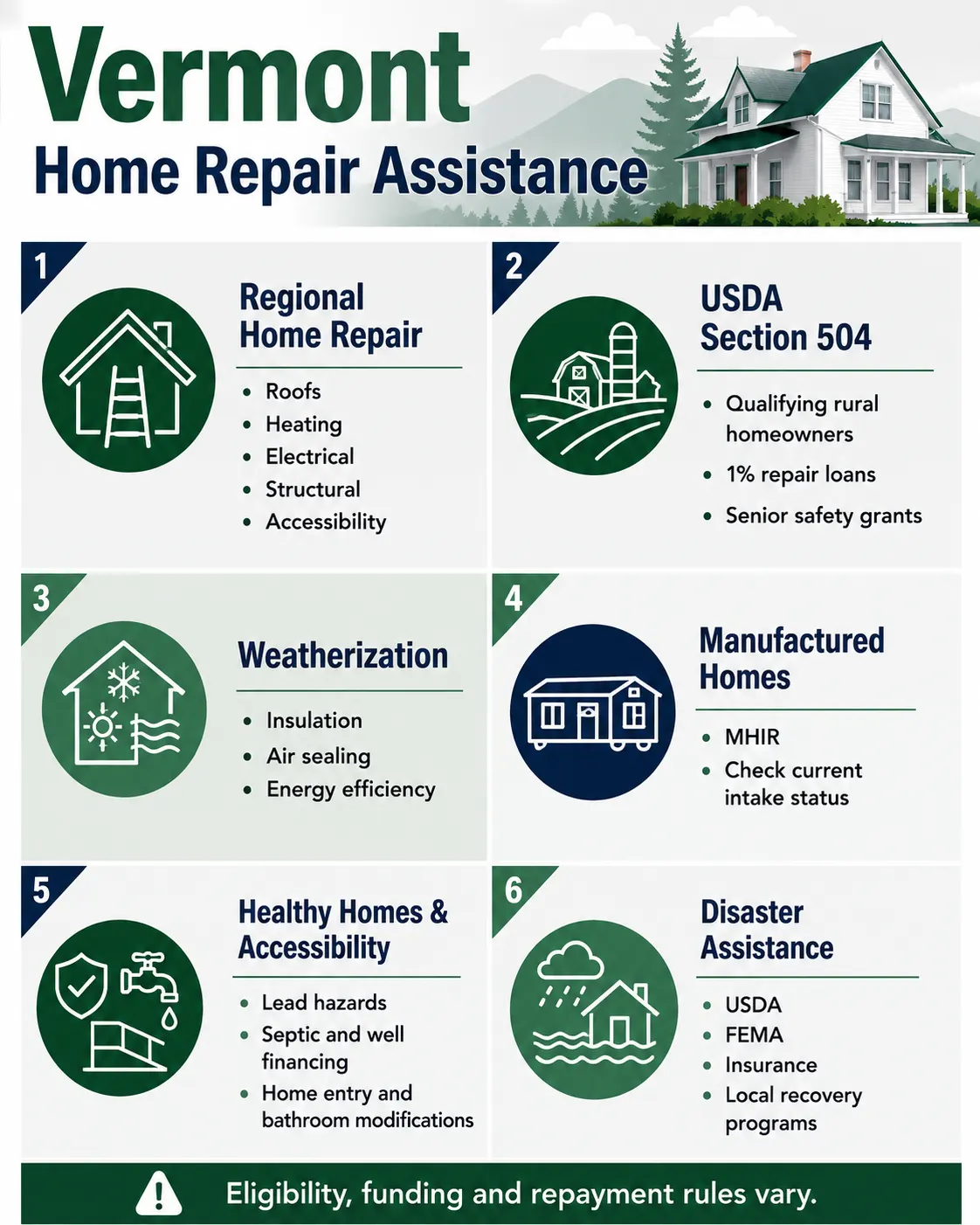
Since much of Vermont falls within USDA rural eligibility areas, the USDA Section 504 Home Repair program is a major 2026 resource. Eligibility is address-specific, so use USDA’s official map instead of assuming an entire county qualifies.
- Grants: Up to $10,000 for qualifying very-low-income homeowners age 62 or older to remove health and safety hazards.
- Loans: Up to $40,000 for qualifying very-low-income homeowners at a fixed 1% interest rate for up to 20 years.
- Standard Combined Maximum: Up to $50,000 when an applicant qualifies for both assistance types.
- Declared-Disaster Grant: USDA lists up to $15,000 for qualifying Section 504 repairs in a presidentially declared disaster area, which can raise combined assistance to $55,000.
USDA applications are accepted year-round, subject to funding and processing capacity.
Official Link: USDA Section 504 in Vermont and New Hampshire
For forms, repayment rules, and application steps, read our complete USDA Section 504 home repair guide.
Comparison of 2026 Vermont Programs
| Program | Focus Area | Potential Assistance | Main Condition |
|---|---|---|---|
| Regional Home Repair | Roofs, systems, safety, accessibility | Varies by regional program | Income, location and financing terms vary |
| MHIR | Manufactured-home repairs and foundations | Foundation up to $15,000; repair awards tiered | Applications currently closed |
| VHIP 2.0 | Rental units, ADUs, multi-unit structural work | Up to $50,000 for certain projects | 20% match and affordability covenant |
| Efficiency Vermont | Insulation and air sealing | Current Home Performance offer up to $7,000 | Eligibility and funding limits apply |
| USDA Section 504 | Rural health and safety repairs | $50,000 standard combined; up to $55,000 in qualifying declared disaster area | Very-low income; grant portion generally age 62+ |
| USDA Disaster Fund | Qualifying disaster damage | Grant up to $32,420 | Disaster, income, rural eligibility and funding rules apply |
2026 Eligibility Criteria: Do You Qualify?
There is no single income limit or eligibility rule for every Vermont home repair program.
- The 80% AMI Rule: Many local repair and Healthy Homes programs use income limits around 80% of Area Median Income, but this is not universal and the dollar amount changes by county and household size.
- USDA: Section 504 uses stricter county-specific very-low-income limits.
- Primary Residence: Most homeowner repair programs require you to own and occupy the home. VHIP is different because it focuses on rental units, ADUs, and affordable rental housing.
- Property Standing: Some programs review property taxes, mortgage status, insurance, liens, title, or other property obligations. An outstanding issue does not have the same effect under every program.
- Repair Need: Health, safety, code, accessibility, structural, heating, water, wastewater, flood, and energy-related problems generally have a stronger case than cosmetic remodeling.
How to Apply for Vermont Home Repair Assistance
- Identify the repair first: Get photographs, inspection notices, contractor observations, or an estimate showing what is wrong and why the repair is necessary.
- Match the repair to a program: Use USDA for qualifying rural repairs, regional Homeownership Centers for whole-house health and safety work, Community Action for heating and Weatherization, and specialized programs for lead, accessibility, septic, manufactured homes, or disaster damage.
- Check intake before hiring anyone: Ask whether applications are open, whether your address is served, what the income limit is, and whether assistance is a grant, loan, forgivable loan, rebate, or direct service.
- Wait for written authorization: MHIR, Weatherization, regional repair programs, rebates, and other programs may refuse to cover work started before approval.
- Keep the paperwork: Save copies of every application, estimate, inspection, approval letter, email, receipt, and financing agreement.
The Housing Grants Finder eligibility checker can help you organize possible starting paths. It is an informational screening tool, not a Vermont government application and not an official eligibility decision.
Documents Worth Preparing
- Government-issued ID
- Deed or other proof of ownership
- Recent household income documentation
- Mortgage and property-tax information
- Homeowners insurance information
- Repair photographs
- Inspection, code, engineer, or contractor reports when available
- Written repair estimates
- Disaster and insurance documents when relevant
FAQs
Can I get a grant for a kitchen or bathroom remodel?
You normally cannot get repair assistance for a purely aesthetic remodel. However, if the kitchen floor is rotting from a plumbing failure, wiring is unsafe, plumbing is failing, or a bathroom needs accessibility work, a regional repair program may consider the necessary health, safety, or code-related work. Coverage depends on the administrator’s approved scope.
What if I live in a mobile home?
Manufactured-home owners may have several paths, including Weatherization, regional repair assistance, USDA Section 504 when property rules are met, and MHIR when that program is accepting applications. As of August 2026, MHIR states that all applications are closed.
How long is the waitlist?
There is no reliable statewide wait time. Weatherization, home repair, manufactured-home, and accessibility programs have different workloads and funding levels. Heating emergencies may receive priority during crisis season, but a specific 48- or 72-hour repair cannot be guaranteed.
Is there a free roof program in Vermont?
There is no universal government program that gives every Vermont homeowner a free roof. A necessary roof repair may be included through a regional home repair program, USDA Section 504, qualifying disaster assistance, MHIR when open, or another health-and-safety program. Read our roof replacement assistance guide for the main funding paths.
Conclusion
Vermont’s 2026 repair programs reward homeowners who match the repair to the right program and confirm current funding before work begins. Start by checking USDA rural eligibility if Section 504 or disaster assistance may fit your situation. At the same time, contact the regional Homeownership Center serving your county for whole-house health and safety repairs.
If heating costs or a failed furnace are the problem, contact your Community Action Agency and ask about Fuel Assistance, Weatherization, crisis assistance, and furnace repair or replacement. These programs have separate requirements, and enrollment in one program does not guarantee another benefit.
Get your paperwork in order early. Scan your deed, recent income documentation, tax information, insurance records, repair photographs, and estimates. Having complete records ready can reduce avoidable delays, but it does not guarantee funding or priority.
Finally, be careful with websites, contractors, or consultants promising guaranteed government repair money. Review our home repair scam and contractor fraud guide before paying anyone to obtain a grant for you.