Hawaii Home Repair Grants 2026: USDA, OHA, HILP Programs
Hawaii homeowners may qualify for home repair help through USDA Section 504, Hawaii County HILP, Honolulu’s Residential Rehabilitation Loan Program, OHA Native Hawaiian assistance, Habitat repair help, and VA disability housing grants. The best option depends on your island, income, age, disability status, Native Hawaiian eligibility, and whether the repair is urgent.
For most low-income homeowners, the strongest starting points are USDA 504 for rural health and safety repairs, HILP for Big Island owner-occupants, Honolulu’s 0% rehab loan for Oahu homeowners, and OHA programs for eligible Native Hawaiian households. Hawaii faces salt air, termites, flooding, humidity, and roof damage instead of the cold-weather problems covered in our South Dakota repair programs. You can also browse the homepage for more home repair funding opportunities.
Quick Answer: What Hawaii Home Repair Help Is Available in 2026?
In 2026, Hawaii homeowners can look at several repair funding paths: USDA Section 504 for rural low-income homeowners, Hawaii County HILP for Big Island repairs, Honolulu’s rehab loan for Oahu owner-occupants, OHA assistance for eligible Native Hawaiian homeowners, Habitat repair help, and VA grants for disabled veterans.
- Best for rural seniors: USDA Section 504 grant or 1% repair loan.
- Best for Big Island repairs: Hawaii County Home Improvement Loan Program.
- Best for Oahu major repairs: Honolulu Residential Rehabilitation Loan Program.
- Best for Native Hawaiian homeowners: OHA housing and disaster repair assistance.
- Best for disabled veterans: VA SAH, SHA, or HISA benefits.
Before applying, confirm your income, ownership documents, repair estimates, and whether the home is your primary residence. You can also use the eligibility checker to narrow down which repair path fits your situation.
USDA Section 504 Home Repair (Hawaii)
If you live in a rural area (much of the Big Island, Maui, or Kauai), the USDA 504 home repair program in Hawaii is your strongest tool for Hawaii county home preservation. It is designed to help very-low-income homeowners fix health and safety hazards.
- Home Repair Grants (62+): Get up to a $10,000 lifetime grant (or $15,000 in disaster areas) for fixing dangerous wiring, broken stairs, or making a bathroom safe. (Learn more about free home repair grants for seniors).
- The 1% Loan: If you are under 62, borrow up to $40,000 at a fixed 1% interest rate over 20 years.
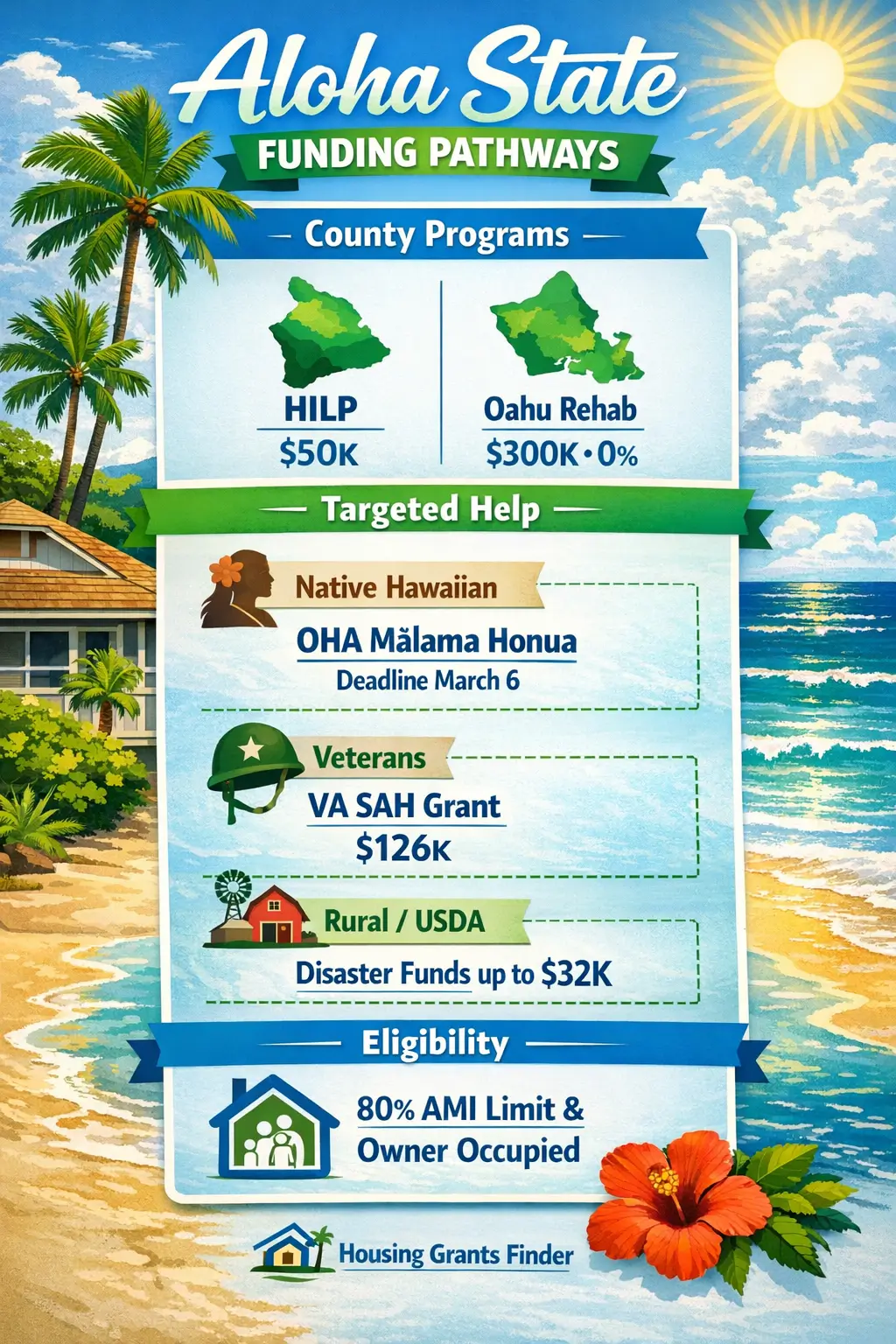
- Rural Disaster Home Repair Grants: For homes damaged by fires or storms since 2022, you can get up to $32,420 in disaster recovery grant money.
- Note: Grants must be repaid if you sell the home within 3 years.
Official Link: USDA Rural Development Hawaii 504
Note: Our team monitors the 2026 HUD Area Median Income (AMI) updates and local county housing notices to ensure these deadlines are accurate as of March 2026.
Home Improvement Loan Program (HILP)
The Big Island recently launched a massive initiative for the 2026 cycle.
- The Funding: Loans from $2,500 to $50,000 at 3% simple interest.
- The Deferred Benefit: Payments are deferred for 15 years.
- Principal Balance Forgiveness: If you are 62+ or have a disability, 50% of the loan may be forgiven at the end of those 15 years.
- Eligible Repairs: Termite damage, wood rot, leaky roofs (including emergency roof repair Hawaii needs), lead-based paint abatement, and solar water heating.
Official Link: Hawaii County HILP
Note: The old Residential Repair Program (RRP) is currently not accepting applications.
Oahu: Honolulu Residential Rehabilitation Loan Program
For residents in Honolulu, the city offers one of the most generous housing rehabilitation funds (often considered among top Honolulu senior housing grants) in the country. And offer up to $300,000 at zero interest for homeowners under 80% of the median income (AMI).
- The processing time is at least 1 year, due to State Historic Preservation approval. Do not wait for an emergency to apply.
- Eligible Work: Roof repair, electrical rewiring, plumbing, and photovoltaic systems.
Official Link: Honolulu Rehab Loan Program
Native Hawaiian Home Repair Assistance: OHA Mālama Honua
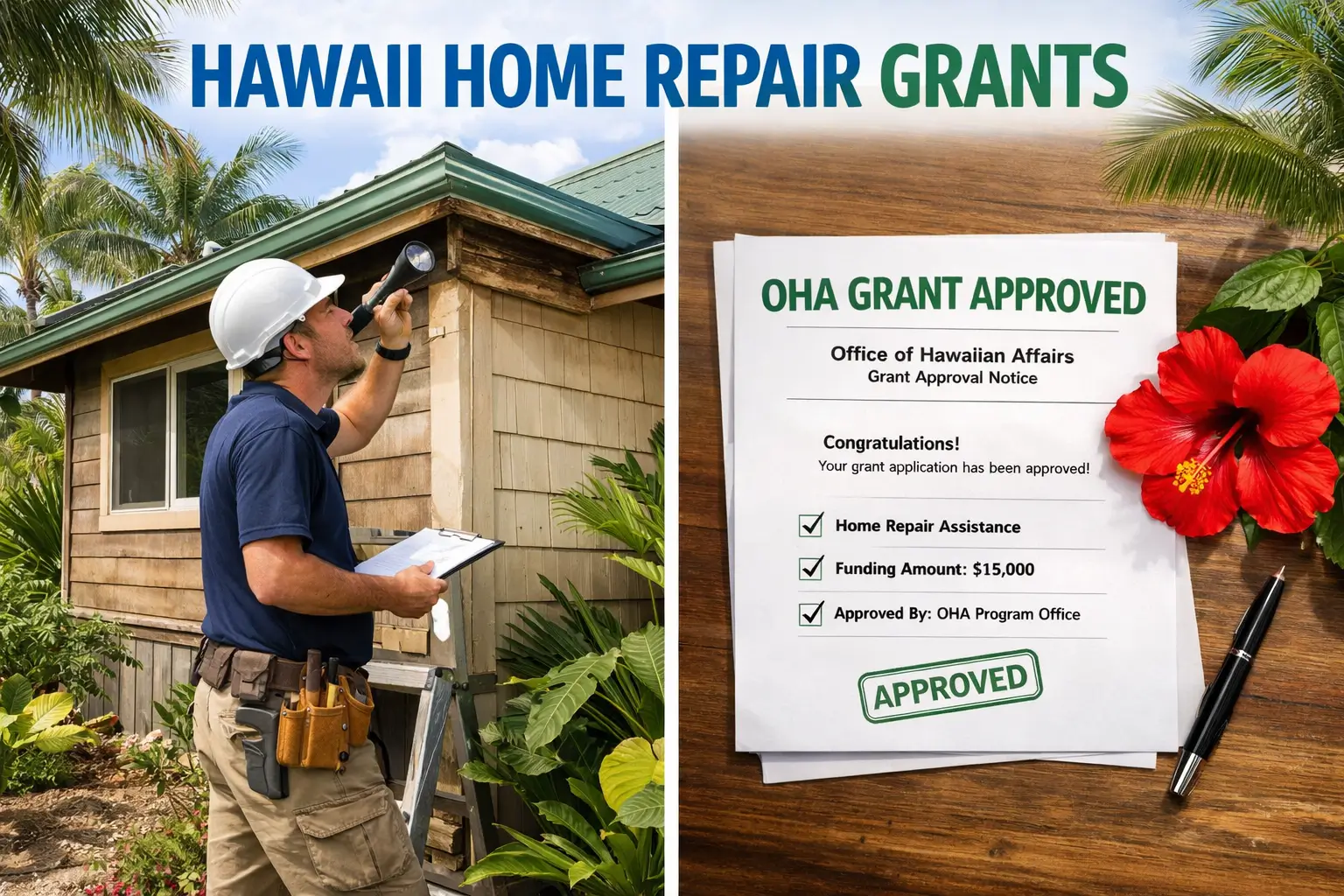
Eligible Native Hawaiian homeowners should check OHA housing and disaster repair programs before using a private loan. OHA’s Mālama Honua Home Repair/Renovation pathway focuses on health and safety repairs for Native Hawaiian households that may not qualify for traditional financing.
Important 2026 update: The earlier Mālama Honua grant administrator LOI window ran from February 20 through March 6, 2026, so that round is no longer an open homeowner application window. OHA has also launched the Mālama Honua Disaster Fund for eligible Native Hawaiian homeowners affected by the March 2026 Kona Low storms. That fund provides a limited number of $10,000 repair grants for minor storm-related cleanup or repair needs.
- Best fit: Native Hawaiian homeowners with urgent repair, disaster, or habitability issues.
- Common repairs: Storm cleanup, water damage, minor non-structural repairs, and health or safety repairs.
- Key documents: Hawaiian Registry verification, proof of ownership, primary residence proof, repair estimates, photos, and IRS Form W-9 when required.
Official Link: OHA Housing Programs
Habitat for Humanity: Critical Home Repair (Hawaii Island)
Habitat affiliates handle more than just new builds; they provide emergency home repairs that Hawaii homeowners need to preserve their homes.
- The Cost: You must pay 10% up front and contribute sweat equity (5 hours per $1,000 of cost).
- Veterans Program: For disabled veterans, costs may be waived or discounted entirely. You must intend to stay in the home for 5 years after the housing rehabilitation.
Official Link: Habitat Hawaii Island
Island-Specific County Programs (Oahu & Big Island)
Best for: Major housing rehabilitation and termite-damage repair assistance that Hawaii residents need to maintain structural integrity.
Veterans: Disability Home Modification Grants Hawaii
The disability home modification grants that veterans use are meant to turn a standard house into a safe, accessible home. These are specialized grants that do not require repayment as long as you use the funds for approved structural changes.
Specially Adapted Housing (SAH) Grant
For FY 2026, the maximum amount is $126,526. It is used for major housing rehabilitation, such as building a wheelchair-accessible home on land you already own or remodeling an existing home with wide hallways and specialized bathrooms.
- The Catch: You must have a permanent and total service-connected disability to qualify for the full amount.
- Link: VA SAH Grant Details
Special Home Adaptation (SHA) Grant
The 2026 maximum is $25,350. This grant is for smaller but critical changes. It is perfect for adding accessibility modifications (ramps/grab bars), widening doorways, or improving flooring to prevent falls.
- The Rule: You can use this grant up to six times in your lifetime, provided you don’t exceed the total dollar limit.
- Link: VA SHA Grant Details
HISA Benefit: Home Improvements and Structural Alterations
This is a $6,800 lifetime benefit that is often easier to get than the SAH or SHA. It covers medically necessary structural alterations, such as bathroom safety modifications, lowering kitchen counters or improving entrance paths.
- HISA requires a direct prescription from a VA physician. If your doctor doesn’t explicitly state that the modification is medically necessary, the VA will reject the claim immediately.
- Link: VA HISA Benefit Details
Specialized Assistance (Native Hawaiian & Veterans)
Best for: Native Hawaiian home improvement grants and disability home modification grants that Hawaii veterans use for Aging in Place.
Eligibility Quick-Scan
- Owner-Occupancy: You must occupy the property as your owner-occupant primary residence.
- Income Limits: Most programs cut off at 80% Area Median Income (AMI).
- Condition: Funding is prioritized for health and safety hazards (roof, electrical, plumbing) rather than cosmetic upgrades.
- Property Type: Homes must be on a permanent foundation.
How to Apply for Hawaii Home Repair Assistance
Start with the program that matches your island and repair type. Rural homeowners should contact USDA Rural Development first. Big Island homeowners should check Hawaii County HILP. Oahu homeowners should contact Honolulu’s Residential Rehabilitation Loan Program. Native Hawaiian homeowners should review OHA’s current housing and disaster assistance notices.
- Step 1: Confirm that you own and live in the home as your primary residence.
- Step 2: Collect proof of income, photo ID, property tax records, mortgage or deed documents, and recent utility bills.
- Step 3: Get written repair estimates from licensed contractors when the program requires cost documentation.
- Step 4: Apply before starting major repair work, because many programs will not reimburse work already completed.
- Step 5: Ask whether the help is a grant, deferred loan, forgivable loan, or standard repayment loan. You can read more about repayment rules in our guide on whether home repair grants have to be paid back.
FAQs
Who qualifies for home repair grants in Hawaii in 2026?
You must be an owner-occupant earning below 80% Area Median Income. Seniors (62+) and disabled residents receive the highest priority and are eligible for forgiveness.
Does Hawaii Weatherization pay for a new roof?
No. This program (low-income weatherization assistance HI) covers only solar water heaters and insulation. You must repair roof leaks first, using a USDA 504 grant instead.
Is the assistance forgivable, or do I have to pay it back?
It depends on the program. USDA grants may need to be repaid if you sell within 3 years. Hawaii County HILP is a deferred loan, but eligible seniors and disabled homeowners may qualify for 50% principal forgiveness after 15 years. Honolulu rehab help is generally a 0% loan, not a free grant.
Are there any strict Hawaii home repair deadlines in 2026?
Yes. Some disaster and Native Hawaiian assistance windows can close quickly. The earlier OHA Mālama Honua LOI window closed on March 6, 2026, but OHA later announced disaster repair help for eligible Native Hawaiian homeowners affected by the March 2026 Kona Low storms. USDA and county repair programs may accept applications on a rolling basis, but funding can run out.
Can I get help if I live on Hawaiian Home Lands?
Yes. Homesteaders should use the HUD Section 184A guarantee. This bypasses the leasehold barriers that typically lead to traditional bank loan rejections.
What is the Historic Preservation catch for Oahu homeowners?
Oahu’s rehab loan requires a State Historic Preservation review for older homes. This adds months of waiting, so apply before emergencies happen.
Next Steps for Hawaii Homeowners
Finding government grants for home repairs in Hawaii in 2026 is a matter of timing and patience. Because Honolulu’s program takes a year to process and OHA has a tiny two-week window in February, you cannot afford to wait. Gather your 2026 Social Security Award Letter and two months of pay stubs today.
Visit the Hawaii ADRC website now to find the contact information for your island’s Aging and Disability Resource Center and start your application. Check our state grants directory for more continuous updates.