Maryland Home Repair Grants 2026: WholeHome, Lead, HVAC
Maryland homeowners may be able to get help through WholeHome critical repair grants, lead hazard funding, energy upgrade programs, and county-level rehabilitation loans. The best option usually depends on your ZIP code, the type of repair, your income, and whether the issue is severe enough to threaten health or safety.
This guide covers the main Maryland home repair grants and repair assistance options for roofs, heating systems, lead hazards, accessibility needs, and major county-based rehabilitation programs. If you are comparing home improvement grants in Maryland, start with the programs below and match the repair type first.
Who Qualifies for Maryland Home Repair Grants?
Most Maryland repair programs use the same core filters before approving an application.
- Owner-occupancy: You usually need to live in the property as your primary residence.
- Income rules: Limits vary by program, and some Maryland options allow higher income thresholds than people expect.
- Repair type: The strongest cases involve roof leaks, failed heating, structural risk, lead hazards, accessibility barriers, or other health and safety issues.
- Title and tax status: Liens, unclear ownership, unpaid taxes, or water bills can stop an application before work even begins.
- Contractor compliance: If the project requires licensed work, the contractor must meet Maryland program rules.
Some Maryland programs are grants, while others are deferred or forgivable loans. Before signing anything, compare the repayment structure here: pay back home repair grants.
WholeHome Critical Repairs Grant
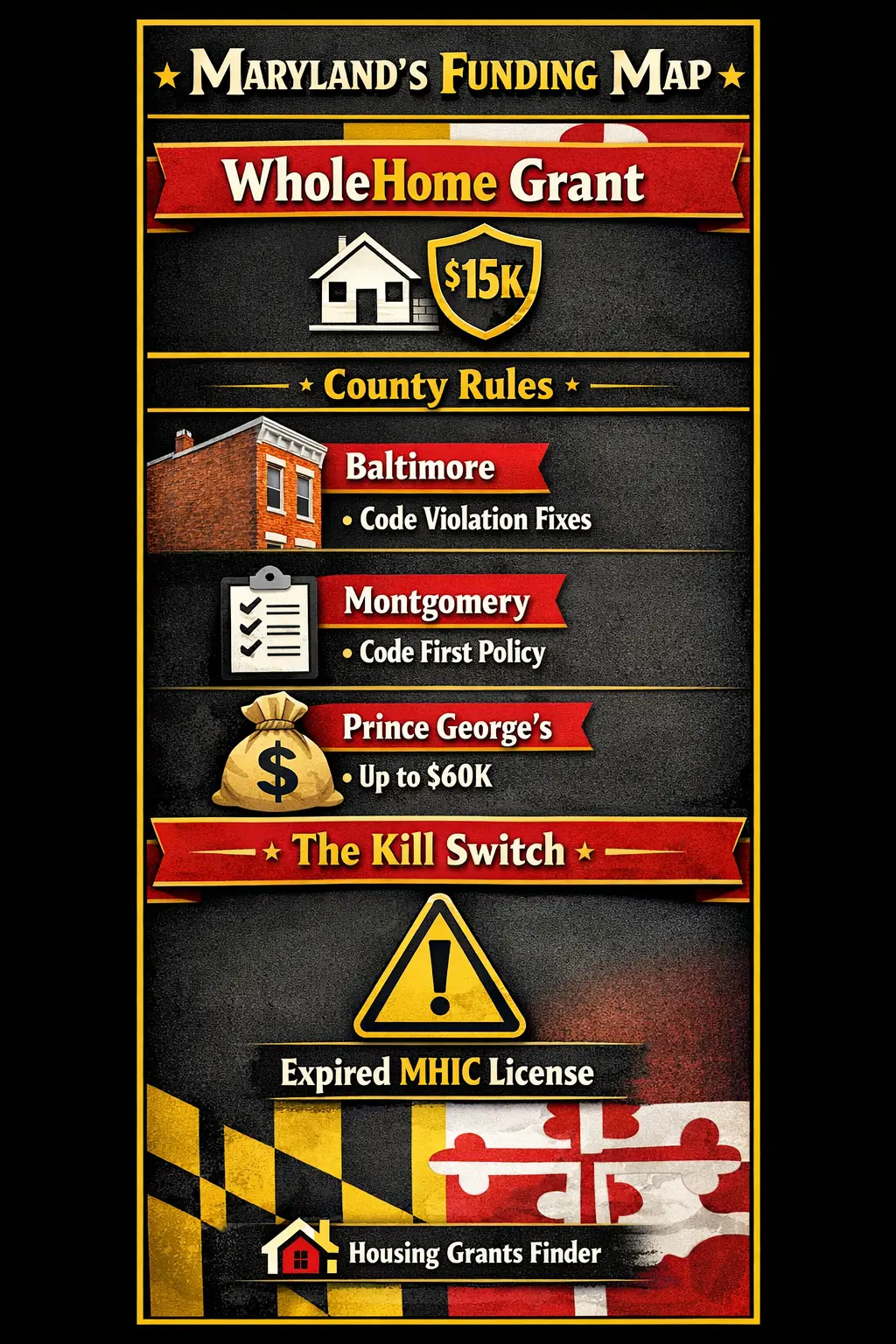
The WholeHome program is Maryland’s Umbrella for all state-level repair help (replacing the old DHCD Special Loans structure). For 2026, the state has prioritized the Critical Home Repairs grant to keep people in their homes. Most grants stay around $10,000, but they can be pushed to $15,000 if you can prove the repair is an immediate safety threat.
- The Eligibility: Maryland is unique. They often allow up to 150% of the Area Median Income (AMI) for this specific grant. In high-cost areas such as Anne Arundel or Montgomery County, this means a middle-class family can qualify.
- The Repairs: It specifically targets displacers. This means a roof that is actively leaking, a non-functional furnace in winter, or structural stabilization.
- Link: Maryland DHCD WholeHome Portal
Statewide Help: Lead & Heat Pumps
The Lead Hazard Reduction Grant
Maryland is among the most aggressive states in the country on lead paint. If your home was built before 1978, you are eligible for significant lead abatement funding.
- The Benefit: These are usually pure grants, not loans. The state wants the lead out.
- The Requirement: You must have a child under age 6 or a pregnant woman living in or regularly visiting the home.
- Note: If you qualify, the state will often cover the cost of a hotel stay during work.
BeSmart Home Program
This is Maryland’s 2026 push for Green Energy. If you swap an old gas furnace for a high-efficiency electric Heat Pump, the state offers a mix of rebates and low-interest financing.
- The 2026 Catch: You must use an approved BeSmart contractor. You cannot just hire anyone off the street.
Maryland Help for Seniors, Accessibility, and Bathroom Safety
Maryland has better accessibility repair pathways than many other states, but homeowners often miss them because they apply through general rehab channels first.
- Minor repair help for older homeowners: Baltimore’s Handyworker track is a better fit for grab bars, smoke detectors, and small safety fixes than a full rehab application.
- Walk-in shower and access modifications: Accessibility-related repairs should be framed as mobility and safety work, not general remodeling. For broader options, see grants for walk-in tubs and bathroom safety.
- Senior-focused repair help: If the homeowner is older, mention fall risk, bathroom safety, heating failure, and aging-in-place needs early in the application. You can also compare broader options here: home repair grants for seniors.
Rural Maryland: USDA Section 504 Fallback Option
If you live outside the denser county repair systems, USDA Section 504 can still be an important fallback for very low-income homeowners in eligible rural areas. It is especially relevant when the repair involves health and safety hazards and the local county program is too slow, too strict, or not available for your area.
For homeowners age 62 and older, the grant side of USDA may help with serious hazards. For others, the low-interest loan side can still be useful when a county program is not a fit. Review the full rules here: USDA Section 504 home repair program.
The County Treasure Map
Baltimore City: Handyworker & Deferred Loans
Baltimore is grant-rich but notoriously slow. Provides free minor repairs for seniors (62+) up to $5,000. They fix the small things, leaky faucets, smoke detectors, and grab bars.
- Deferred Loans: For major work, the city offers up to $18,500, fully forgiven if you stay in the home for 10 years.
- Note: Baltimore City requires a Title Search for every application. If you have any unpaid water bills or minor liens, your application will be stopped cold. Clear those first.
Montgomery County: HOC & DHCA Rehab
Montgomery County has some of the highest income limits in the state.
- The Benefit: Zero-interest deferred loans for major systems.
- The Catch: The county has a Code First policy. If their inspector finds an illegal basement apartment or unpermitted wiring during a roof inspection, they may require you to address those issues as part of the project. This can sometimes make the project too expensive to start.
Prince George’s County: HRAP
The Housing Rehabilitation Assistance Program (HRAP) is one of the largest in the state.
- The Money: Up to $60,000.
- The Terms: This is usually a 0% interest loan that must be repaid when you sell the home. It is effectively a county-backed home equity loan.
Why People Get Rejected
Maryland programs have specific Kill Switches that will end your application instantly. Avoid these.
- The MHIC License Rule is the primary reason for the denial. Your contractor must have a valid Maryland Home Improvement Commission (MHIC) license. If their license is expired or under investigation on the state’s website, your grant is dead. (Read more on contractor fraud).
- The Clear Title Rule: Maryland does not recognize informal ownership. If the home is in a Life Estate or still in your late parents’ name, you will be rejected. You must have a recorded Deed in your name.
- The Tax Stand-Off: If you owe the State of Maryland back taxes (Income or Property), they will not give you a grant. They will request a Certificate of Good Standing before signing any check.
FAQs
Can I get a Maryland grant for an old mobile home?
Yes, but only if you own the land. If you rent frequently in a mobile home park, you are typically limited to Weatherization Assistance. If you own the land and the home is on a permanent foundation, you can use the WholeHome grant.
What if I have a reverse mortgage in Maryland?
This is a central friction point. Many city-led programs, like Baltimore, will reject you if you have a reverse mortgage because the city cannot place a Secondary Lien on the property. However, the USDA 504 Grant and Lead Abatement Grants usually do not care about your mortgage status.
Does Maryland have a ‘Handyman’ grant?
Technically, no. Maryland is very strict about licensing. Any repair over $300 requires an MHIC-licensed contractor. If you are looking for minor handyman help, your best bet is the Baltimore Handyworker Program or the Habitat for Humanity ‘Aging in Place’ program in your county.
How long is the actual wait time in 2026?
For the WholeHome Grant, expect a 3- to 5-month timeline. For Baltimore City or Prince George’s local programs, the wait is closer to 9 to 12 months. These are not emergency funds; they are long-term preservation funds.
Conclusion
Maryland repair funding is not one single statewide pot. It is a mix of WholeHome, lead removal help, energy upgrades, and county-specific programs with different rules. Start with the repair type first, then match it to the correct county or state pathway. If the issue is urgent, document the safety risk clearly, keep your title and tax records clean, and verify the contractor before you apply.
For more verified options, visit housinggrantsfinder.com.