Virginia Home Repair Grants 2026: EHARP, USDA & City Help
Virginia homeowners may be able to get help with serious repair needs such as roof leaks, unsafe electrical systems, failed plumbing or septic systems, heating and cooling problems, accessibility barriers, structural hazards, and rural health or safety repairs. The right program depends on your city or county, household income, ownership status, repair type, funding availability, and whether the work is approved before it begins.
For 2026, the main Virginia repair paths to check are EHARP in participating areas, IPR Flex for major system failures and rehabilitation, USDA Section 504 for eligible rural homeowners, Weatherization for energy-related work, and local programs in Fairfax, Loudoun, Richmond, Henrico, Virginia Beach, Norfolk, Hampton Roads, and Southwest Virginia.
Quick Answer: Who can get Virginia home repair help?
Virginia homeowners and, in some programs, tenants with owner permission may qualify for repair assistance through EHARP, IPR Flex, USDA Section 504, Weatherization, or local city and county programs. There is not one single statewide grant that covers every repair.
- Immediate health, safety, or accessibility repair: Check EHARP if your community participates, or check your local entitlement-jurisdiction repair program.
- Major plumbing, HVAC, electrical, roofing, or rehabilitation need: Check IPR Flex through its regional administrator.
- Rural senior or very-low-income repair: Check USDA Section 504.
- Insulation, air leaks, ducts, unsafe heating or cooling: Check Weatherization through the provider serving your county.
- Fairfax, Loudoun, Richmond, Henrico, Virginia Beach, Norfolk, and other excluded EHARP areas: Start with the city or county housing office.
The Statewide Foundations: Your First Line of Defense
Before you look at local city funds, you must understand the three programs that cover almost every corner of the Commonwealth.
EHARP: Essential Home and Accessibility Repair Program
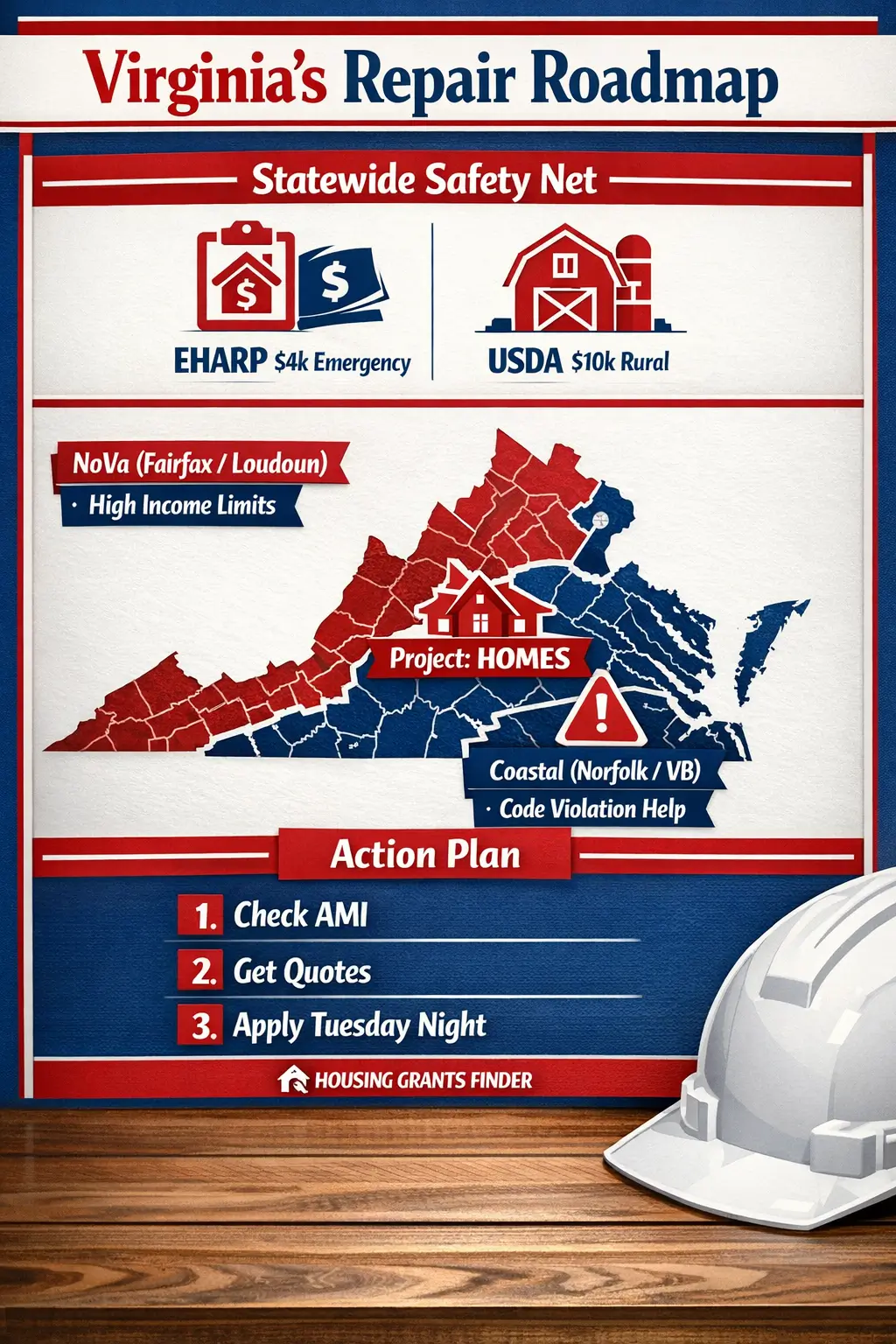
EHARP may provide up to $4,000 through local administrators to remove essential health and safety hazards or accessibility barriers. Eligible work may include plumbing, structural, electrical and roofing repairs, wheelchair ramps, and other accessibility modifications.
- Income: Total gross household income generally cannot exceed 80% of Area Median Income, adjusted for household size.
- Who may apply: Homeowners and tenants with written homeowner approval may apply through a local provider.
- Important location rule: EHARP is not available in several federally designated entitlement jurisdictions, including Fairfax County, Loudoun County, Henrico County, Prince William County, Richmond, Norfolk and Virginia Beach. Residents in excluded areas should contact their local city or county housing office.
- Apply locally: Use DHCD’s current EHARP provider list. DHCD funds local administrators but does not function as a universal direct homeowner repair portal.
- Official Link: Virginia DHCD EHARP
For roof-specific programs, also compare these options with our government roof replacement grants guide.
USDA Section 504 (The Rural Safety Net)
If you live in a rural county, the federal government is your best friend.
- For Seniors (62+): You can get a $10,000 grant. If you sell your house in less than three years, you have to pay it back.
- For Everyone Else: You can get a 1% interest loan for up to $40,000.
- Timing: USDA processing time varies by application completeness, inspection, local workload and available funding. For an active emergency, also contact the local emergency repair provider serving your address rather than relying on one program alone.
- Repayment: USDA Section 504 grants generally must be repaid if the property is sold in less than 3 years.
- Official Link: USDA Section 504 Home Repair
Indoor Plumbing Rehabilitation Flex Program (IPR Flex)
IPR Flex may provide forgivable loans to eligible low- and moderate-income owner-occupants whose homes lack complete indoor plumbing or have one or more major systems failing, such as HVAC, electrical or roofing.
- Possible work: Indoor plumbing, wastewater-related rehabilitation, HVAC, roofing, electrical systems, accessibility improvements and broader general rehabilitation may qualify.
- Ownership: The applicant generally must own and occupy both the house and the land where it is located.
- Repayment structure: Assistance uses a recorded deed of trust and is forgiven monthly over a term based on the assistance amount, not exceeding 180 months.
- Apply locally: Regional administrators handle outreach, intake, income and property eligibility, and construction management.
- Official Link: Virginia DHCD IPR Flex
Before accepting a lien, deed of trust, deferred loan, or forgivable award, read our guide on when home repair grants have to be paid back.
Heating and Cooling Emergency Help
If your furnace dies in winter or your cooling system fails during a dangerous heat wave, do not rely on a slow full-rehab process alone. In Virginia, the faster path is often a local emergency repair provider or a Weatherization-linked intake through the regional agency serving your area.
- Best use: HVAC failure, unsafe heating equipment, medically risky indoor temperatures, and urgent mechanical breakdowns.
- Good companion page: If your main problem is heating failure, review our LIHEAP emergency furnace repair guide.
- Longer-term path: For larger energy-efficiency upgrades after the emergency is stabilized, check your local Weatherization provider.
Northern Virginia (NoVa): High Stakes and Tight Rules
NoVa has the highest income limits, but also the most red tape.
Fairfax County: Home Repair for the Elderly Program
Fairfax HREP provides eligible older homeowners and people with disabilities with up to one week of labor and up to $1,000 in materials for minor repairs and accessibility improvements.
- Possible work: Minor electrical or plumbing repairs, window and door repair, grab bars, handrails, screen replacement, minor deck work and electric water-heater repair or replacement.
- Not covered: Emergency repairs, work requiring permits or licensing, and projects requiring access above a six-foot ladder are outside this program’s scope.
- Eligibility: Applicant must own and occupy a Fairfax County home and be age 62+, have a disability, or have a household member with a disability, subject to financial rules.
- Official Link: Fairfax HREP
Older homeowners should also review our home repair grants for seniors guide.
Loudoun County: HARP
Loudoun’s Home Accessibility and Repair Program (HARP) offers one-time forgivable loans for home repairs and accessibility improvements for owner-occupants.
- The Benefit: Assistance can go up to $35,000 depending on the repair scope.
- Forgiveness terms: $0 to $10,000 uses a 5-year forgivable period, $10,001 to $20,000 uses a 10-year period, and $20,001 to $35,000 uses a 15-year period.
- Best fit: Accessibility upgrades, structural repairs, and owner-occupied homes with major repair needs.
Prince William County: Neighborhood Rehab
Prince William prioritizes families at 50% AMI. If you make more, you might be moved to the bottom of the list.
- Application tip: Verify the current application method, intake status, income priority and required documents directly with Prince William County before submitting. Save a copy of every uploaded document and confirmation email.
Central Virginia: Richmond, Henrico, and Chesterfield
This region is dominated by project: HOMES, one of the most efficient nonprofits in the state.
City of Richmond: Metro Rehab
Richmond uses a Deferred Loan model. They fix your home (roof, plumbing, electrical). They place a lien on the house. If you live there for 10 or 15 years, the debt disappears completely.
- The Friction: If you have a reverse mortgage, you are usually disqualified. Reverse mortgages prevent the city from placing its required lien.
Henrico County: Critical Repair
Henrico offers up to $45,000 for moderate rehabilitation.
Note: You must have owned and lived in the home for at least five years. New homeowners are almost always told to wait.
Coastal & Hampton Roads: The Battle Against Code
Hampton Roads homeowners deal with saltwater air and high humidity. These elements destroy roofs and window frames faster than anywhere else. Local programs here are aggressive but come with heavy strings attached.
Virginia Beach: OORP (Owner-Occupied Rehabilitation Program)
Virginia Beach provides assistance to eligible owner-occupants for health, safety, accessibility, and rehabilitation needs through its Owner-Occupied Rehabilitation Program.
- The Grant: Eligible homeowners may receive an unsecured grant up to $30,000.
- If the work costs more: When the rehabilitation exceeds $30,000, the homeowner may need to sign for an unsecured forgivable 5-year loan for the amount above the grant limit.
- Repairs covered: Health and safety hazards, accessibility work, and broader owner-occupied rehabilitation needs, including envelope-related repairs.
- Link: Virginia Beach Owner-Occupied Home Rehabilitation
Norfolk: Renovate Norfolk
Renovate Norfolk is a voluntary grant program for income-eligible owner-occupants needing necessary interior or exterior improvements for safe, sanitary housing or accessibility.
- Current intake: Eligible homeowners can complete the city’s interest survey to join the waitlist.
- Selection: Norfolk conducts randomized selection quarterly in March, June, September and December, within priority tiers.
- Capacity: The city says current funding and contractor availability are expected to support approximately 12 homes per year.
- Basic rules: The home must generally be owner-occupied, in Norfolk, insured, current on mortgage and taxes, and suitable for rehabilitation.
- Official Link: Renovate Norfolk
Newport News & Hampton: HRCAP
The Hampton Roads Community Action Program (HRCAP) covers the Peninsula. They specialize in Emergency Repairs. If your water heater explodes or your furnace dies in a cold snap, call them immediately.
- The Catch: You must prove you have no other way to pay. They will review your bank statements for any hidden cash.
- Link: HRCAP Housing Services
Southwest & Blue Ridge: TAP and Local Support
In the mountains, repairs are about survival. Rotted floors and dangerous wiring are typical in older homesteads.
TAP (Total Action for Progress)
TAP is the primary lifeline for the Roanoke Valley. They cover Alleghany, Bath, Botetourt, Craig, Roanoke, and Rockbridge. They only fix Hazardous conditions. We are talking about rotted floor joists, failing roofs, and knob and tube wiring that is a fire hazard.
- Intake: Funding, repair scope, eligibility and response times may vary by service area. Use TAP’s current contact method and ask whether limited home repair intake is open for your locality.
- Follow-up: Keep your confirmation number, record the date of contact, and follow up politely using the phone or email listed by the program.
- Link: TAP Limited Home Repair
SERCAP (Southeast Rural Community Assistance Project)
SERCAP is based in Roanoke but serves all of rural Virginia. They are the experts in Water and Wastewater. If your well has gone dry or your septic is backing up, SERCAP offers low-interest loans and some small grants.
- Note: They often require a Perc Test or a health department report before they approve a septic fix. Have your local health department inspector come out first.
- Link: SERCAP Individual Water and Wastewater Assistance
Specialized Help: Veterans and Energy
Granting Freedom for Veterans and Service Members
Virginia Housing’s Granting Freedom program may support accessibility modifications for eligible veterans or service members with qualifying service-related injuries. Eligibility, award caps, renter participation and landlord-permission rules should be verified from the current Virginia Housing guidelines before applying.
- Possible work: Accessibility modifications may include ramps, wider doorways, bathroom safety work and other approved changes tied to disability needs.
- Rental home: A renter may need written property-owner approval before modifications can proceed.
- Verify: Confirm the current award limit, documentation and service-related eligibility with Virginia Housing.
For bathroom safety, ramps, roll-in showers, and mobility-related modifications, compare these programs with our bathroom safety and walk-in tub grants guide.
Virginia Weatherization Assistance Program
Virginia WAP may help eligible households lower energy use and improve health and safety through cost-effective measures selected after a home assessment. It is not a general remodeling grant and does not pay utility bills.
- Possible work: Air sealing, insulation, ventilation fans, duct repairs, carbon monoxide and safety testing, and repair or replacement of inefficient or unsafe heating and cooling systems may be included.
- No guaranteed item: A new furnace or AC unit is not automatically provided because of age alone. The local provider determines cost-effective measures after inspection.
- Timing: Wait times vary by provider, funding, household priority and local workload. Do not publish a universal 6-to-12-month wait.
- Apply locally: Contact the WAP provider serving the county where the home is located.
- Official Link: Virginia DHCD Weatherization
If the repair involves old windows, doors, insulation, or air leakage, also read our window and door replacement grants guide.
Step-by-Step: Your Action Plan for 2026
- Find Your AMI: Look up the 80% Area Median Income for your county on the HUD website. If you are over this, you won’t qualify for 90% of these programs.
- Call Your Local Planning District Commission (PDC): These are regional offices that know exactly which nonprofit is holding the cash this month.
- Get Two Contractor Quotes: Most programs won’t even look at your application until you have a professional estimate of the costs. (Watch out for home repair scams).
- Save application proof: Submit through the official program method, save screenshots or confirmation emails, and keep copies of every income, ownership and contractor document uploaded.
How to Apply in Virginia
- Match the problem to the right program: Use EHARP for immediate health and safety repairs, USDA Section 504 for slower rural safety and modernization work, IPR for failed septic or plumbing situations, and Weatherization or emergency heating-cooling help for utility-driven hazards.
- Find the real local gatekeeper: In Virginia, the intake point is usually a local nonprofit, Community Action Agency, Planning District office, or city housing office, not a single statewide homeowner portal.
- Get your documents ready first: Most programs will want proof of ownership, proof of residency, income documents, property-tax status, and contractor estimates before they move forward.
- Understand the funding structure: Some Virginia programs are true grants, but many local rehab programs are deferred or forgivable loans. See when home repair grants have to be paid back.
FAQs
What is EHARP in Virginia?
EHARP is Virginia’s Essential Home and Accessibility Repair Program. It may provide up to $4,000 through local providers for essential health, safety and accessibility repairs. It is not available in every city or county.
Is EHARP available in Fairfax, Loudoun, Richmond or Virginia Beach?
No. DHCD lists these and several other entitlement jurisdictions as outside the statewide EHARP service area. Homeowners in excluded communities should contact their city or county housing office for local rehabilitation programs.
Can Virginia home repair programs pay for a new kitchen?
Usually not for cosmetic remodeling. Assistance generally focuses on health, safety, accessibility, code compliance, failed major systems and necessary rehabilitation. A kitchen repair may qualify only when needed to correct an approved health or safety condition.
What does Virginia IPR Flex cover?
IPR Flex may help eligible owner-occupants whose homes lack complete indoor plumbing or have major systems failing, including HVAC, electrical or roofing. Accessibility improvements and general rehabilitation may also qualify.
Can Weatherization replace a furnace or air conditioner?
Possibly. Virginia Weatherization may repair or replace inefficient or unsafe heating and cooling systems when the local provider’s assessment finds the measure eligible and cost-effective. Replacement is not guaranteed because of equipment age alone.
Can I use more than one Virginia repair program?
Sometimes, but each agency must approve the arrangement. Different programs may cover separate eligible repairs, but two programs generally should not pay for the same work.
Do Virginia home repair grants have to be repaid?
It depends on the program. EHARP assistance is different from IPR Flex forgivable loans, city rehabilitation loans, or USDA grants. Some assistance may require a lien, deed of trust, continued occupancy, or repayment after an early sale.
Can a reverse mortgage affect repair-program eligibility?
Yes, it may affect programs that need to record a lien or deed of trust, but it does not automatically disqualify a homeowner from every program. Ask each agency how existing liens and reverse mortgages are treated.
Conclusion
Virginia home repair help in 2026 works best when you match the repair problem to the correct intake path. EHARP is the fastest statewide emergency option, USDA Section 504 is the stronger rural repair route, IPR is the right answer for failed septic or plumbing systems, and local city or county programs often decide whether you get a major rehab slot or not.
The smartest next step is to identify the local nonprofit, city office, or regional administrator serving your address, then get your ownership, income, tax, and contractor documents ready before the next intake window fills up.