Electrical Rewiring Grants, Loans, and Repair Help
Unsafe wiring can turn an ordinary repair into a serious financial and safety problem. A breaker that trips repeatedly, a hot outlet, a burning-plastic smell, or an outdated panel may require work that costs far more than a household can manage at once.
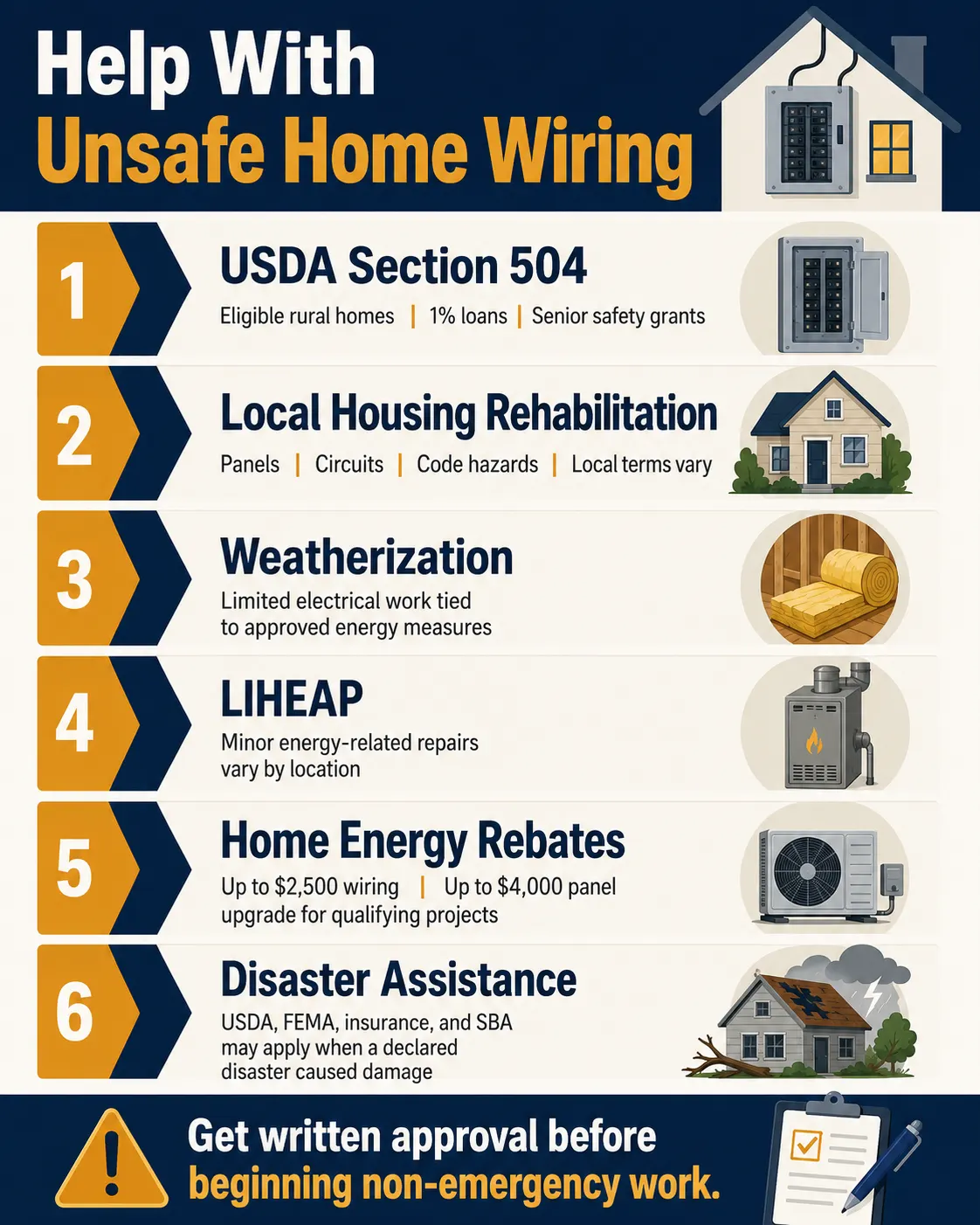
Government help may cover electrical rewiring when the problem creates a documented fire, shock, code, energy, disaster, or habitability hazard. There is no single federal grant that rewires every older home, but qualified households may find assistance through USDA Section 504, local housing rehabilitation, Weatherization, LIHEAP, energy rebates, or disaster programs.
Quick Answer: Who Can Get Help With Unsafe Wiring?
Lower-income homeowners have the strongest chance of receiving assistance when they own and occupy the home and meet the program’s income and location rules.
- Rural, very-low-income homeowner: Check USDA Section 504.
- Electrical code or whole-home safety problem: Contact your city or county housing office.
- Wiring affecting heating or cooling: Check Weatherization and LIHEAP.
- Panel needed for a heat pump or other eligible equipment: Check Home Energy Rebates.
- Storm, fire, flood, or other disaster damage: Contact insurance and check USDA disaster assistance, FEMA, and SBA.
Funding, waiting lists, covered repairs, and repayment terms vary by location.
Electrical emergency: Leave the home and call 911 if you see flames, heavy smoke, or active sparking. Do not touch exposed wiring or remove an electrical-panel cover. Hot or discolored outlets, frequent breaker trips, flickering lights, buzzing, sparks, and the smell of burning insulation can indicate an electrical hazard. The U.S. Consumer Product Safety Commission recommends having a qualified electrician investigate warning signs such as hot faceplates, sparks, failed circuits, flickering lights, or burning-plastic odors. See the CPSC electrical warning-sign guidance.
Government Electrical Repair Programs Compared
| Program | Best for | Assistance type | Main limitation |
|---|---|---|---|
| USDA Section 504 | Serious repairs in eligible rural homes | Grant or 1% loan | Very-low income required; grants generally require age 62+ |
| City or county rehabilitation | Code violations, panels, circuits, and broader home repairs | Grant, deferred loan, forgivable loan, or low-interest loan | Programs and funding vary locally |
| Weatherization Assistance | Electrical corrections connected to approved energy work | Direct contractor service | Not a general whole-house rewiring program |
| LIHEAP | Minor energy-related repairs or heating and cooling emergencies | Benefit or direct service | Services differ by state, territory, and Tribe |
| Home Energy Rebates | Wiring or panel upgrades supporting eligible equipment | Rebate | Available only through participating programs |
| USDA Disaster Assistance Fund | Qualifying disaster-damaged homes | Grant, with a current maximum of $32,420 | Disaster, income, location, deadline, and funding rules apply |
| FEMA and SBA | Electrical systems damaged by a declared disaster | FEMA assistance or repayable SBA loan | Damage must be connected to an eligible disaster |
What Electrical Repairs May Qualify?
Repair programs usually focus on work needed to make a home safe, sanitary, functional, or compliant with local standards.
Depending on the inspection and program rules, approved work may include:
- Replacing a damaged or unsafe breaker panel
- Repairing burned, exposed, deteriorated, or improperly connected wiring
- Correcting serious electrical code violations
- Restoring safe power to essential rooms or equipment
- Adding required grounding or electrical safety protection
- Repairing disaster-damaged wiring
- Completing electrical work needed for an approved energy upgrade
Permit fees, inspection costs, and limited wall repairs may also be included when they are necessary to complete the approved electrical project.
Old Wiring Is Not Automatically Unsafe Wiring
A home being old does not automatically qualify it for repair assistance.
The application is stronger when an electrician or inspector identifies a specific problem, such as overheating, arcing, exposed conductors, repeated breaker failure, damaged insulation, an unsafe service panel, or the loss of electricity to an essential part of the home.
A program may approve a targeted repair instead of complete rewiring. For example, it may replace the panel and two dangerous circuits without paying to rewire every room.
USDA Section 504: The Main Rural Repair Option
The USDA Single Family Housing Repair Loans and Grants program, commonly called Section 504, is one of the clearest federal assistance paths for unsafe home conditions.
Section 504 loans can be used to repair, improve, or modernize an eligible home or remove health and safety hazards. Grants are limited to removing health and safety hazards. Unsafe wiring may therefore be considered when USDA documents and approves it as part of the repair scope.
Who May Qualify?
Applicants generally must:
- Own and occupy the property
- Live in a USDA-eligible rural area
- Meet the very-low-income limit for their county
- Be unable to obtain affordable credit elsewhere
The grant option is generally limited to homeowners age 62 or older. A younger homeowner who meets the other conditions may still qualify for a Section 504 loan.
Do not assume your address is ineligible because you live near a town. USDA rural boundaries can include smaller communities and areas outside major population centers.
Current Section 504 Limits
As verified in July 2026:
- Maximum loan: $40,000
- Interest rate: Fixed at 1%
- Repayment term: Up to 20 years
- Standard lifetime grant: Up to $10,000
- Section 504 grant for a qualifying presidentially declared disaster area: Up to $15,000
The standard loan and grant may be combined for up to $50,000 in assistance, or up to $55,000 in a qualifying presidentially declared disaster area. A grant generally must be repaid if the home is sold within three years. Applications are accepted throughout the year, but processing depends on available funding and local workload.
Official link: USDA Section 504 Home Repair Loans and Grants
For application forms, rural-property rules, and repayment details, read our complete USDA Section 504 home repair guide.
City and County Housing Rehabilitation Programs
For homeowners outside USDA-eligible rural areas, the strongest option may be a city, county, or state owner-occupied rehabilitation program.
Local governments can use Community Development Block Grant funds for the repair, rehabilitation, or reconstruction of owner-occupied homes. HUD gives participating communities flexibility to create emergency repair, targeted repair, or whole-home rehabilitation programs based on local needs.
What Local Programs May Cover
Electrical work may be included when it is needed to:
- Correct a code violation
- Remove a fire or shock hazard
- Replace a failed service panel
- Restore safe electrical service
- Bring a larger rehabilitation project up to local standards
The program may approve rewiring as one part of a broader project involving roofing, plumbing, heating, structural damage, or accessibility.
Assistance May Come With Conditions
Local repair help is not always a cash grant. It may be offered as a:
- Deferred-payment loan
- Forgivable loan
- Low-interest rehabilitation loan
- Direct contractor service
- Grant with continued-occupancy conditions
A deferred or forgivable loan may place a lien on the home. Repayment can be triggered if the homeowner sells, moves, transfers ownership, rents out the property, or refinances before the required period ends.
Read our guide explaining when home repair grants and loans must be paid back before accepting assistance.
How to Find the Correct Local Office
Search using the name of your location. Look for a city or county Housing, Community Development, Neighborhood Services, Planning, or Redevelopment department.
You normally do not submit a general rewiring application directly to HUD. The city, county, state agency, or nonprofit operating the local program handles homeowner applications.
Official link: HUD Community Development Block Grant Program
Use the home repair assistance directory by state to identify programs serving your area.
Weatherization Assistance and Electrical Safety Work
The Department of Energy’s Weatherization Assistance Program, or WAP, helps eligible lower-income households reduce energy costs while improving health and safety.
Weatherization is usually provided as a direct service. A local agency assesses the home, selects cost-effective measures, and arranges the approved work instead of giving the household unrestricted repair money.
Who May Be Eligible?
Under DOE guidelines, a household at or below 200% of the federal poverty guidelines may be eligible. A state or territory may instead use LIHEAP eligibility criteria of up to 60% of state median income. Households receiving Supplemental Security Income may also meet DOE eligibility rules. Final eligibility, waiting-list priorities, and covered measures are determined locally.
Both homeowners and renters may apply, although a renter normally needs the property owner’s cooperation before permanent work can begin.
Official link: How to Apply for Weatherization Assistance
Can LIHEAP Pay for Electrical Repairs?
The Low Income Home Energy Assistance Program, or LIHEAP, primarily helps eligible households with energy bills, heating and cooling emergencies, Weatherization, and energy-related minor home repairs.
LIHEAP is designed differently in every state, territory, and Tribe. It should not be described as a nationwide electrical rewiring program.
When LIHEAP Is Worth Checking
Contact the local LIHEAP administrator when:
- Faulty wiring prevents a furnace from operating
- An electrical defect creates a cooling emergency
- A circuit must be repaired for essential energy equipment
- The local crisis program includes minor energy-related repairs
Explain how the wiring problem affects safe heating, cooling, or energy use. Use the official LIHEAP local-office search tool to find the administrator serving your area.
For broader heating and cooling assistance, read our LIHEAP, Weatherization, and HVAC repair guide.
Home Energy Rebates for Wiring and Electrical Panels
Home Energy Rebates may help when new wiring or an electrical-panel upgrade is needed for an eligible energy-efficiency or electrification project. These are rebates, not general home repair grants.
Current Potential Rebate Amounts
The Department of Energy lists potential Home Electrification and Appliance Rebates of:
- Up to $2,500 for eligible electrical wiring
- Up to $4,000 for an eligible electrical panel or circuit upgrade
A qualifying household may also receive other rebates for eligible equipment, subject to the program’s total household limit. The wiring or panel work normally must support an approved project, such as the installation of eligible electric equipment.
A damaged panel does not automatically qualify for a $4,000 rebate. The household, equipment, project, contractor, and timing must meet the rules of the participating state, territory, or Tribe.
Check Before Hiring a Contractor
Local procedures may require:
- Income verification
- A rebate reservation
- An approved contractor
- A home assessment
- Authorization before installation
Rebate availability differs across the country because states, territories, and Tribes operate their own programs.
Official link: DOE Home Upgrades and Rebate Information
Our guide to combining HEAR, HOMES, Weatherization, and repair programs explains how separate programs may cover different eligible costs without paying twice for the same work.
Disaster Help: USDA, FEMA, and SBA
If a hurricane, tornado, wildfire, flood, severe storm, or another declared disaster damaged the electrical system, contact your insurer and document the damage as soon as it is safe.
Take photos before walls, wiring, or damaged materials are removed. Keep the electrician’s report, insurance correspondence, receipts, and any fire or inspection notices.
2026 USDA Single Family Housing Disaster Assistance Fund
This is separate from the standard Section 504 disaster grant. USDA currently lists the Single Family Housing Disaster Assistance Fund as open for processing through September 30, 2026, subject to funding.
- Maximum grant: $32,420
- Purpose: Disaster-related home repairs, site preparation, and certain manufactured-home moving costs
- Applicant: An eligible very-low- or low-income homeowner whose home was damaged by a qualifying declared disaster
- Location: Generally an eligible rural area, with stated exceptions for California and Hawaii
The grant cannot duplicate insurance or another benefit that pays for the same repair. Confirm that your disaster area and household meet the current USDA rules.
Official link: USDA Single Family Housing Disaster Assistance Fund
For a broader explanation of post-disaster programs, read our FEMA and HUD disaster recovery assistance guide.
FEMA Home Repair Assistance
FEMA’s Individuals and Households Program may provide financial or direct assistance for uninsured or underinsured necessary expenses and serious needs after an eligible disaster.
FEMA assistance is intended to help meet basic recovery needs. It does not replace insurance or necessarily pay the full cost of returning the home to its previous condition.
A pre-existing problem does not make unrelated work eligible. The declared disaster must have caused or worsened the electrical damage being claimed, and FEMA verifies the eligible loss.
Official application: DisasterAssistance.gov
SBA Physical Disaster Loans
Homeowners in a declared disaster area may apply for an SBA physical disaster loan of up to $500,000 to repair or replace an eligible primary residence.
This is a repayable loan, not a grant. It can cover eligible losses that insurance or other assistance does not fully pay. Secondary homes and vacation properties are not eligible for homeowner disaster loans.
Official link: SBA Physical Damage Loans
Insurance, USDA, FEMA, SBA, and other programs generally cannot pay twice for the same electrical repair.
How to Apply for Electrical Rewiring Assistance
There is no single national application. Use the following order.
Step 1: Address the Immediate Hazard
For flames, smoke, or active sparking, leave the property and call emergency services.
For a serious but non-active problem, stop using the affected circuit or equipment and contact a qualified electrician. Do not attempt to open the panel or repair permanent wiring yourself.
Step 2: Document the Problem
Take clear photographs and gather:
- The electrician’s written report
- An itemized estimate
- Code-enforcement or inspection notices
- Fire department or utility reports
- Insurance documents, when relevant
Do not discard damaged components or open walls before the program or insurer explains its inspection requirements.
Step 3: Match the Repair to the Correct Program
Use this order:
- USDA Section 504 for eligible rural homeowners
- City or county rehabilitation for broader code and safety repairs
- Weatherization or LIHEAP for energy-related electrical problems
- Home Energy Rebates for qualifying electrification work
- USDA disaster assistance, FEMA, SBA, and insurance for disaster damage
The Housing Grants Finder eligibility checker can help identify a starting point. It is an informational screening tool, not an official application or eligibility decision.
Step 4: Call the Actual Administrator
Use clear wording: “I own and occupy a home with an electrical hazard documented by an electrician. Does your program currently cover owner-occupied electrical repair or rehabilitation at my address?”
Then ask:
- Is the program accepting applications?
- Does it serve my address?
- Is there a waiting list?
- Is the help a grant, loan, rebate, or direct service?
- Must I use an approved contractor?
- Does the program pay for permits and inspection?
- Can work begin before written approval?
Step 5: Wait for Written Approval
An initial phone screening is not project approval.
The administrator may need to verify income, review ownership, inspect the home, prepare its own work specification, obtain bids, and approve a contractor before work begins.
Starting non-emergency repairs too early can make the expense ineligible.
When the condition cannot safely wait, ask whether the program allows emergency stabilization. Request written instructions and photograph the condition before temporary work begins.
Documents to Prepare
Most programs request some combination of:
- Government-issued identification
- Proof of ownership and primary residence
- Household income and benefit records
- Mortgage, property tax, and insurance documents
- Recent utility bills
- Electrician’s report and itemized estimate
- Photographs and inspection notices
- Insurance and disaster records, when applicable
Keep a full copy of the application and every attachment. Save email confirmations, submission numbers, mailing receipts, and the names of people you contact.
Read our home repair scam and contractor-fraud guide before paying a grant consultant or signing a rushed repair agreement.
What Will You Actually Receive?
Applicants do not always receive cash.
| Assistance type | How it normally works |
|---|---|
| Grant | Approved costs generally do not require repayment if all conditions are met |
| Direct service | The program hires or pays the contractor |
| Deferred loan | Repayment is delayed until a future event, such as sale or transfer |
| Forgivable loan | The balance is reduced over a required occupancy period |
| Low-interest loan | The homeowner repays the repair cost under the agreed terms |
| Rebate | Part of an eligible cost is deducted or reimbursed |
Ask for the funding structure in writing. Do not rely on a contractor or advertisement describing every form of help as a grant.
FAQs
Can I Get My Entire House Rewired for Free?
Possibly, but complete no-cost rewiring is uncommon and cannot be promised in advance. A program may cover the approved project, offer a loan, or limit assistance to the panel and circuits creating the greatest danger.
Does USDA Section 504 Cover Electrical Rewiring?
USDA Section 504 may cover electrical repairs when USDA approves the work as an eligible improvement or the removal of a health and safety hazard.
Can Weatherization Rewire an Old House?
Weatherization may consider limited electrical corrections needed to complete approved energy work safely. It is not generally intended to finance complete rewiring.
Can LIHEAP Replace an Electrical Panel?
Only in limited circumstances. A state, Tribal, or local LIHEAP administrator may cover a minor energy-related repair when the panel problem affects safe heating or cooling. There is no nationwide LIHEAP panel-replacement benefit.
Is There a $2,500 Electrical Wiring Rebate?
The Department of Energy lists a potential rebate of up to $2,500 for eligible electrical wiring through participating Home Energy Rebate programs.
Can I Get $4,000 to Replace an Electrical Panel?
An eligible household may receive up to $4,000 for a qualifying panel or circuit upgrade through a participating Home Energy Rebate program.
The upgrade normally must support eligible electrification work. It is not an automatic rebate for every old or damaged electrical panel.
Does Homeowners Insurance Pay for Rewiring?
Insurance may cover wiring damaged by a covered event, such as a fire, lightning strike, or storm. Policies often treat gradual deterioration, poor maintenance, outdated wiring, and pre-existing defects differently.
Can FEMA Pay for Electrical Damage?
FEMA may help with necessary electrical repairs when an eligible declared disaster damages an owner-occupied primary residence and the cost is uninsured or underinsured.
Conclusion
Government help for unsafe electrical wiring works best when the repair is matched to the correct program.
USDA Section 504 is the strongest federal option for qualifying rural homeowners. City and county rehabilitation programs are more likely to address broader electrical code and habitability problems. Weatherization and LIHEAP may help when wiring affects approved energy work, while Home Energy Rebates focus on electrical upgrades required for eligible equipment. USDA disaster assistance, FEMA, and SBA apply when a declared disaster caused or worsened the damage.
Document the hazard, contact the official administrator, confirm whether the assistance is a grant, loan, rebate, or direct service, and wait for written authorization before beginning non-emergency work. Funding and waiting lists change, so verify the current status with the agency serving your address.