Nebraska Home Repair Grants 2026: USDA, Omaha, Lincoln Aid
Nebraska homeowners may be able to get help through USDA repair assistance, weatherization, city rehabilitation funds, nonprofit repair programs, and tribal housing support. The best program usually depends on where you live, your income, your age, and whether the repair involves health, safety, accessibility, or a major system failure.
This guide covers the main Nebraska home repair grants and repair assistance options for rural homeowners, seniors, low-income households, and city-specific repair programs in places like Lincoln and Omaha. If you are trying to compare home improvement grants Nebraska homeowners can actually use, start with the programs below.
Quick Answer: Where Should Nebraska Homeowners Start?
- Rural health or safety repair: Check USDA Section 504.
- Insulation, drafts or inefficient heating: Contact the Nebraska Weatherization provider serving your county.
- Broken furnace or central AC: Check Nebraska LIHEAP repair assistance and ask DWEE about HCRRA.
- Lincoln health hazard: Check the Healthy Homes Grant and the separate 0% Home Rehabilitation program.
- Omaha metro: Check Habitat Omaha and Greenlining-funded repair providers.
- Winnebago member: Check the Emergency or Senior Home Repair programs.
- Omaha Tribe member: The Tribe currently lists its ARPA-funded Home Improvement Program as accepting applications.
Important: Program availability, income limits and repair scope vary. Qualification does not guarantee funding.
Who Qualifies for Nebraska Home Repair Grants?
Eligibility varies by program. Owner-occupancy is common for rehabilitation grants and loans, but some programs, including Weatherization, may also serve eligible renters.
- Income: Programs use different standards, including county-specific USDA very-low-income limits, federal poverty guidelines or local AMI limits.
- Property status: Many repair programs require the applicant to own and occupy the home, while Weatherization may also serve renters with required landlord permission.
- Repair purpose: Health, safety, accessibility, energy efficiency and habitability problems are generally stronger fits than cosmetic remodeling.
- Location: City, nonprofit, Tribal and USDA programs have different geographic service areas.
- Documents: Ownership, income, insurance, mortgage, tax, disability or repair documents may be required depending on the program.
- Work timing: Confirm inspection and approval rules before starting contractor work.
If you are looking for free home improvement grants Nebraska residents can qualify for, the strongest cases usually involve roofs that threaten habitability, dangerous electrical issues, broken heating systems, accessibility barriers, or clear health and safety hazards.
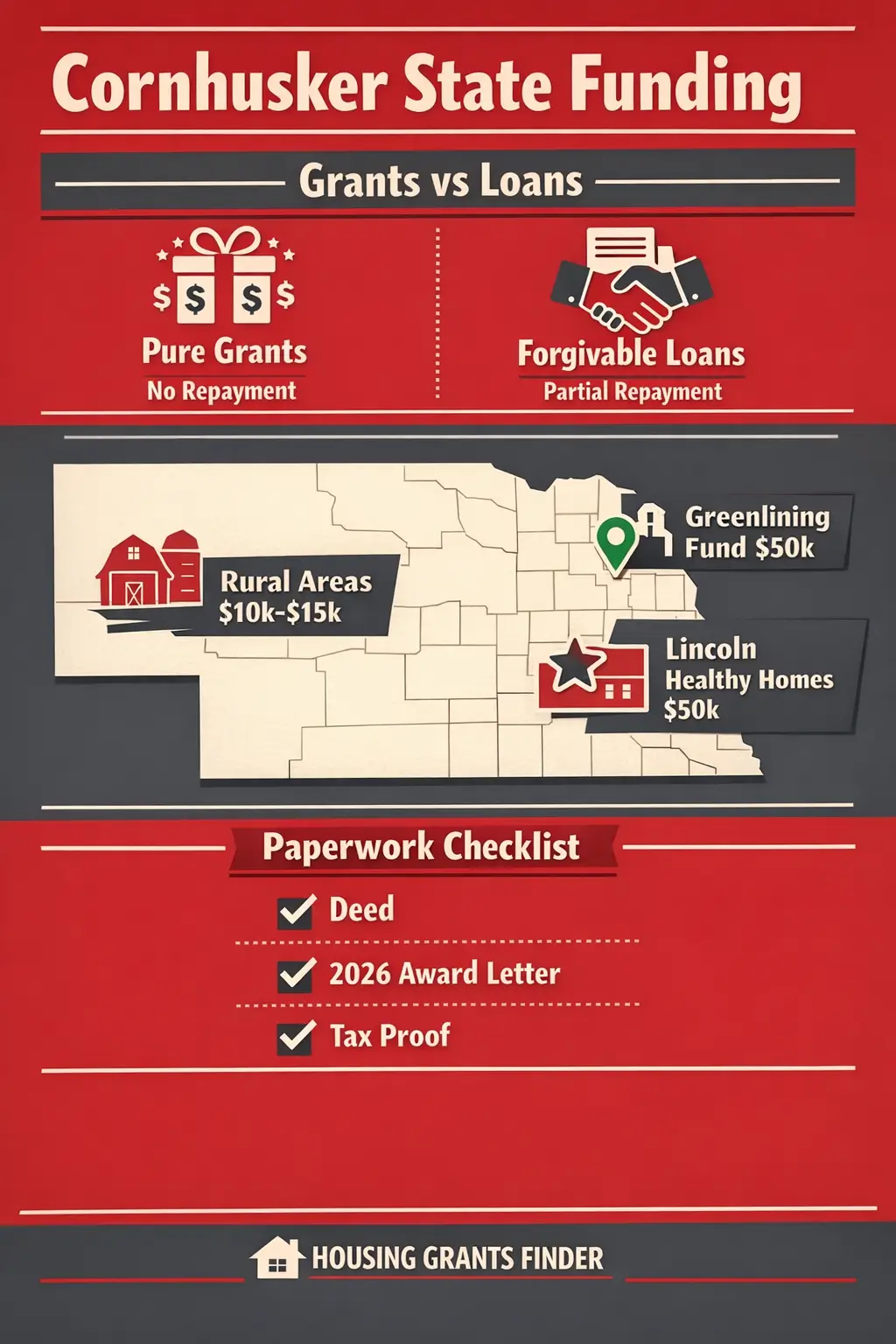
Know what you are signing: Grants vs. Loans.
Not all help is a gift. Many people get excited about funding, only to realize they just put a lien on their house.
- Grants: No repayment if you follow the rules.
- Loans: You pay this back, but the interest is usually tiny (1% or 0%).
- Deferred Loans: You don’t make monthly payments. Instead, the balance is due when you sell or move.
- Forgivable Loans: Some or all of the balance may be forgiven over a stated occupancy period. The exact forgiveness schedule, lien and repayment triggers depend on the written program agreement.
The Rural Safety: USDA Section 504 Nebraska
USDA Section 504 is currently open in Nebraska and accepts applications through local Rural Development offices on an ongoing basis. It serves eligible very-low-income homeowners in USDA-eligible rural areas.
- Loan: Up to $40,000 at a fixed 1% interest rate for up to 20 years.
- Standard grant: Up to $10,000 for eligible homeowners age 62 or older who cannot repay a repair loan. Grant funds must remove health and safety hazards.
- Presidential-disaster grant: Up to $15,000 for an eligible home damaged in a qualifying presidentially declared disaster area.
- Combined assistance: Up to $50,000 normally or $55,000 in a qualifying presidentially declared disaster area.
- Credit: Applicants must be unable to obtain affordable credit elsewhere.
- Rural eligibility: Check the exact property address through USDA’s eligibility site rather than relying on one population cutoff.
- Repayment: A grant generally must be repaid if the property is sold within three years.
Link: USDA Rural Development Nebraska
Can You Get a Government Grant for a New Roof?
This is what everyone asks for.
Roof work may qualify if it’s tied to health, safety, or making the home livable again. It is often covered under the USDA 504 program or local city rehab programs if the leak is damaging the structure. (Learn more about roof replacement programs).
Cosmetic upgrades do not qualify.
Lower Your Bills: Weatherization Assistance (WAP)
Nebraska’s Weatherization Assistance Program is administered by the Nebraska Department of Water, Energy, and Environment (DWEE) through local providers. It is an energy-efficiency program, not a general home-remodeling or roof-replacement grant.
- Possible work: Insulation, air-leak reduction, furnace repair or replacement, high-efficiency lighting, water-heater and pipe insulation, and cracked-window repairs.
- Income: Household income generally must be below 200% of the Federal Poverty Level.
- Mobile homes: Manufactured and mobile homes may qualify for approved weatherization measures.
- Renters: Renters may qualify with required landlord permission and subject to program rules.
- Roof limitation: Weatherization is not a standalone roof replacement program. Ask the local provider whether a condition must be corrected before energy-efficiency work can proceed.
If You Need Emergency Repair Help Fast
Nebraska Furnace and Cooling Repair Help
DHHS LIHEAP: Eligible households may receive up to $750 toward repair or replacement of a furnace or central air conditioner. The household must meet the applicable LIHEAP heating or cooling rules, document the need and provide estimates when requested.
DWEE HCRRA: Nebraska also lists a separate Heating and Cooling Repair and Replacement Assistance pathway of up to $5,000. Contact DWEE for the separate eligibility requirements.
Current LIHEAP income: For the October 1, 2025 through September 30, 2026 program year, standard LIHEAP eligibility generally uses 150% of the Federal Poverty Level.
Do not send the same application everywhere if the repair is urgent. In Nebraska, speed usually depends on matching the hazard to the right program first.
- Emergency furnace or heating failure: Start with LIHEAP emergency furnace repair or your local Community Action Agency.
- Rural roof, stair, plumbing, or wiring hazard: USDA Section 504 is usually the first call.
- Lincoln or Omaha repair issue: Start with the city or nonprofit pathway before looking statewide.
- Storm-related damage: Compare local options with broader disaster recovery grants if your county has a declared event.
City-Specific: Lincoln and Omaha
Lincoln: Healthy Homes & Rehab
Lincoln’s Healthy Homes Grant addresses health and safety hazards in qualifying properties within eligible census tracts. The City received a $1 million HUD award, and current program information says funding is available until fall 2028 or until funds are exhausted.
- Healthy Homes grant amount: Lincoln’s original award announcement states that each grant is limited to $12,000 per unit.
- Possible hazards: Roof leaks, causes of mold, radon, electrical hazards, smoke and carbon-monoxide alarms, exterior security issues and climate-control problems such as HVAC or broken windows.
- Priority: Preference is given to qualifying households with children, adults age 62+, or persons with disabilities.
- Geography: The property must fall within the program’s eligible census areas.
Lincoln Home Rehabilitation Loans
The City’s separate federally funded Home Rehabilitation Program provides 0% interest loans to qualifying low- and moderate-income homeowners. Do not combine this loan program’s terms with the Healthy Homes grant.
Important: The current public program page does not publish a universal $50,000 homeowner cap, so remove that hard-coded amount unless you are using the current program policies and procedures.
Omaha: Habitat Home Repair & Greenlining
Habitat for Humanity of Omaha currently serves Douglas, Sarpy, Washington, Cass and Burt counties.
- Structure: Qualified homeowners generally receive a 0% interest repair loan repaid over 1–10 years.
- Possible repairs: Furnace, AC, water heater, roofing, windows and doors, plumbing, electrical work, exterior repairs and accessibility improvements.
- Basic screening: Ability to repay, clear title, owner-occupancy, property taxes, insurance and income are part of the eligibility review.
Greenlining Fund: Front Porch Investments currently supports no-cost repair programs for qualifying homeowners in formerly redlined areas of Northeast and Southeast Omaha.
- Current no-cost repair providers: Canopy South, Homewoven and Habitat Omaha.
- Income: Household income generally must not exceed 80% of Omaha Metro AMI for the no-cost repair program.
- Property: The applicant must own and occupy a single-family home in an eligible formerly redlined census tract.
- Old loan program: The Greenlining Home Equity Loan Fund’s interest period is closed and new interest forms are no longer being accepted. Do not present the old 30-year 0% HELF loan as the current primary Greenlining option.
Mobile Home and Accessibility Help in Nebraska
Nebraska does not have one single statewide mobile home repair grant, but some repair help still reaches manufactured homes when the issue involves safety, accessibility, or basic habitability.
Weatherization is an important manufactured-home option: Nebraska’s Weatherization program specifically states that mobile homes can receive approved measures such as underbelly insulation, window sealing and air-leak sealing.
For rural homeowners, USDA Section 504 may still be the strongest starting point if the home and ownership setup meet program rules. For accessibility changes such as ramps, safer bathrooms, and other aging-in-place improvements, senior and disability-focused repair pathways may be a better fit than standard rehab programs. You can also review our bathroom safety and walk-in tub grants guide for related accessibility help.
Tribal Housing Assistance
If you are a member of a tribal nation, your first stop should be the Tribal Housing office.
Winnebago Tribe of Nebraska
They offer an Emergency Home Repair Program and a Senior Home Repair Program.
- Ownership/residency: The Tribal Housing page requires proof of ownership and states that the applicant must have lived in the home for at least two years.
- Repair bids: Two written work bids are required.
- Accessibility: A doctor’s recommendation is required for handicap-accessibility work.
Omaha Tribe of Nebraska
Current status: The Omaha Tribe posted on July 15, 2026 that its ARPA-funded Home Improvement Program is accepting applications. Applications are available online and at the reception desk in the Tribal administration building.
Because Tribal funding and eligibility rules can change, enrolled members should use the current Tribal application and confirm required documents directly with the Omaha Tribe before arranging repairs.
Who should start where?
- Rural Seniors: Start with USDA 504.
- Omaha Homeowners: Check Habitat Omaha or the Greenlining Fund.
- Lincoln Residents: Check the Healthy Homes grant.
- Tribal Members: Go to your Tribal Housing office first.
Your Paperwork Checklist
Each Nebraska program requests different documents. Prepare these common items, but submit only what the administrator asks for:
- Identity: Photo ID and age or disability documentation when relevant.
- Ownership or occupancy: Deed, mortgage documents, lease or other accepted proof.
- Income: Current pay records, Social Security or other benefit statements, tax returns or bank records as requested.
- Property information: Taxes, mortgage balance and homeowners insurance where the specific program requires them.
- Repair evidence: Photos, inspection findings, code notices or contractor estimates if requested.
- Do not start early: Confirm whether inspection and written approval must occur before work begins.
FAQs
What is the main government home repair program for rural Nebraska?
USDA Section 504 is one of the main federal options for eligible very-low-income rural homeowners. Loans may reach $40,000, while qualifying homeowners age 62+ who cannot repay a loan may qualify for a grant up to $10,000.
Can Nebraska seniors get help with roof repairs?
Possibly. USDA Section 504 grants may help eligible rural homeowners age 62+ when roof work is needed to remove a health or safety hazard. Lincoln, Omaha and Tribal programs may offer additional options depending on location and funding.
Does Nebraska Weatherization pay for a new roof?
Weatherization is not a general roof replacement program. It focuses on energy-efficiency measures such as insulation, air sealing and heating-system work. Ask the local provider whether another repair must be completed before weatherization can proceed.
What is the income limit for Nebraska repair help?
There is no single statewide limit. Nebraska Weatherization generally uses 200% of the Federal Poverty Level, LIHEAP currently uses 150% FPL, USDA uses county-specific very-low-income limits, and local programs use their own AMI or income rules.
Can Nebraska LIHEAP help replace a furnace?
Possibly. Nebraska DHHS currently lists up to $750 for qualifying furnace or central-air repair or replacement. Nebraska DWEE also administers a separate HCRRA pathway that may provide up to $5,000 under its own eligibility rules.
How much does Lincoln Healthy Homes provide?
Lincoln received a $1 million Healthy Homes award, but the City’s award announcement states that individual grants are limited to $12,000 per unit. The program targets qualifying health and safety hazards in eligible areas.
Is Omaha’s Greenlining home repair program still available?
Current Greenlining funding supports no-cost repair programs through providers including Canopy South, Homewoven and Habitat Omaha for qualifying homeowners in eligible formerly redlined areas. The older 30-year Home Equity Loan Fund intake is closed.
Can I use more than one home repair program?
Sometimes. Different programs may help with separate eligible needs, but the same repair cost generally cannot be paid twice. Confirm duplication-of-benefits and stacking rules with each administrator before accepting assistance.
Conclusion
Nebraska home repair assistance is divided among USDA Rural Development, Weatherization and energy programs, Lincoln city programs, Omaha-area nonprofit funding and Tribal housing programs. There is no single application that covers every repair.
Start with the program that matches your location and repair type, confirm current intake and gather the documents that specific administrator requests. Do not begin contractor work before required inspection or written approval, and review whether the assistance is a grant, no-cost service, loan, deferred loan or forgivable assistance before accepting it.