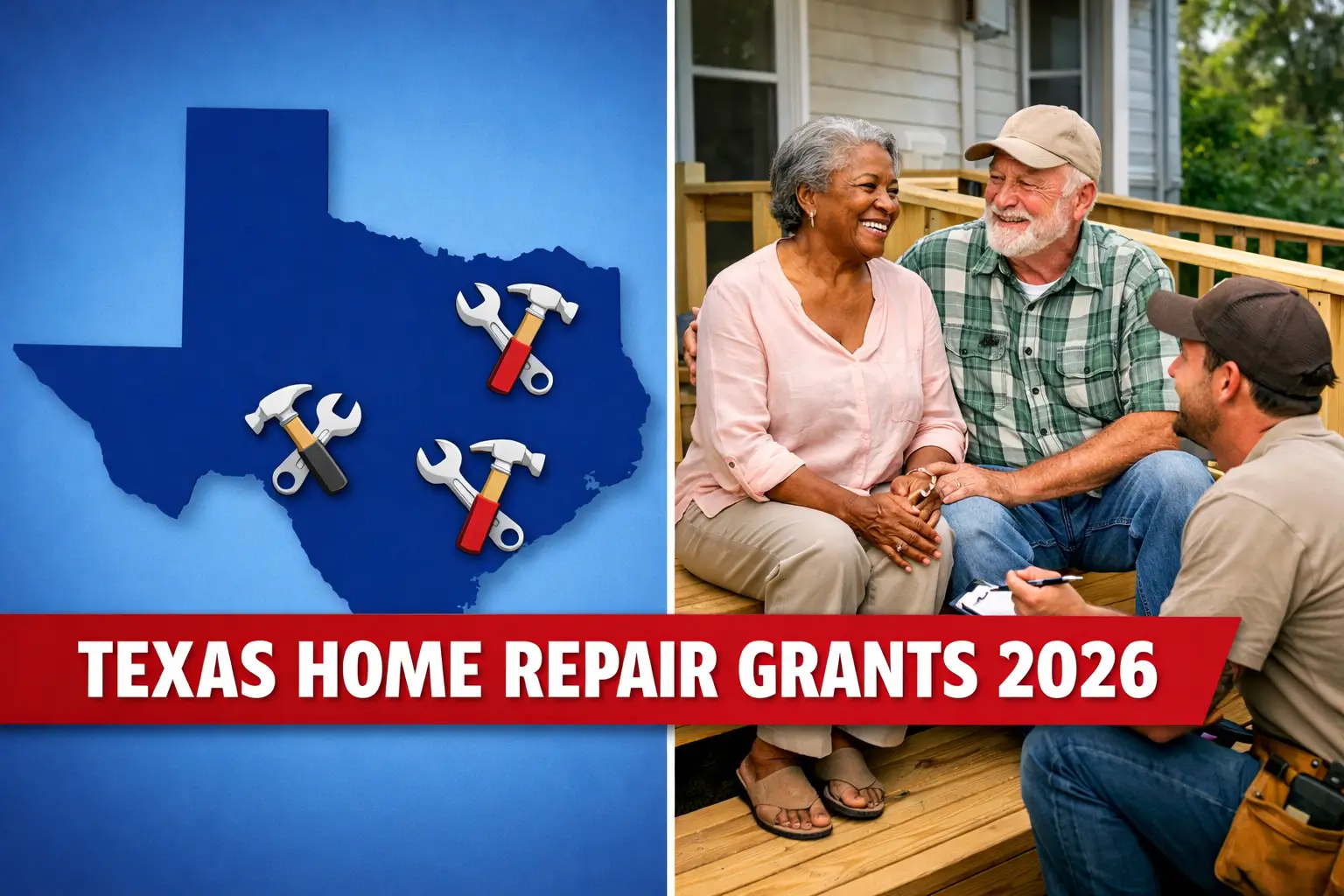
Texas Home Repair Grants 2026: AYBR, HRA & City Programs
If you own a home in Texas, you already know what heat, humidity, and wild weather can do to a roof, plumbing, foundation, electrical wiring, and HVAC systems. In 2026, repair costs are higher than ever, but Texas has real programs that cover health and safety hazards, accessibility modifications, and, in some cases, full reconstruction for eligible homeowners.
This guide combines the most essential official Texas programs, local city and county funding, and nonprofit options, including key terms and contact details that people often overlook.
Fast Eligibility Check
Most programs look for some mix of:
- Owner-occupied, primary residence
- Clear title or workable title pathway
- Household income at or below a set limit (often 80% AMI or AMFI)
- Priority categories such as age 62+, disability, children in the home, or serious health and safety hazards
- Proof such as insurance, tax status, and documentation
Many programs open and close based on funding. Some operate through a waiting list.
Best Texas Home Repair Programs by Situation
If you are trying to find the right Texas home repair program fast, match your situation first instead of applying blindly.
- Disability or accessibility needs: Amy Young Barrier Removal is often the strongest Texas option for ramps, safer bathrooms, wider access points, and hazard-removal work tied to daily use.
- Home is unlivable or beyond repair: Homeowner Reconstruction Assistance is the better fit when reconstruction, replacement housing, or site-based rebuilding may be required.
- City-specific repair help: Austin, Dallas, San Antonio, and Harris County each run separate repair tracks with their own intake rules, funding windows, and documentation standards.
- Rural homeowners: USDA Section 504 is one of the most practical options for very low-income owners in eligible rural areas who need essential repairs.
- Senior households: Priority often improves when the homeowner is older, has a disability, or the repair affects basic health and safety. See our full guide to home repair grants for seniors.
Amy Young Barrier Removal (AYBR): Disabled Texans
The Amy Young Barrier Removal (AYBR) program is Texas’s standout accessibility grant. It is not a general remodeling. It is intended to make a home safe for daily living when someone in the household has a documented disability.
What AYBR covers
This is where searches for wheelchair ramp grants, walk-in showers, roll-in showers, grab bars, and widened doorways fit naturally. (See our full guide on bathroom safety grants).
- Entry and interior ramps
- Handrails and safer pathways
- Bathroom safety upgrades and accessibility layouts
- Accessibility-related fixes are tied to serious hazards when they affect the safe use of the home
What it Offers
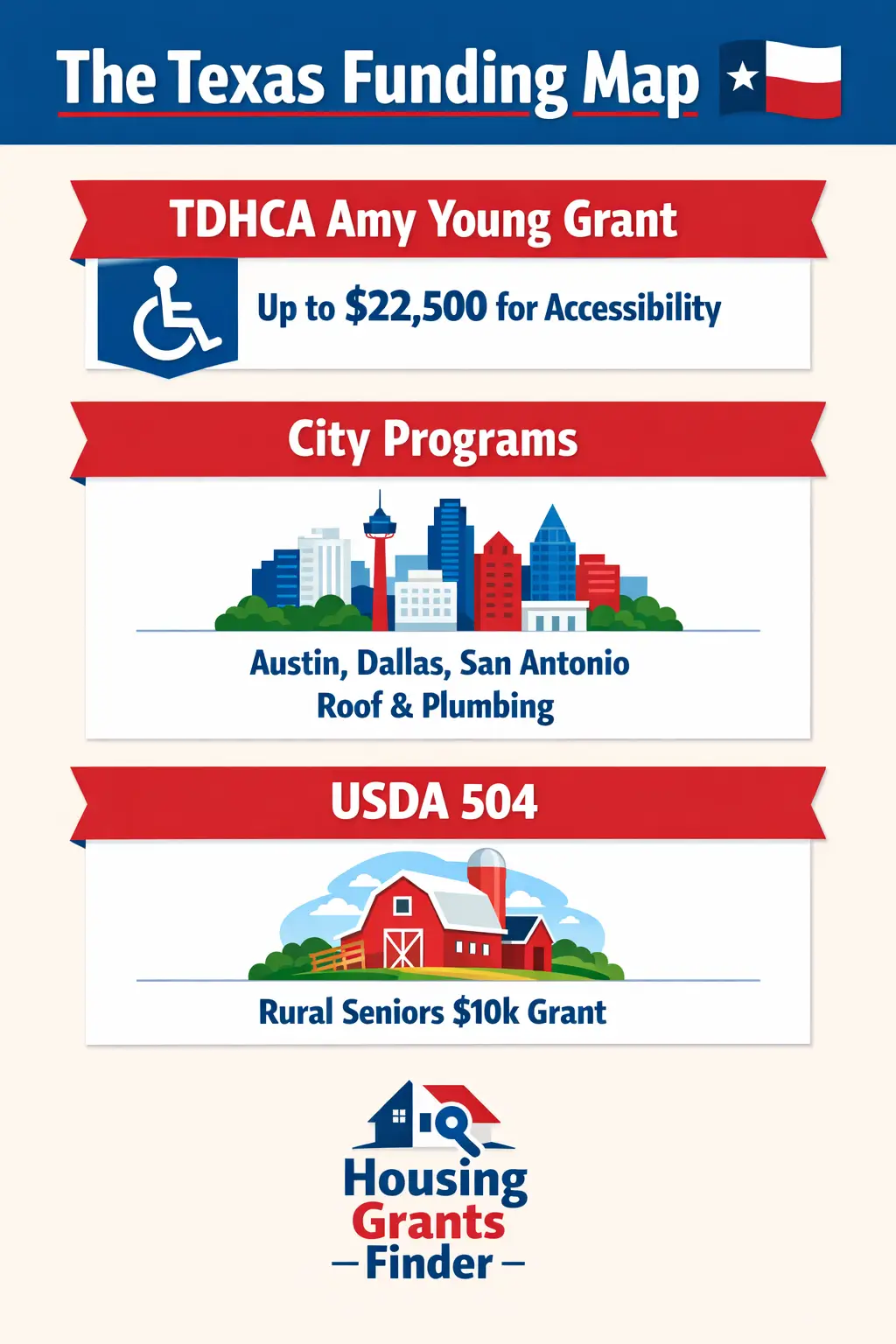
- Maximum grant: Up to $22,500 per household
- Repayment: $0 (grant, not a loan)
- Income limit: Household income typically at or below 80% AMFI
- 75/25 rule: At least 75% must be used for accessibility work, and up to 25% can go to other life-threatening hazards tied to safe use
- Manufactured housing: Units built on or after January 1, 1995, may qualify for complete work. Older units are commonly limited to exterior-only accessibility features.
How Funding Actually Works
AYBR uses a reservation system through local administrators. Reservations are time-stamped and reviewed in order, but funding is not guaranteed just because a name is on a list. Availability depends on the local provider’s funding cycle and remaining capacity.
Official Resource: TDHCA Amy Young Program Details
Texas Homeowner Reconstruction Assistance (HRA)
If a home is beyond repair, condemned, or rendered unlivable under qualifying conditions, Texas uses the Homeowner Reconstruction Assistance (HRA) framework administered by local administrators and participating jurisdictions.
This section is for homeowners dealing with a seriously damaged or unlivable house, including situations where rebuilding, relocation after a disaster (see our disaster recovery guide), or Colonia-related housing standards may apply.
What HRA can Support?
- Reconstruction on the same site, when allowed under program conditions
- Replacement housing or new construction in qualified scenarios
- Work tied to severe habitability problems, such as condemnation or disaster-related unlivable status, is handled by the local administrator
How assistance is structured
HRA support is commonly structured in two ways:
- Reconstruction on the same site is often handled as a grant agreement with an affordability or residency-compliance period.
- New construction or replacement housing: can be structured as a 0% interest loan with payment deferral and annual pro rata forgiveness.
Best Texas Programs for Seniors
Older homeowners are one of the strongest priority groups for Texas repair help, especially when the issue affects safe occupancy, mobility, sanitation, or a major home system.
- USDA Section 504: Best for very low-income rural homeowners, with grant help for eligible owners age 62 and older.
- Harris County Home Repair: Prioritizes homeowners age 62 or older, people with disabilities, and households needing accessibility improvements.
- City repair hubs: Austin, Dallas, and San Antonio each have separate repair pathways that may work for older homeowners depending on income, title, and location.
- Nonprofit support: Waiting-list based nonprofit programs can also be important for aging in place when local government funding is closed or delayed.
Texas does not use one single senior repair portal, so the best next step is usually to identify the local administrator first and then confirm whether your issue is treated as emergency repair, accessibility work, or major systems rehabilitation.
2026 Program Directory: City and County Hubs
If you are looking for an emergency home repair grant, a roof replacement grant, a sewer line repair grant, a 0% home rehabilitation loan, lead hazard help, code violation repairs, or health and safety home repairs, this section will be helpful.
City of Austin: Plumbing and Sewer Help Plus Multiple Repair Tracks
Austin has separate tracks depending on the problem:
- REPAIR! Grant Program for serious structural and safety issues
- Private Lateral Grant for sewer line repair or replacement
- Architectural Barrier Removal for accessibility
- Plumbing assistance programs and repair pathways
- Home rehabilitation loan options, including 0% interest structure, are offered under the program
Contact: (512) 974-3100 | Email: [email protected] | Official Site
City of Dallas: HIPP and the Strict Emergency Rule
Dallas assistance can open and close based on funding and city intake periods, so applications are accepted only when the city opens the program.
- Emergency Home Rehabilitation (EHR): Grant up to $10,000. A strict rule applies to emergencies, with a short window between the event and the application.
- Major-Systems Repair (MSRP): Interest-free, forgivable, self-amortizing assistance up to $24,000
- Dallas Tomorrow Fund: Up to $20,000 for exterior code violations tied to compliance requirements
Contact: (214) 670-3644 | Email: [email protected] | Official Site
City of San Antonio: Under 1 Roof and Healthy Homes
San Antonio programs are strong, but eligibility rules are strict, especially around title, insurance, and property documentation.
Under 1 Roof
- One-time roof replacement assistance up to $19,000
- Uses high-reflectance white shingles to reduce heat gain and support cooling efficiency
- Processing can take months, depending on demand
Program contact: (210) 207-6459 | Official Site
Green and Healthy Homes
Targets:
- Lead-based paint hazards
- Asthma triggers
- Fire hazards
Program phone: (210) 207-4444 | General city contact: 3-1-1
Harris County (Houston Area)
Harris County home repair assistance is designed to address serious health and safety hazards for eligible homeowners.
- Minor Repair Grants: up to $20,000
- Moderate Repair or Rehab: up to $60,000 (often structured as deferred or forgivable assistance)
Priority eligibility commonly includes:
- Age 62+ or
- Disability (any age) or
- A disabled household member needing accessibility improvements
Contact: (832) 927-4955 | Official Harris County Site
Federal Funding: USDA Section 504
If you live in an eligible rural area, USDA Section 504 Home Repair is one of the most reliable sources of repair assistance for seniors and very low-income homeowners.
The numbers
- Maximum grant (age 62+): $10,000
- Maximum loan: $40,000
- Interest rate: 1% fixed
- Loan term: up to 20 years
- Hard rule: you must be unable to obtain affordable credit elsewhere
- Grant repayment rule: the grant generally must be repaid if the home is sold within 3 years (Read the full USDA 504 Guide).
Texas USDA Housing Staff: (254) 742-9770
Nonprofit Repair Programs Texans Actually Use
Meals on Wheels Central Texas
This program is widely searched for aging-in-place support and major home safety repairs.
- Service counties often include: Travis, Williamson, Bastrop, Caldwell, Hays, Burnet, Blanco, and Fayette.
- It can operate via a waiting list, depending on demand
Waiting list phone: (737) 218-4262
Habitat for Humanity: Montgomery County
Habitat Montgomery County provides critical repair support through a structured intake process.
- Pre-qualification
- Interview
- Documentation review
Contact: (936) 441-4663 | Email: [email protected]
Find the Hidden Local Money for Your County
Texas repair funding often flows through local providers rather than directly to individuals.
Use TDHCA’s provider directory
Search for Home Repair or Home Repair and Accessibility, and enter your city or county. The local administrator is often:
- A Community Action Agency
- A Council of Government (COG)
- A nonprofit listed as the local program operator
Use 2-1-1 for fast referrals
If you want the quickest way to reach the person who handles it locally, call 2-1-1 and ask for the home repair and accessibility administrators for your ZIP code, especially the Community Action Agency or the COG.
What Counts as an Emergency Repair in Texas?
Most Texas programs use emergency repair language for problems that create an immediate threat to health or safety, not for cosmetic damage or routine wear.
- Electrical hazards, exposed wiring, or systems that make the home unsafe
- Major plumbing failures, sewer backups, or gas-line issues
- Roof failures or structural problems that leave the home exposed to active water intrusion
- Unsafe heating or cooling conditions when they create a serious habitability problem
If the issue is tied to loss of heating or cooling, you may also want to review our guide to LIHEAP emergency furnace repair help because some energy-related emergencies move through a different funding path.
How to Apply for Texas Home Repair Help
- Match the problem to the right program: accessibility, emergency repair, major systems repair, reconstruction, or rural repair help.
- Find the real local administrator: in Texas, the operator may be a city housing office, county program, Community Action Agency, Council of Government, or nonprofit partner.
- Gather documents early: proof of ownership, ID, income records, insurance information if applicable, property-tax status, and photos of the damage.
- Do not start work before approval: many repair programs will not reimburse work that begins too early.
- Ask how the money is structured: some programs are true grants, while others use deferred or forgivable assistance. Read more in our guide on whether home repair grants have to be paid back.
- Stay careful with contractors: if a program is open, use approved intake channels and avoid anyone asking for large upfront payments or fake grant-processing fees. See our guide on how to avoid home repair scams.
FAQs
Do I have to pay back a home repair grant?
Usually no, but many programs have a compliance timer. Example: USDA 504 grants may require repayment if you sell within 3 years. Many local programs use deferred forgivable assistance with multi-year forgiveness periods.
What counts as an emergency repair?
Dallas uses a strict definition and a short time window for emergency events. In most areas, emergencies are life-safety threats like electrical failures, gas leaks, or severe structural collapse.
Can I get help for a manufactured home?
Sometimes. USDA rules and local program rules vary. For AYBR, manufactured housing eligibility depends on the unit meeting the program’s construction requirements, with older units often limited to exterior-only accessibility items.
What if I move before the forgiveness timer ends?
With forgivable-loan programs, the remaining balance is typically recaptured through the property transaction or handled under the program’s terms.
How do I quickly find the local administrator?
Use TDHCA’s provider directory for your county and cross-check with your city or county housing hub. The administrator’s name matters more than the program name.
Are Texas home repair programs grants or forgivable loans?
Texas uses a mix of true grants, deferred assistance, and forgivable loan structures. AYBR is a grant, but other programs may require you to keep the home as your primary residence for a set number of years before the balance is fully forgiven. Always ask whether the assistance places a lien, restrictive covenant, or compliance period on the property. For a plain-English explanation, read our guide on when home repair grants have to be paid back.
Conclusion
Texas home repair help in 2026 is real, but it is fragmented across disability grants, local repair hubs, rural federal funding, reconstruction pathways, and nonprofit waitlists. The homeowners who move fastest usually do two things early: they identify the correct local administrator and they gather their ownership, income, and damage documents before the intake window closes.
If your repair problem is urgent, start with the local city, county, or TDHCA-linked administrator that actually controls the intake for your area, then confirm whether your case fits emergency repair, accessibility work, major systems repair, or USDA rural assistance.