Maine Home Repair Grants 2026: USDA, State & Local Help
Owning a home in the Pine Tree State is a lesson in maintenance. Whether you’re defending an 1890s farmhouse in Aroostook County from a record-breaking snowpack or patching up a coastal Cape that’s weathered too many January gales, the Way Life Should Be usually comes with a hefty repair bill. In 2026, the rules have shifted. Maine has moved aggressively toward electrification and climate-resilient rebuilding. (See how these New England climate upgrades compare to Rhode Island’s latest repair cycles).
This guide identifies every verified path from whole-house restorations to the brand-new 2026 roofing grants, to protect your home without draining your savings. For homeowners exploring nationwide options, our directory offers guidance on finding financial assistance for home repairs.
⚡ Quick Answer: Maine Home Repair Grants (2026 Snapshot)
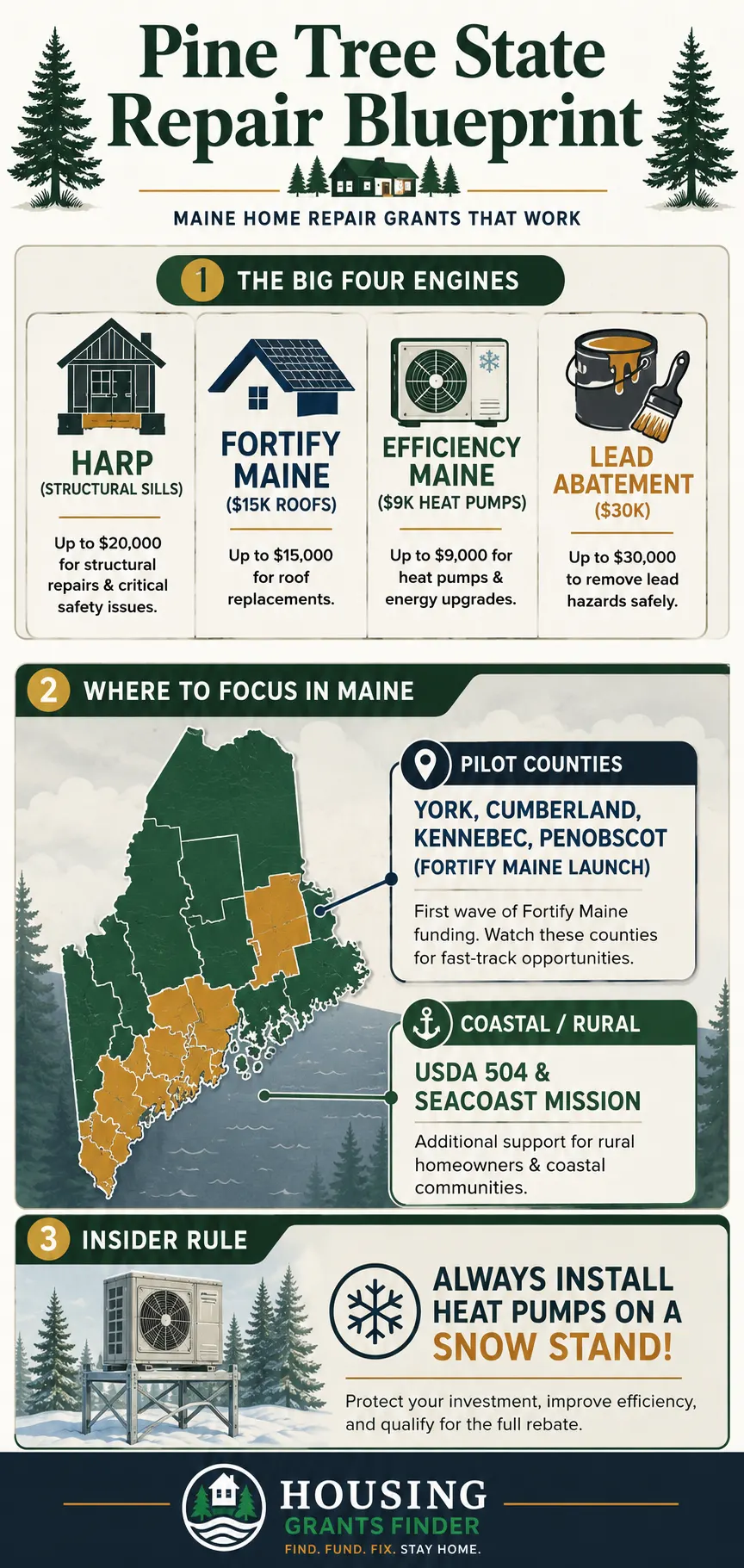
Eligible Maine homeowners can access up to $35,000 in non-repayable grants or 100% forgivable loans this year. The four primary funding engines active right now are: MaineHousing HARP (for structural foundation sills and general repairs), the new Fortify Maine Grant ($10,000 to $15,000 for wind-resistant roofs), Efficiency Maine heat pump rebates ($3,000+), and USDA Section 504 rural grants ($10,000 for seniors age 62+). To get fast-tracked, apply for LIHEAP fuel assistance first at your local CAP agency to automatically verify your household income.

Home Accessibility & Repair Program (HARP)
Formerly known simply as the home repair program, MaineHousing’s HARP is the state’s primary tool for major structural fixes.
Provided through deferred, forgivable loans. If you remain in the home for a set period (usually 10 years), the debt is entirely forgiven.
- The Scope: Covers roofs, chimneys, structural sills, electrical upgrades, and hazardous flooring.
- 2026 Update: The program now includes Barrier Removal funding, specifically to fix roofs or sills that would otherwise prevent you from qualifying for free weatherization.
- Lived-In Detail: In Maine, inspectors check the sills first. These are the heavy beams at the bottom of your house. Decades of snow piling against the foundation often rot these out. HARP is one of the few programs that will actually pay to jack up your house and replace these beams.
- Official Link: MaineHousing HARP
Fortify Maine Roofing Grant
Launching in June 2026, this initiative was created to stop insurance companies from dropping Maine homeowners due to aging roofs.
- The Benefit: $10,000 (Standard) or $15,000 (Enhanced) grants for households on SNAP or MaineCare verification lists.
- Pilot Counties: The 2026 launch is limited to York, Cumberland, Kennebec, and Penobscot counties before expanding statewide.
This isn’t just a shingle swap. You must use a FORTIFIED-certified roofer who installs a sealed roof deck and enhanced attachments to withstand 100+ mph winds.
- Insurance Perk: Homeowners with a fortified roof will qualify for insurance premium discounts starting in late 2026.
- Official Link: Fortify Maine – Bureau of Insurance
Heat Pumps & Weatherization
Maine is leading the nation in heat pumps. In 2026, the incentives are higher than ever, especially since the Federal 25C tax credit has expired.
Efficiency Maine Rebates
- Low-Income Tier: $3,000 per unit (up to $9,000 total for three units).
- 2026 Bonus: Get an additional $500 per unit for upgrades completed between March 1 and December 31, 2026.
- Mobile Home HEAR Grant: Single-wide mobile homes occupied by low-income residents can stack rebates for up to $17,000 in total heat pump coverage (essential for low-income weatherization Maine households).
If you’re moving to heat pumps, don’t let the contractor put the outdoor unit right under a drip edge on your roof. In Maine, melting snow will fall on it, refreeze, and turn the unit into a block of ice. Always ask for a snow stand to keep it running high above the snowdrifts in February. (Need immediate heating fixes? See emergency heating repair Maine crisis funds).
- Official Link: Efficiency Maine Rebates
Specialized Grants: Water, Lead, and Accessibility
While a new roof is great, some problems are invisible or deeply structural. Maine has carved out specific funding for these high-stakes issues:
Lead Hazard Reduction Program
Maine has some of the oldest housing stock in the U.S., which means lead paint is almost a given in homes built before 1978.
This program provides up to $30,000 to swap out lead-contaminated windows, doors, and trim. Because windows are the primary source of lead dust (from friction), this often results in a full set of high-efficiency replacements.
- During lead abatement, the containment is serious. Contractors will tape off rooms with thick plastic. Plan for a HEPA-vac clean-up. You’ll be amazed at how much quieter your house is once those old 1940s single-pane windows are finally gone.
- Official Portal: MaineHousing Lead Abatement Program
Small Community Grant (SCG) for Septic
It is Designed to replace failing systems polluting waterbodies. If your federal taxable income was $84,086 or less, you may qualify for a grant covering 25% to 100% of the cost.
- Deadline Alert: All ARPA-funded septic grants must be spent by October 2, 2026.
- Lived-In Detail: To qualify, you’ll need a perc test. Be prepared for the Easement: to take this money, you usually grant the town a permanent right to inspect the system.
- Official Portal: Maine DEP Small Community Grant Program
Mobile Home Replacement Initiative
If you live in a mobile home built before June 15, 1976, the state considers it a safety hazard.
- Instead of patching a dangerous unit, MaineHousing provides a $35,000 grant to help you haul the old unit away and replace it with a new, Energy Star-certified manufactured home.
- Official Portal: MaineHousing Mobile Home Replacement
Accessibility & Aging in Place
- Community Aging in Place (CAP): Small but mighty. Volunteers install grab bars and ramps to prevent falls.
- Alpha One: Handles significant changes like widening doors or walk-in tubs through the mPOWER loan and adaptive grants.
- Lived-In Detail: If you’re building a ramp, ask for aluminum over wood. Maine winters rot wooden ramps quickly, and aluminum provides better grip in the slush.
- Official Links: Alpha One Accessibility | Community Aging in Place Grant
Regional & Federal Safety Nets
Maine Seacoast Mission (Washington & Hancock Counties)
Homeowners in Washington and Eastern Hancock Counties can apply for the 2026 Housing Improvement Program. This volunteer-led effort focuses on making homes warm, safe, and dry.
- Official Link: Maine Seacoast Mission Housing Repair
USDA Section 504 Home Repair
For residents in towns with fewer than 35,000 people (USDA Section 504 guidelines).
- The Grant: Up to $10,000 for seniors (62+) to remove safety hazards.
- The Loan: Up to $40,000 at a fixed 1% interest rate.
- Official Link: USDA Rural Development Maine
2026 Program Comparison Table
Eligibility Criteria
- Income Caps: Most programs use 80% of the Area Median Income (AMI). For a family of four, this is roughly $72,000.
- Primary Residence Only: Grants are strictly blocked for camps or vacation rentals.
- Tax Standing: Maine towns are aggressive with tax liens. You must be current on property taxes or have an official payment plan.
How to Apply: The Step-by-Step Guide
- The LIHEAP: Apply for Fuel Assistance (LIHEAP) first at your local Community Action Program (CAP). Even a $1 benefit automatically proves your income for almost everything else.
- Request a WSD Inspection: Ask for a Warm, Safe, and Dry inspection from your CAP agency.
- Check for Red Tags: If a technician shuts off your furnace for safety, keep that Red Tag. It is a fast-pass that bypasses the 6-month waitlist for repairs.
FAQs
Can I get help with burst pipes?
HARP and CHIP cover underlying plumbing failures if the home is unsafe. Furnace-related bursts may qualify for emergency heater replacement grants.
Is my seasonal lake camp eligible for rebates?
Rebates often apply to secondary homes, but the highest low-income tiers require primary residency and year-round LIHEAP enrollment.
What if my town skips the Septic Grant?
You cannot access SCG funds directly. Instead, use a USDA Section 504 loan for 1% interest repairs regardless of town participation.
Why the 1976 rule for mobile homes?
Pre-1976 units lack federal HUD safety codes. They are often too structurally weak to fix, so Maine prioritizes full replacement instead.
Conclusion
The secret to winning a Maine home repair grant is Stacking. Start by applying for LIHEAP at your local CAP agency today. Then, prepare your digital folder: scan your deed and 2025 tax returns.
Having these ready to email the moment an inspector visits will jump you ahead of the hundreds of other homeowners currently on the 2026 pending list.