Utah Home Repair Grants 2026: USDA, City, Senior Options
Utah homeowners may be able to get help through USDA repair assistance, regional housing rehabilitation programs, city emergency repair funds, weatherization, and accessibility grants. The best option usually depends on where you live, your income, and whether the repair involves a roof leak, failed heating system, accessibility barrier, or another health and safety problem.
This guide covers the main Utah home repair grants and repair assistance options for low-income homeowners, seniors, rural households, and people dealing with urgent system failures. If you are trying to compare Utah repair help by city, county, or program type, start with the sections below.
Who Qualifies for Utah Home Repair Grants?
Most Utah repair programs use the same core filters before approving an application.
- Owner-occupancy: You usually need to live in the home as your primary residence.
- Income limits: Many Utah programs use thresholds such as 80% AMI, 50% AMI, or federal poverty guidelines, depending on the program.
- Repair type: The strongest applications involve roof leaks, electrical hazards, failed HVAC systems, accessibility barriers, plumbing issues, or other health and safety conditions.
- Property status: You may need current homeowners insurance, clear ownership records, and proof that taxes or housing obligations are current.
- Priority groups: Seniors, disabled residents, military households, and rural homeowners often have stronger pathways than the average applicant.
USDA Section 504 (Rural Utah)
The USDA Section 504 Utah program remains the primary tool for rural home repair grants for residents outside major metro areas. It targets very-low-income homeowners to remove health and safety hazards.
USDA Home Repair Loan & Grant Limits (2026)
- Grant Portion: Up to $10,000 (or $15,000 in disaster areas). Specifically for homeowners age 62+ to remove hazards or fund accessibility modifications.
- Loan Portion: Up to $40,000 at a fixed 1% interest rate over 20 years.
- Combined Funding: You can mix both for up to $50,000 in assistance.
Deadline: Applications are accepted year-round through your local Rural Development office.
Official Link: USDA Rural Development Utah Section 504
Know What You’re Signing: Grants vs. Loans in Utah
Not all Utah home repair help works the same way. Some programs are true grants, while others are deferred or low-interest loans.
- Grants: Usually do not require repayment if you follow the rules.
- Loans: Must be repaid, even when the interest rate is low.
- Deferred loans: Often have no monthly payment, but the balance becomes due when you sell, move, or refinance.
- Forgivable loans: Can shrink over time if you stay in the home long enough.
For a broader repayment breakdown, see pay back home repair grants.
State & Regional Support: MAG & NUNIP
Utah utilizes regional associations to distribute housing rehabilitation funds, ensuring help reaches local neighborhoods.
Mountainland Association of Governments (MAG)
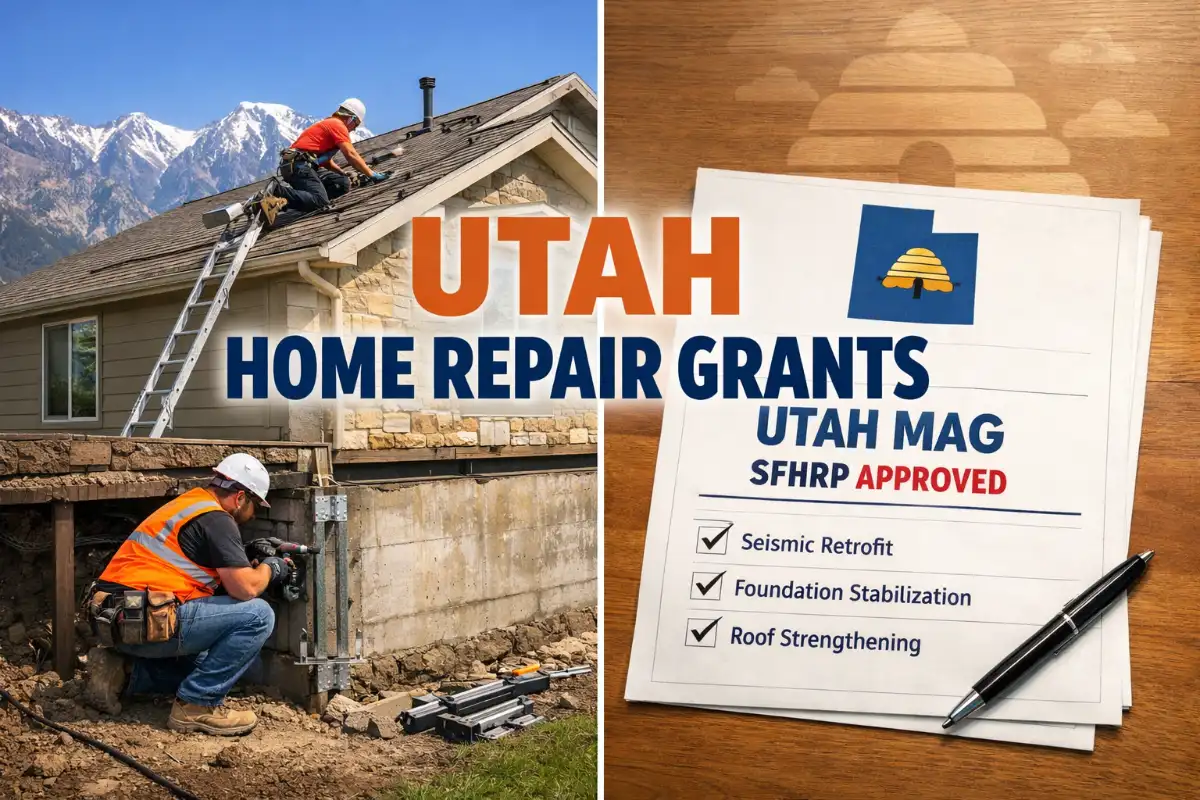
Serving Summit, Wasatch, and rural Utah Counties, the SFHRP is a critical resource for 2026.
- What it covers: Roof replacement, electrical/plumbing updates, and energy efficiency.
- Eligibility: Must earn less than 80% Area Median Income (AMI) and have current homeowners’ insurance.
Link: MAG SFHRP Information
Northern Utah Neighborhood Improvement Program (NUNIP)
Active for residents of Box Elder, Cache, and Rich counties.
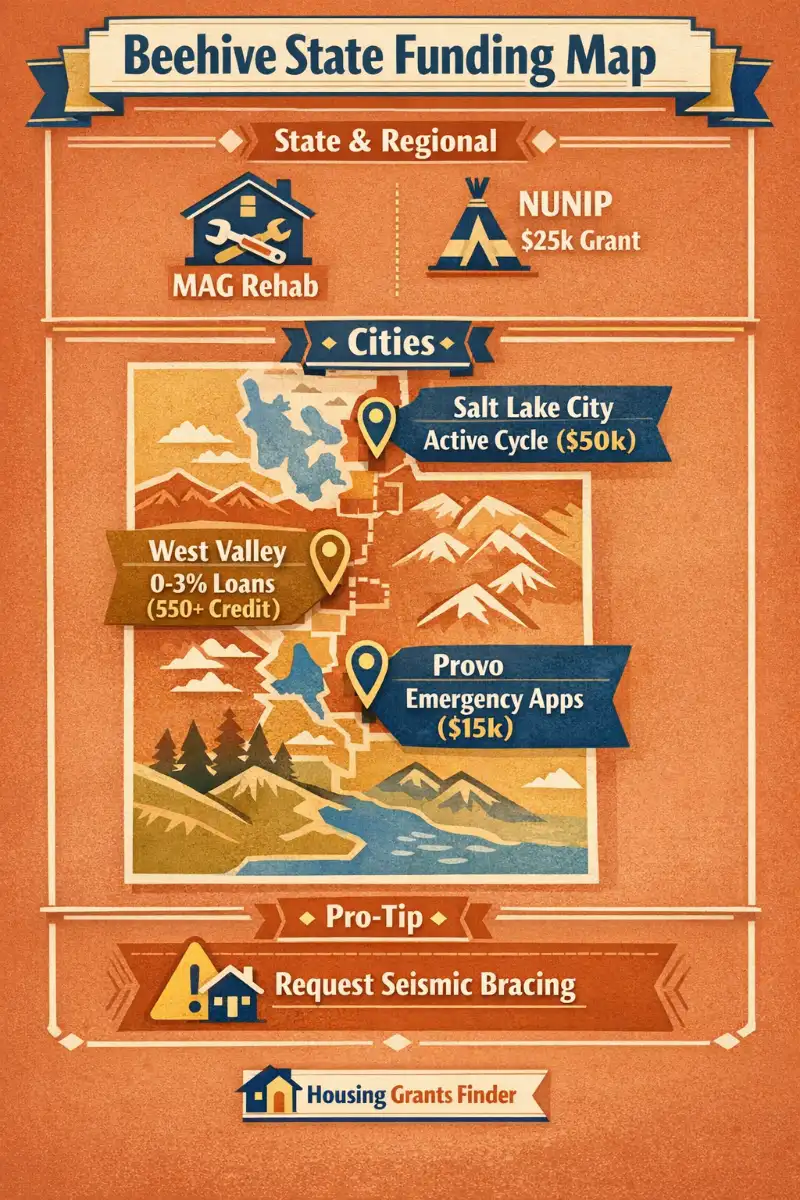
- The Deal: Qualified applicants receive a grant of up to $25,000 for approved repairs.
- Repayment: NO REPAYMENT IS REQUIRED! Funds are first-come, first-served.
Link: NUNIP Home Improvement
Municipal Boots on the Ground (City-Specific)
Utah’s largest cities manage their own Community Development Block Grants (CDBG) for emergency home repair assistance.
Specialized Assistance: Aging in Place & Weatherization
This section focuses on programs designed to lower your monthly bills and allow you to stay in your home safely as you age. These are the most active efficiency programs for the 2026 cycle.
Emergency Heating and Payment Relief
Not every urgent housing problem is a repair grant issue. Some Utah households first need payment relief or emergency heating help before they can stabilize the property.
- Mortgage and housing arrears: UHAF is payment relief, not a direct home repair grant.
- Failed furnace or heating emergency: Compare local repair pathways with LIHEAP emergency furnace repair.
- Energy-efficiency related repairs: Weatherization may help when the issue overlaps with insulation, air sealing, or furnace replacement.
Weatherization Assistance Program (WAP)
This is not a repair grant but a permanent efficiency upgrade program to slash your utility bills (often run by Utah community action agencies housing rehab teams).
- The Fixes: Includes furnace repair/replacement, attic and wall insulation, and advanced air sealing. (Provides vital low-income weatherization assistance Utah residents need).
- Eligibility: Household income must be at or below 200% of the Federal Poverty Level.
Official Link: Utah WAP Providers
Rehab Accessibility Program (RAP)
A state-funded initiative focused on barrier removal for residents with physical disabilities.
- The Funding: Provides a grant of up to $7,000 for accessibility modifications.
- Eligible Work: Installation of ramps, lifts, walk-in showers, and widening of doorways.
- Requirement: Your household income must be at or below 50% of the Area Median Income (AMI).
VA HISA Benefit
Specifically for Utah veterans, the Home Improvements and Structural Alterations (HISA) benefit is a medical necessity grant.
- The Benefit: A $6,800 lifetime grant for service-connected veterans, or $2,000 for non-service-connected veterans.
- Top 2026 Tip: The VA requires a direct prescription from a VA physician showing the modification is medically necessary.
- Official Link: VA HISA Benefits
Pro-Tips for Utah Homeowners
Navigating government bureaucracy in the Beehive State requires a strategic approach. Use these insider tips to move your application to the front of the line:
- Prioritize Need over Want: Lead with safety hazards like faulty wiring or roof leaks to trigger priority emergency processing.
- Leverage Seismic Readiness: Request seismic bracing in your rehab loan to align with 2026 earthquake readiness goals.
- Master the Fiscal Reset: Join interest lists before July 1st to secure priority when new annual budgets drop.
- Don’t Guess Your Rural Status: Check the USDA map; pockets of urban counties still qualify for rural-specific grant funding.
- Stack Your Programs: Use city grants for roof leaks, then let Weatherization handle high-cost furnace replacements.
Tribal and Navajo Home Repair Help
Utah homeowners living on tribal land or connected to tribal housing programs may have separate pathways that do not look like standard city or county repair programs.
- Navajo housing help: The Navajo HAF Project may provide substantial repair support for eligible homeowners in the four-state region.
- Why this matters: Tribal repair pathways often have different eligibility and documentation rules than standard Utah city programs.
FAQs
Who qualifies for home repair grants in Utah in 2026?
Owner-occupants earning below 80% Area Median Income qualify. Priority is given to seniors (60+), disabled residents, and active-duty military households.
Does Utah Weatherization pay for a new roof?
No. This program covers only furnaces and insulation. You must repair roof leaks first, using a USDA grant or city loan.
Is the assistance forgivable, or do I have to repay it?
Grants are generally forgivable after 3 years. Most major rehab loans are 0% interest, deferred loans repaid only when homes are sold.
Are there any strict deadlines I should be aware of for 2026?
The HAF Reinstatement Program closes strictly on September 30, 2026. Local pools like NUNIP typically run out of funding by mid-summer.
Can I get help if I live on the Navajo Nation land in Utah?
Yes. The Navajo HAF Project offers up to $100,000 for significant home repairs for eligible Navajo homeowners in the four-state region.
What is the credit score requirement for West Valley City?
Applicants must have a minimum FICO credit score of 550. This program focuses on 0-3% interest loans for vital health repairs.
Conclusion
Utah home repair assistance is strongest when you match the problem to the right program first. Rural homeowners should usually start with USDA Section 504, regional households should check MAG or NUNIP, and city residents should use the local repair or emergency loan track that matches their ZIP code. Keep your ownership records, income documents, insurance, and repair estimates ready before you apply.
For broader options, visit housinggrantsfinder.com.