Arizona Home Repair Grants 2026: USDA, AC & City Help
Arizona homeowners may be able to get help through a mix of federal repair programs, emergency utility assistance, city rehabilitation funds, and local nonprofit repair programs. The best option usually depends on whether the repair involves cooling, roofing, plumbing, accessibility, or a serious health and safety issue.
This guide covers the main Arizona home repair grants and repair assistance options for emergency AC failure, roof leaks, rural safety repairs, mobile home rehabilitation, and owner-occupied city programs. If you are looking for government home repair grants in Arizona, start by matching your repair type to the programs below.
Quick Answer: Where should Arizona homeowners start?
Arizona homeowners may qualify for repair assistance, but the correct program depends on the repair, location, household income, property type and current funding.
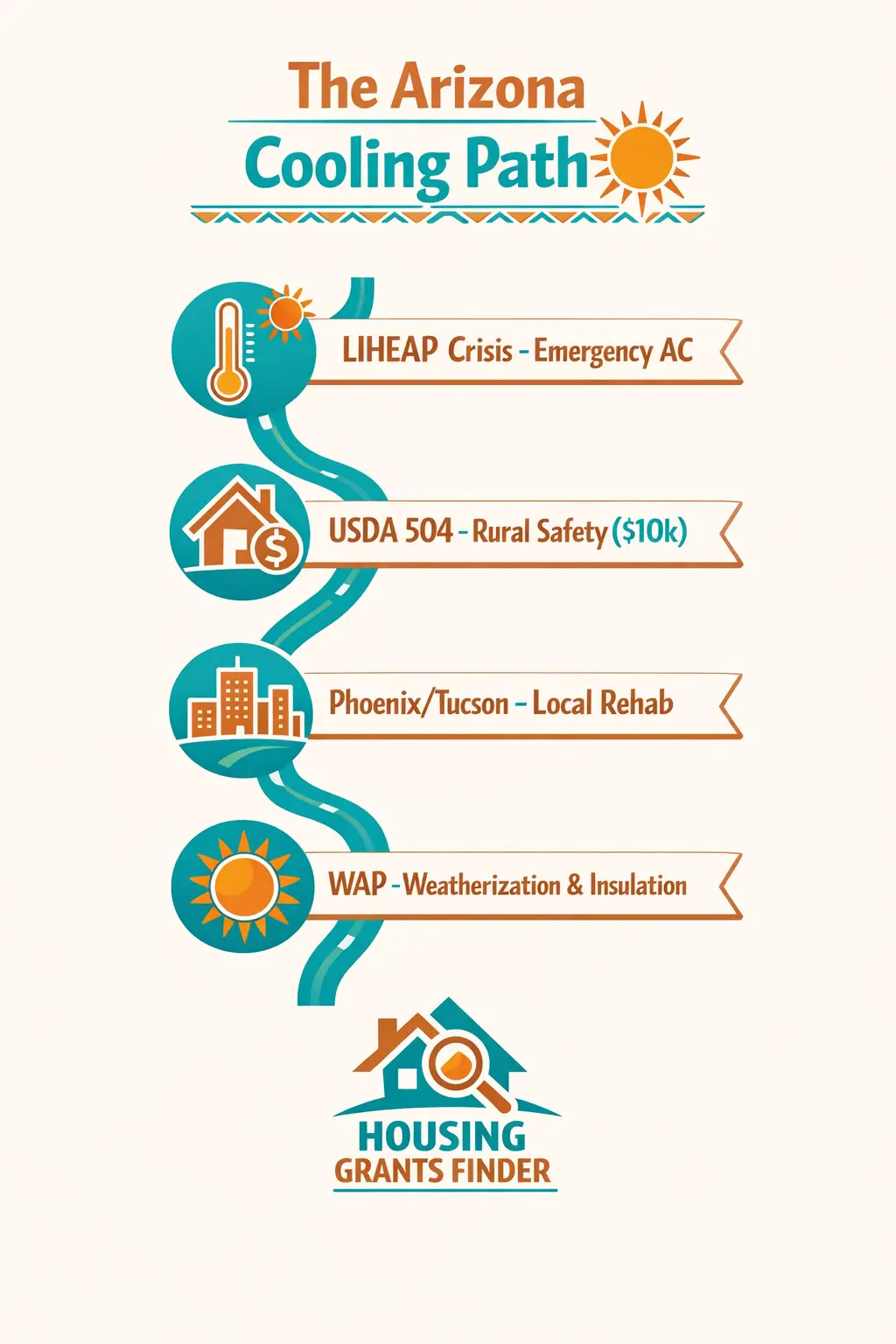
- Rural health and safety repair: Check USDA Section 504.
- Broken AC or dangerous heating system: Contact the local Community Action Agency, Weatherization provider and city or county emergency-repair program.
- Phoenix: Apply through the City of Phoenix Housing Repairs Program.
- Maricopa County outside participating city programs: Check the county Home Improvement Program service area.
- Tucson: Check THRP, Lead Hazard Reduction, Healthy Homes or Home Access.
- Mobile or manufactured home: Check Tucson PRICE updates, Pinal County OOHR, Weatherization and USDA rules.
- Bad work by a licensed contractor: Check the Arizona ROC Recovery Fund.
Important: Assistance is not guaranteed. Approval depends on eligibility, inspection, repair scope, property condition and available funds.
Who Qualifies for Arizona Home Repair Grants?
Most Arizona repair programs look at the same basic factors before approving an application.
- You own and live in the home as your primary residence.
- Your household income falls within the local program’s limits, often 50% to 80% of AMI.
- The repair involves health, safety, habitability, accessibility, or a major system failure.
- You can provide proof of ownership, income records, and any documents required by the city, county, or agency.
- No work has started before the program completes any required review or approval.
In Arizona, some programs are true grants, while others are forgivable or deferred loans. That is why it is important to confirm the repayment rules before you apply.
Arizona ROC Residential Recovery Fund
The Arizona Registrar of Contractors Recovery Fund is not a general repair grant. It may compensate an eligible residential property owner for actual damages caused by a licensed residential contractor’s violation, poor workmanship or failure to perform.
- Maximum: Up to $30,000 per residence, subject to eligibility and compensable actual damages.
- Licensed contractor required: Work by an unlicensed contractor generally does not receive the same Recovery Fund protection.
- Process: The homeowner may need to file a contractor complaint, pursue the contractor’s license bond and receive a final administrative or court order.
- No guaranteed payment: An award cannot exceed the amount needed to complete or repair the original project and cannot create a financial gain for the claimant.
- Records: Keep the contract, invoices, proof of payment, photographs, inspection records and contractor communications. Review our contractor fraud and repair scams guide.
- Official Link: Arizona ROC Recovery Fund
Federal & Statewide Home Programs
USDA Section 504 Home Repair (Rural Areas)
Often called the base option for rural Arizona, this program supports repairs and modernization for very-low-income residents.
- Maximum Assistance: Loans up to $40,000 (1% interest, 20 years) and grants up to $10,000 (for those 62+). (Check USDA eligibility).
- Disaster Bonus: In presidentially declared disaster areas, the grant max can hit $15,000, with combined assistance up to $55,000.
- Repayment rule: A Section 504 grant generally must be repaid if the property is sold in less than three years. See our grant and forgivable-loan repayment rules.
- Current status: Applications are accepted year-round through USDA Rural Development, subject to funding and eligibility.
Arizona Cooling, Utility and Weatherization Assistance
Arizona has separate programs for utility bills, energy crises and long-term weatherization. These programs should not all be described as guaranteed AC replacement grants.
- LIHEAP: Helps qualifying households with heating and cooling utility costs. Current benefits generally range from $160 to $640, with crisis assistance up to $500.
- Power AZ: Expands utility-assistance income eligibility to households with income up to 100% of State Median Income. Applicants use the combined LIHEAP and Power AZ application.
- Weatherization: May include insulation, air sealing, window shading, duct work and testing or maintenance of heating and cooling equipment after an energy audit.
- AC repair or replacement: A new system is not automatic. Ask the local Community Action Agency, weatherization provider or emergency-repair administrator whether equipment work is eligible.
- Manufactured homes: Stationary mobile or manufactured homes may qualify for Weatherization when used as the primary residence.
- Official LIHEAP Link: Arizona LIHEAP and Power AZ
- Official Weatherization Link: Arizona Weatherization Assistance
Emergency AC and HVAC Help in Arizona
A failed air conditioner can become a serious health and safety issue during Arizona heat. However, there is no single statewide program that automatically provides every household with a free replacement unit.
Start by contacting the local Community Action Agency, Weatherization provider and city or county emergency-repair program. Depending on location and eligibility, assistance may involve utility-bill help, equipment testing or repair, a city-managed rehabilitation project or replacement of an unsafe system.
- Utility shutoff or delinquency: Apply for LIHEAP or Power AZ.
- Unsafe or non-functioning system: Ask Maricopa County, Phoenix, Gilbert, Tucson or the applicable local repair provider.
- Energy-efficiency work: Apply through Arizona Weatherization.
- Do not hire first: Many programs require inspection and written approval before contractor work begins.
You can also review our AC and heating assistance guide for related national options.
Maricopa County & Metro Phoenix Hub
City of Phoenix Housing Repairs
The City of Phoenix provides no-cost, no-payment, fully forgivable deferred-loan assistance for approved repairs such as faulty electrical panels, broken air conditioners, defective plumbing and damaged structures.
- Income: Household income must meet the current program limits.
- Process: Complete the city Household Assessment Form.
- Approval: The city arranges professionals and determines the eligible scope.
- Official Link: Phoenix Housing Repairs Program
Maricopa County Home Improvement Program
Maricopa County may assist eligible homeowners with a non-functioning air conditioner or heater and other qualifying health and safety problems.
- Income: Household income at or below 80% AMI.
- Liquid assets: Must not exceed $12,000.
- Lifetime assistance: Must not exceed $25,000.
- Other requirements: Current property taxes, mortgage and applicable HOA dues.
- Service area: The program does not serve every incorporated city. Confirm the address on the official county page.
- Official Link: Maricopa County Home Improvement Programs
Town of Gilbert & Rebuilding Together
- Gilbert: Offers help for roof leaks and ADA home modifications (80% AMI limit; $30,000 asset cap). Gilbert Emergency Home Repair
- Rebuilding Together Valley of the Sun: Do not present the Critical Repair Program as currently available unless the organization confirms active intake. Direct homeowners to current local programs while funding status is verified.
Tucson & Pima County Programs
Tucson Housing Repair Program
- Income: Household income must generally be at or below 50% AMI.
- Liquid assets: Less than $20,000; households above the limit may need to contribute the excess toward repairs.
- Grant: Eligible repairs up to $15,000 may be provided as a grant.
- Lien: Rehabilitation projects up to $25,000 may use a five-year forgivable lien for the amount billed over $15,000.
- Priority: Applications are scored based on repair severity, age, disability and submission date.
- Status: THRP is currently accepting applications, subject to available funding.
Tucson Lead Hazard Reduction and Healthy Homes
- Lead eligibility: The home must generally have been built before 1978 and have a child under age six living in or regularly visiting the property.
- Income: Household income generally must be at or below 80% AMI.
- Lead remediation: Up to $30,000.
- Healthy Homes: Up to $10,000 for related eligible hazards while funding is available.
- Assistance type: Current city page describes this assistance as a 100% grant.
Tucson-Pima County PRICE Initiative Status
The Tucson-Pima County region received approximately $11.5 million in HUD PRICE funding to support rehabilitation or replacement of aging and unsafe manufactured homes, resident-owned mobile-home communities and housing-stability services.
Current status: Program development and federal funding-release work are underway. Do not state that homeowner applications are open until the City of Tucson publishes an active application form and final intake rules.
The initial manufactured-home focus is expected to include portions of the 85705 area, Flowing Wells, Benson Highway and the area between I-19 and South Mission Road.
Official Link: Tucson PRICE and Home Repair Updates
Northern Arizona and Pinal County Repair Programs
NACOG Housing Rehabilitation
NACOG is currently accepting housing-rehabilitation applications for Apache, Coconino, Navajo and Yavapai counties. The program handles intake, eligibility review, home assessments, contractor procurement and inspections.
Pinal County Owner-Occupied Housing Rehabilitation
Pinal County’s OOHR Program helps eligible low-income homeowners repair, rehabilitate or reconstruct homes in participating areas.
- Income: At or below 80% AMI.
- Residency: Generally owned and occupied as the principal residence for at least 12 months.
- Property types: Single-family homes, condos and qualifying post-1976 manufactured homes.
- Assistance: Grant or forgivable loan depending on the project and funding source.
- Focus: Code violations and health or safety problems.
- Official Link: Pinal County OOHR
Roof Replacement & Realities
In Arizona, roof repair grants are effectively prioritized when leaks threaten habitability or safety. Tucson THRP, Gilbert, and USDA Section 504 all explicitly list roof repair as eligible. For broader directions, USA.gov remains the core directory for federal weatherization and repair info. (See roof replacement grants guide).
Arizona Help for Seniors and Manufactured Homes
Senior homeowners and people living in older manufactured homes often qualify through a narrower group of repair programs. For seniors in rural Arizona, USDA Section 504 is one of the most important options for safety-related repairs. Local weatherization and cooling programs may also prioritize older adults when the home becomes unsafe during extreme heat.
For manufactured and mobile homes, Tucson’s HUD PRICE initiative and other local rehabilitation programs may be more relevant than standard city repair programs. This is especially true when the home has severe health and safety issues or needs replacement rather than a small repair.
FAQs
Can Arizona homeowners get help with a broken air conditioner?
Possibly. Weatherization, Phoenix, Maricopa County, Gilbert, Tucson and other local programs may address an unsafe or non-functioning cooling system. LIHEAP and Power AZ mainly help with utility costs and energy crises. Equipment replacement is not guaranteed.
How much can the Arizona ROC Recovery Fund pay?
An eligible claimant may receive up to $30,000 per residence for compensable actual damages caused by a licensed residential contractor. Payment is not guaranteed and requires the applicable complaint, bond and legal process.
Does Phoenix provide free home repairs?
Phoenix describes its Housing Repairs Program as a no-cost, no-payment, fully forgivable deferred loan. Eligible repair scope and approval depend on the household, inspection, property and available funding.
How does Tucson’s home repair assistance work?
THRP may provide approved repairs up to $15,000 as a grant. Projects up to $25,000 may place a five-year forgivable lien on the property for the amount billed over $15,000.
Is Tucson’s PRICE manufactured-home program open?
The PRICE initiative is moving through program development and federal funding-release steps. Homeowners should check the official Tucson page for a confirmed application opening and final service areas.
Can a manufactured or mobile home qualify?
Possibly. Arizona Weatherization accepts stationary mobile homes, Pinal County serves qualifying post-1976 manufactured homes, and Tucson’s PRICE initiative is being developed for selected manufactured-home communities.
Can I qualify with a reverse mortgage?
It depends on the program. The agency will review ownership, equity, mortgage status, lien position and the terms of the proposed assistance. Contact the program before assuming that a reverse mortgage automatically qualifies or disqualifies the property.
Where can I find my local Arizona assistance agency?
Use the Arizona Department of Economic Security Community Action Agency directory or call 2-1-1 Arizona to identify the agency serving your county or ZIP code.
Conclusion
Arizona home repair assistance works best when the repair is matched to the correct local program. USDA Section 504 serves qualifying rural homeowners, Weatherization focuses on energy efficiency, Phoenix and Maricopa County may address major safety repairs, and Tucson offers several separate repair, lead, accessibility and manufactured-home pathways.
Before applying, confirm the service area and current intake status, gather the documents requested by that specific program and avoid starting contractor work before inspection or written approval. Award amounts, liens, repayment terms and repair eligibility depend on the program, household, property and available funding.