Home Repair Scams 2026: Protect Yourself from Fraud
I know that feeling when something in the house breaks. It is never just a little leak; it’s that sinking feeling in your chest where you immediately start calculations. How much will this cost? Can I trust the guy I call? Am I about to be taken advantage of?
If you are living on a fixed income, that stress is even heavier. And then, the help starts showing up. You see an ad promising a free roof from the government, or a guy in a bright vest knocks on your door saying he “just finished a job down the street.”
🛑 Red Flag Alert
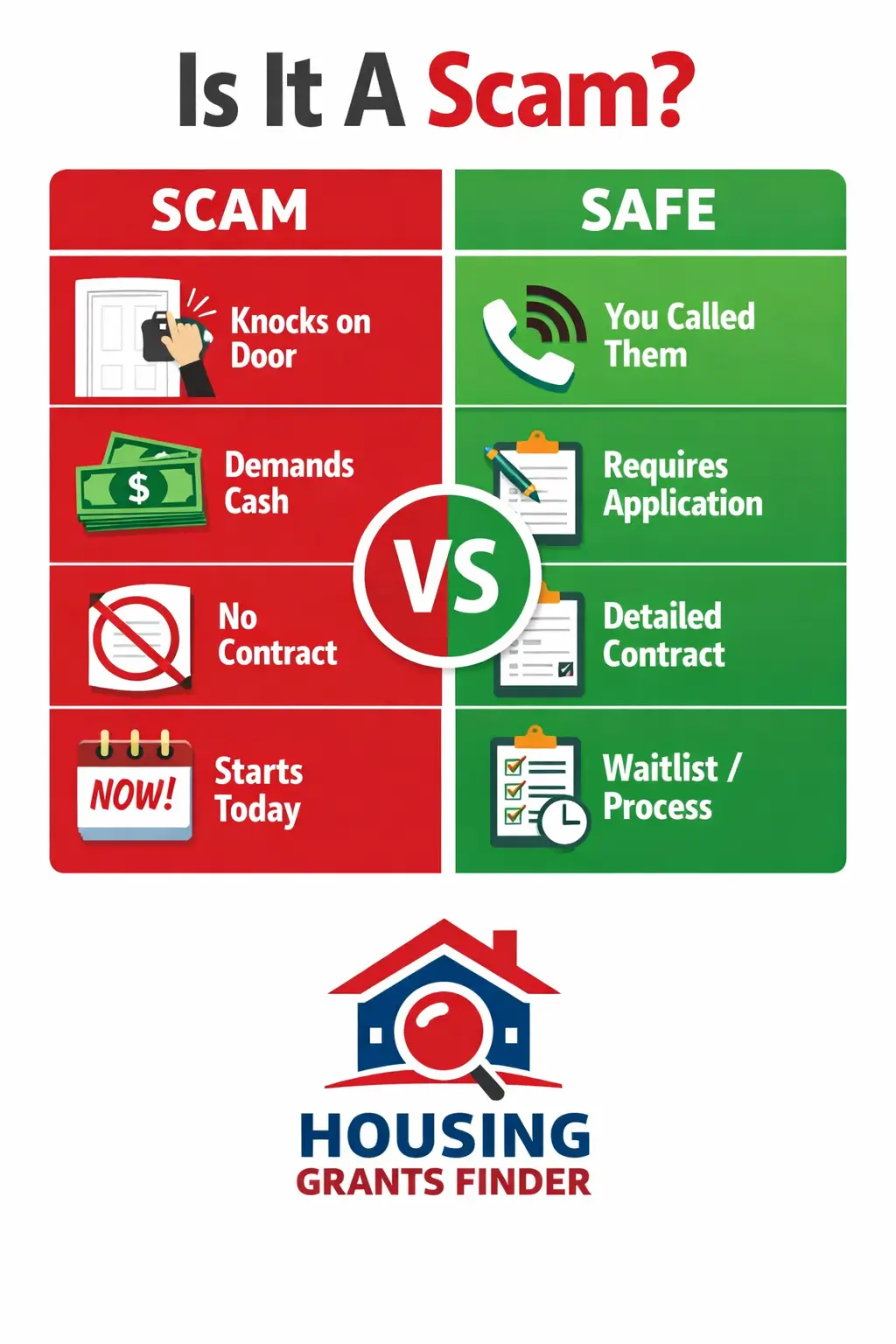
Real government inspectors never show up unannounced. If someone demands cash or an immediate signature, close the door.
It’s exhausting always to have your guard up. But before you sign anything, let’s talk about what is actually happening out there in 2026.
Common Home Repair Scams in 2026
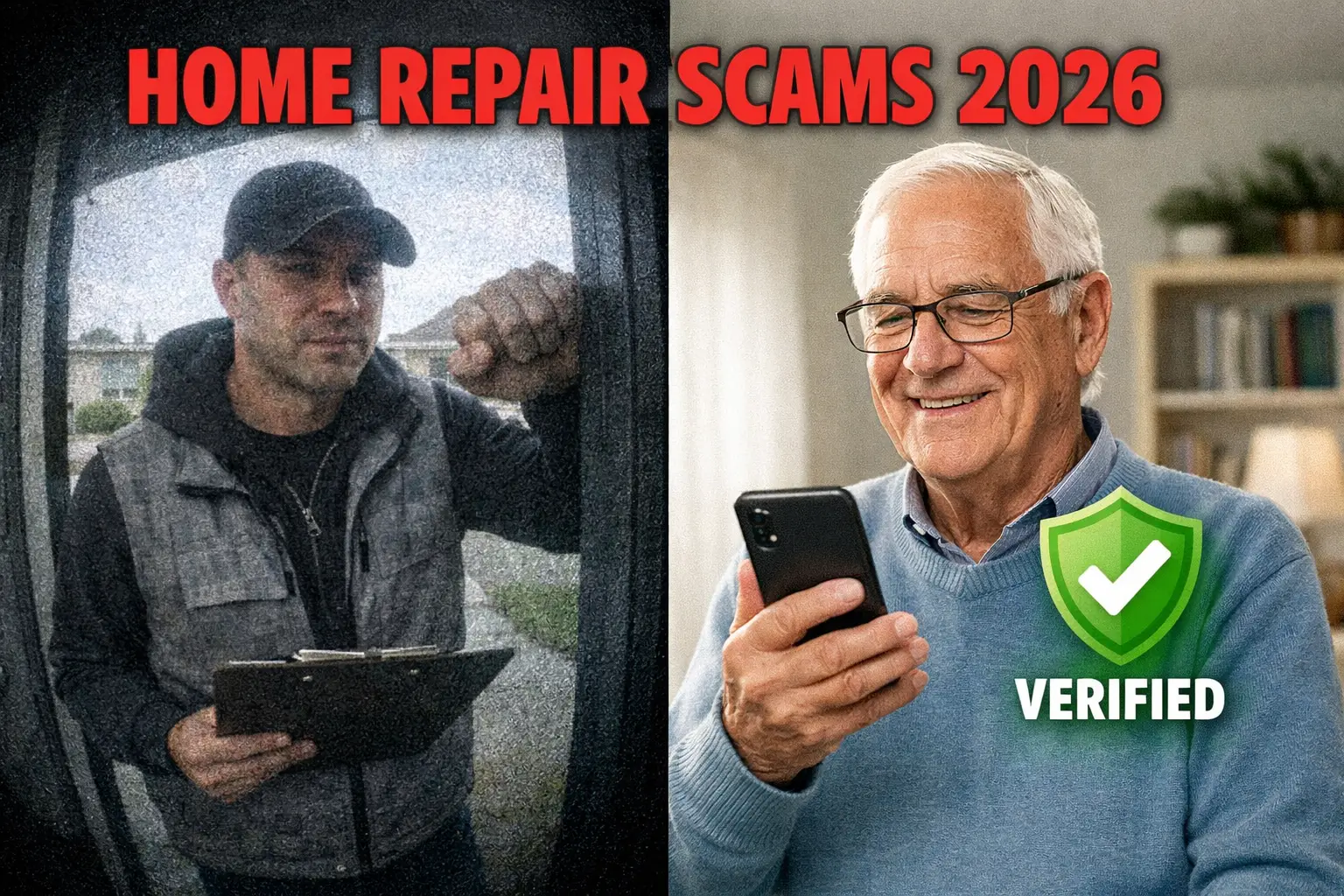
Scammers have updated their playbooks. Beyond the old leftover materials trick, watch out for these newer 2026 tactics:
The Official Fake Inspector
Someone is knocking, claiming to be a Federal Energy Auditor or City Building Inspector. They find a violation that only their recommended contractor can fix. Real inspectors do not show up unannounced to sell you repairs.
AI Voice Cloning
If a contractor or a family member calls from an unknown number requesting emergency funds for a repair, hang up. Scammers now use 3-second clips of a person’s voice to mimic them perfectly. Call your family member back on their known number to verify.
The Free Grant Social Media Trap
Ads promising $0-down windows are usually lead-gen traps. They aren’t grants; they are high-pressure sales companies trying to sign you up for high-interest predatory loans. (Check verified window replacement grants here).
The Rule: Most official government resources end in .gov, but some local or non-profit partner portals may use .org or state-specific domains. If the site is a .com and asks for your Social Security number to verify grant eligibility, proceed with extreme caution.
The Paper Trail: What Your Contract MUST Have
A safe home improvement contract in 2026 should be detailed. If it’s missing any of these, don’t sign:
- Specific Materials: It shouldn’t just say roof shingles. It should list the brand, the weight, and the color. (Especially for roof replacement grants).
- A Solid Timeline: It must include a Start Date and a Completion Date.
- Permit Clarity: The contract should clearly state that the contractor is responsible for obtaining all necessary local permits. If a contractor asks you to pull the permits, it’s a massive red flag; it often means they aren’t licensed or are trying to avoid an inspection.
- The Cooling-Off Rule: Under the FTC’s Cooling-Off Rule, you generally have three business days to cancel certain sales made at your home or a temporary location for more than $25. Note: This rule doesn’t cover every transaction, like emergency repairs you requested, so always check the contract for a written Notice of Cancellation.
Financial Safety: Keep the Power in Your Wallet
The biggest mistake is paying too much too soon. Once the money is gone, you lose all your leverage.
Never pay more than 10% or $1,000 upfront, whichever is less. Tie the rest of the payments to milestones.
Never make the final payment until the job is 100% finished and you have physically inspected it.
Pay by check or credit card. Credit cards offer protection if the contractor disappears.
Verified Home Repair Assistance
Don’t call the numbers on the flyers. For verified help, dial 2-1-1 to reach the universal help line for local social services. They can connect you with these official 2026 programs:
- USDA Section 504 Home Repair: Grants of up to $10,000 for low-income seniors (62+) in rural areas to fix health and safety hazards. In Presidentially declared disaster areas, the grant cap can hit $15,000. (Full details in our USDA 504 Guide). USDA Official Page
- Weatherization Assistance (WAP): Administered by the Department of Energy, this covers whole-home energy efficiency, insulation, and furnace repairs for eligible households. (See our HVAC & WAP Guide). DOE Official Page
- VA Housing Grants: For Veterans with service-connected disabilities, the SAH Grant for FY 2026 is capped at $126,526, and the HISA Grant provides up to $6,800 for medically necessary modifications like walk-in tubs. VA Official Page
- Habitat for Humanity: Its Aging in Place program provides professional, honest repairs on a sliding-scale basis. Habitat Official Page
What If I Already Got Scammed?
If you realized too late that you were targeted, do not be ashamed. These people are professional manipulators. Take these steps immediately:
- Document Everything: Take photos of the work or lack thereof, keep all text messages, and save all receipts.
- Send a Certified Cancellation: If you are within the 3-day window, send a cancellation letter by certified mail with a return receipt requested. This is your legal proof.
- Report the Fraud: Contact the Federal Trade Commission at ReportFraud.ftc.gov and your State Attorney General’s consumer protection office.
- Local Help: Contact your local Area Agency on Aging or 2-1-1. They often have resources to help seniors who have been victims of financial exploitation.
FAQs
Do I have to repay this grant money?
Usually, no. For programs like the USDA 504, the funds are a gift, provided you live in the home for at least three years after the work is completed. If you sell the house or move out before the three-year mark, the government may require you to repay it from the sale proceeds.
Can a contractor apply for a government grant on my behalf?
No. While a contractor can help you gather the quotes you need for an application, you must be the one to initiate the process with the agency. If a contractor claims they can handle the grant for you, it is a scam.
Why do I have to provide my income tax returns?
Legitimate government grants are reserved for those who need them most. Agencies use your tax returns to verify that you meet the very-low-income requirements for your county. If a grant doesn’t care about your income, it isn’t a government program.
How long does the real grant process take?
Real grants don’t happen tomorrow. Because they involve background checks, home inspections, and multiple bids, the process usually takes 3 to 6 months. If someone says they can get you instant grant money, they are likely selling a loan.
What if my income is too high for a grant?
Don’t lose hope. Many programs, like the USDA 504, also offer 1% interest loans. For a $10,000 repair. This is often safer and less expensive than using a high-interest credit card.
Conclusion
Taking that first step to ask for help can feel a little intimidating, but remember, these programs were created because you earned them. You have spent decades contributing to your community and caring for your family. Now, it’s the community’s turn to help take care of you.
Don’t let the noise of the scammers make you feel like you’re alone in this. Pick up the phone, dial 2-1-1, and just ask, “Is there a local program that helps with senior home repair grants?” You’ll be surprised at how many people are waiting on the other end of the line just to help you stay right where you belong: in your own home, safe and sound.