Virginia Home Repair Grants 2026: EHARP & USDA Funding Guide
Over 25% of the state’s homes are now more than 50 years old, and Virginia is facing a quiet crisis. Foundations are settling, roofs are thinning, and septic systems in the rural counties are reaching their breaking point. To address this, the Virginia General Assembly has invested over $77 million in the Housing Trust Fund to support emergency heating repair assistance and structural preservation.
But here is the money: it isn’t a guaranteed gift; it is a competition. If you wait until your ceiling is on the floor, you might be too late. This guide is designed to help you navigate the system and get your home repaired before the funds run out.
The Statewide Foundations: Your First Line of Defense
Before you look at local city funds, you must understand the three programs that cover almost every corner of the Commonwealth.
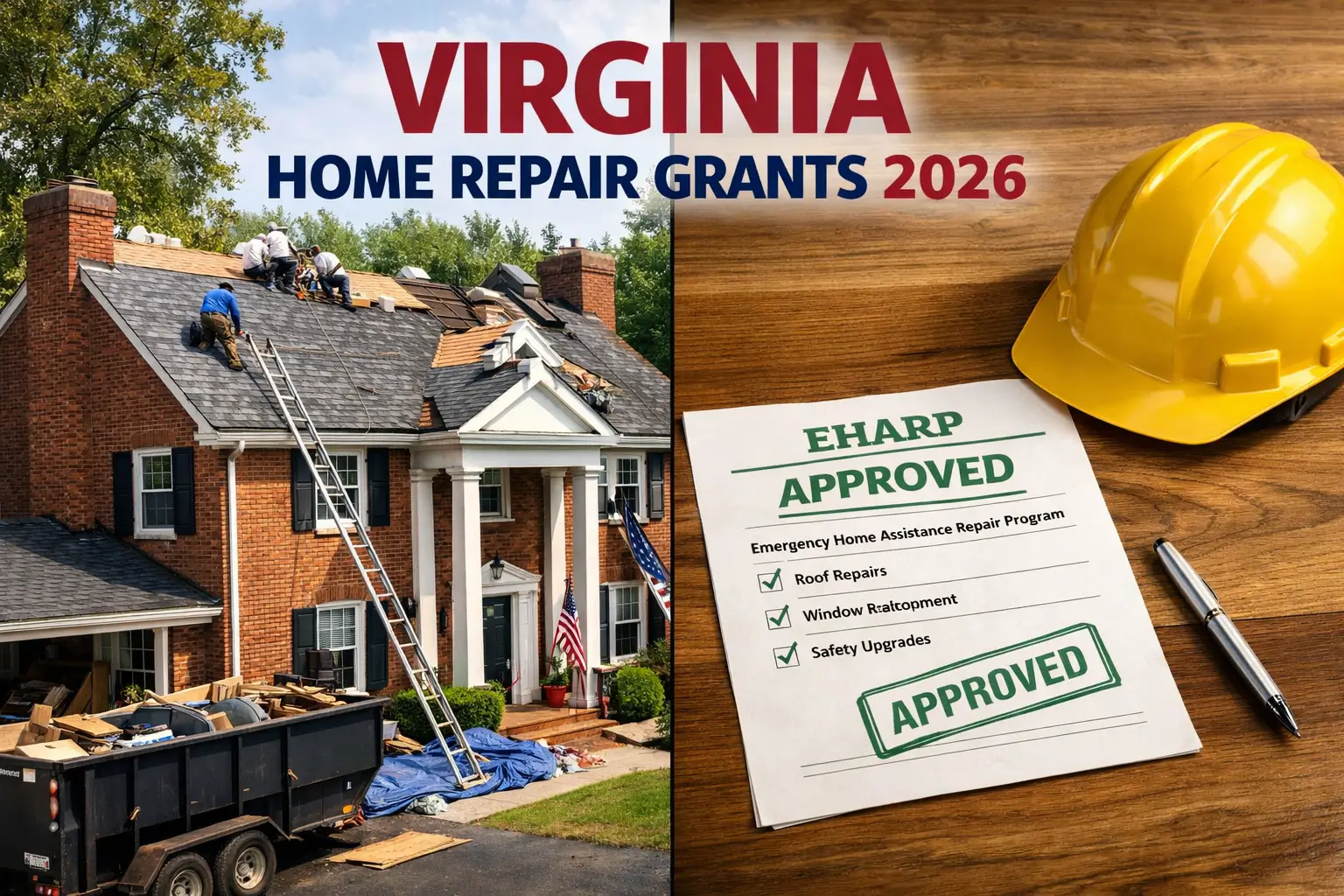
EHARP (Essential Home and Accessibility Repair Program)
This is the Emergency program. If your furnace dies in January or your front porch becomes a trip hazard, EHARP is your first call.
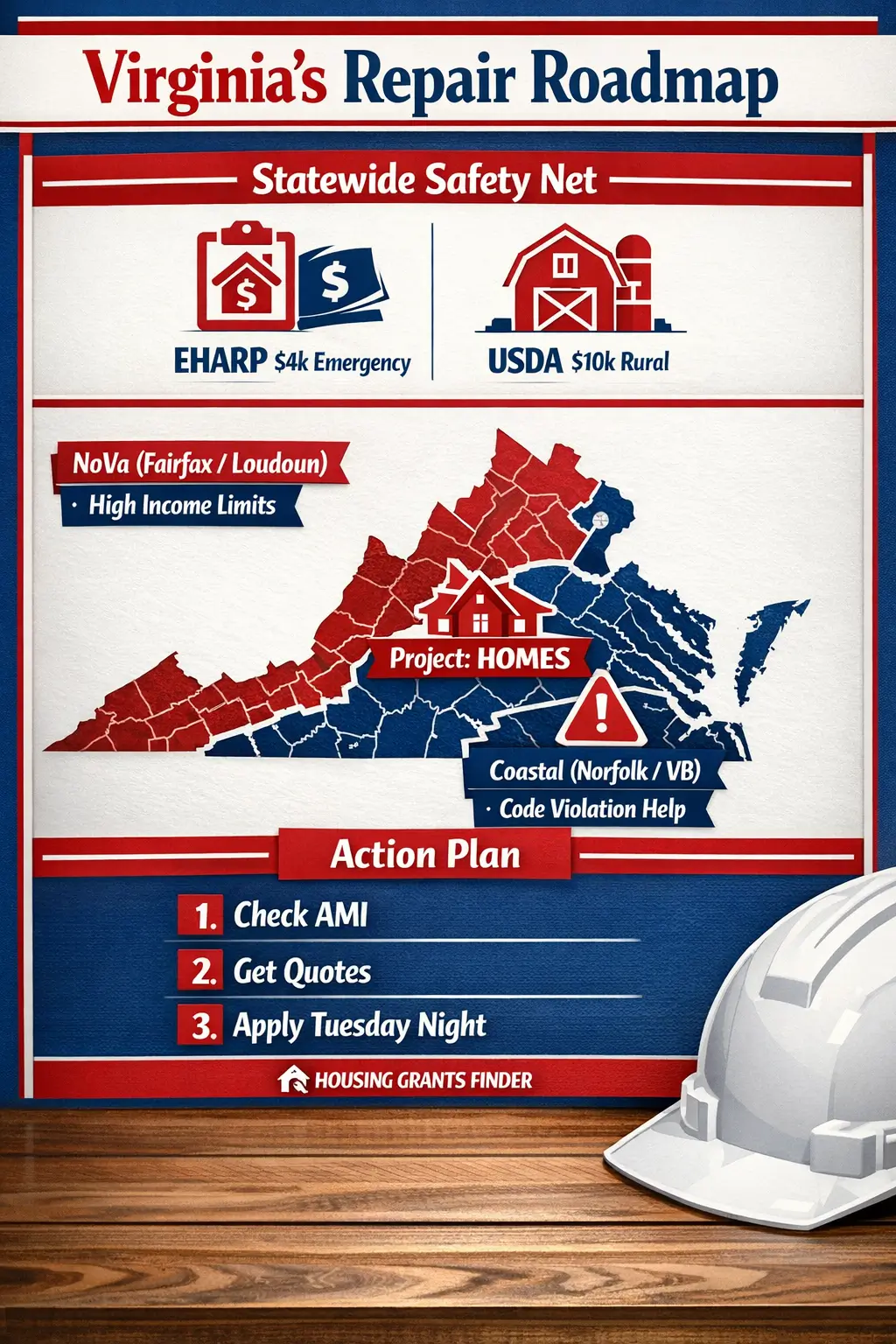
- The Benefit: A grant of up to $4,000.
- The Catch: It is strictly for health and safety. They won’t paint your house or fix a fence. They only fix what might hurt you or make your home unlivable.
- The Application: You apply through local nonprofits like Project: HOMES or Community Housing Partners.
Don’t call the state office in Richmond. They will just tell you to contact the local agency. Find your local DHCD provider on the state website first.
USDA Section 504 (The Rural Safety Net)
If you live in a rural county, the federal government is your best friend.
- For Seniors (62+): You can get a $10,000 grant. If you sell your house in less than three years, you have to pay it back.
- For Everyone Else: You can get a 1% interest loan for up to $40,000.
- Real-World Friction: The USDA is slow. Expect the process to take 4 to 6 months. If your roof is actively pouring water, the USDA isn’t fast enough. Use EHARP for the patch and USDA for the USDA home repair program replacement.
Indoor Plumbing Rehabilitation (IPR)
Septic failure is a nightmare. It can cost $20,000 to $30,000 to fix. In Virginia, the IPR program exists specifically for this. It provides 0% interest loans that are often forgiven over time.
- The Rule: Your income must be below 80% of the Area Median Income (AMI).
- Official Link: Virginia DHCD IPR
Northern Virginia (NoVa): High Stakes and Tight Rules
NoVa has the highest income limits, but also the most red tape.
Fairfax County: Home Repair for the Elderly (HREP)
Fairfax does things differently. They don’t just write a check. They send a Mobile Home Repair crew to your house for one week. They fix leaky faucets, install grab bars, and repair windows.
- The Limit: They provide up to $1,000 in materials at no cost.
- The Catch: You must be 62 or older (or have a disability). You also have to stay in the home for at least one year after the crew leaves. (See home repair grants for seniors).
Loudoun County: HARP
Loudoun has a lot of money, but they hate liquid assets.
- The Rule: If you have more than $10,000 in a savings account, they will likely deny you. They want you to use your own money first.
- The Benefit: Grants of up to $10,000 are standard, but they can reach $25,000 for exceptional structural needs.
Prince William County: Neighborhood Rehab
Prince William prioritizes families at 50% AMI. If you make more, you might be moved to the bottom of the list.
- Application Tip: Their online portal is notorious for crashing on Mondays when everyone tries to log in. Try filling out your application on a Tuesday night or Wednesday morning.
Central Virginia: Richmond, Henrico, and Chesterfield
This region is dominated by project: HOMES, one of the most efficient nonprofits in the state.
City of Richmond: Metro Rehab
Richmond uses a Deferred Loan model. They fix your home (roof, plumbing, electrical). They place a lien on the house. If you live there for 10 or 15 years, the debt disappears completely.
- The Friction: If you have a reverse mortgage, you are usually disqualified. Reverse mortgages prevent the city from placing its required lien.
Henrico County: Critical Repair
Henrico offers up to $45,000 for moderate rehabilitation.
Note: You must have owned and lived in the home for at least five years. New homeowners are almost always told to wait.
Coastal & Hampton Roads: The Battle Against Code
Hampton Roads homeowners deal with saltwater air and high humidity. These elements destroy roofs and window frames faster than anywhere else. Local programs here are aggressive but come with heavy strings attached.
Virginia Beach: OORP (Owner-Occupied Rehabilitation Program)
If the city tags you for code violations, don’t panic. The OORP is designed to keep you from losing your home to fines. They offer grants up to $25,000. This isn’t a check in your hand; they pay the contractors directly.
This is a Secured Grant. The city records a Deed of Trust on your title. You must stay in that house for 5 years. If you sell or move on in year four, you owe the city a prorated amount back.
- Repairs Covered: They focus on the envelope, roof replacement, windows, siding, and exterior doors. They want the house sealed from the elements.
- Link: Virginia Beach OORP Official Site
Norfolk: Renovate Norfolk
Norfolk doesn’t do first-come, first-served. They use a lottery system.
- Why? Demand is so high that the waitlist used to be years long. Now, everyone has a fair shot every quarter.
- The Strategy: Apply once to get in the “hat.” Drawings happen in June, September, December, and March. If you aren’t picked, your application stays active for the next round.
- The Limits: They target homeowners at or below 80% AMI. If you are a senior or have a disability, you get extra entries in the lottery.
- Link: Renovate Norfolk Program Details
Newport News & Hampton: HRCAP
The Hampton Roads Community Action Program (HRCAP) covers the Peninsula. They specialize in Emergency Repairs. If your water heater explodes or your furnace dies in a cold snap, call them immediately.
- The Catch: You must prove you have no other way to pay. They will review your bank statements for any hidden cash.
- Link: HRCAP Housing Services
Southwest & Blue Ridge: TAP and Local Support
In the mountains, repairs are about survival. Rotted floors and dangerous wiring are typical in older homesteads.
TAP (Total Action for Progress)
TAP is the primary lifeline for the Roanoke Valley. They cover Alleghany, Bath, Botetourt, Craig, Roanoke, and Rockbridge. They only fix Hazardous conditions. We are talking about rotted floor joists, failing roofs, and knob and tube wiring that is a fire hazard.
- The Reality Check: TAP is chronically understaffed. Their intake process is slow.
- The Tip: If you haven’t heard back in 10 business days, go to their office in person. Bring your documents. It’s harder for them to ignore a person standing in the lobby.
- Link: TAP Limited Home Repair
SERCAP (Southeast Rural Community Assistance Project)
SERCAP is based in Roanoke but serves all of rural Virginia. They are the experts in Water and Wastewater. If your well has gone dry or your septic is backing up, SERCAP offers low-interest loans and some small grants.
- Note: They often require a Perc Test or a health department report before they approve a septic fix. Have your local health department inspector come out first.
- Link: SERCAP Individual Water & Wastewater Help
Specialized Help: Veterans and Energy
Granting Freedom (Veterans)
This program provides $8,000 in accessibility funding. It is much faster than the VA’s internal HISA grants. It is for Veterans or service members who sustained a line-of-duty injury.
- The Secret: You can use this even if you are a renter. Your landlord just has to sign a form permitting you to modify the home.
- The Process: It’s handled by Virginia Housing (formerly VHDA).
- Link: Granting Freedom Guidelines
Weatherization (WAP)
WAP is not for a new kitchen. It is for air sealing, insulation, and HVAC. If your AC is dead and you qualify for WAP, they can often replace the entire unit. This falls under the Emergency Heating/Cooling portion.
- The Wait: WAP has the longest waitlist in the state. Expect to wait 6 to 12 months.
- The Tip: If you have an infant or a senior in the house, tell them immediately. It can move you up the priority list.
- Link: Virginia DHCD Weatherization
Step-by-Step: Your Action Plan for 2026
- Find Your AMI: Look up the 80% Area Median Income for your county on the HUD website. If you are over this, you won’t qualify for 90% of these programs.
- Call Your Local Planning District Commission (PDC): These are regional offices that know exactly which nonprofit is holding the cash this month.
- Get Two Contractor Quotes: Most programs won’t even look at your application until you have a professional estimate of the costs. (Watch out for home repair scams).
- The Late Night Strategy: If applying through a city portal, do it at 11:00 PM on a Tuesday. The servers are less likely to crash than at 9:00 AM on a Monday.
FAQs
Can I get a grant for a new kitchen?
No. These programs focus on Decent, Safe, and Sanitary conditions. They fix what is broken, not what is ugly.
What if I have a reverse mortgage?
You will likely be denied for city-led rehab programs because they require the Primary Lien holder. However, you can still apply for USDA grants or for the Weatherization Assistance Program (WAP).
Is it really a grant or a loan?
It depends. EHARP is a straight grant. City programs are usually Deferred Loans that go away if you stay in the house for 5–10 years.
Can I layer multiple grants for the same house?
Yes. You can use EHARP for plumbing and USDA for roofing. Just ensure each grant covers a different repair to avoid double-dipping rejections.
What happens if I sell early?
Most grants turn into loans. If you sell within three to five years, you must repay the funds from your home sale proceeds.
Conclusion
The 2026 funding window is open, but it is narrowing. Virginia’s Housing Trust Fund is generous, but the administrative friction is real. If you have a soft spot in your floor or a draft in your windows, start the process now.
Waiting until the winter freeze or the summer humidity peaks will put you at the bottom of a very long waitlist. Apply for free home grants today.